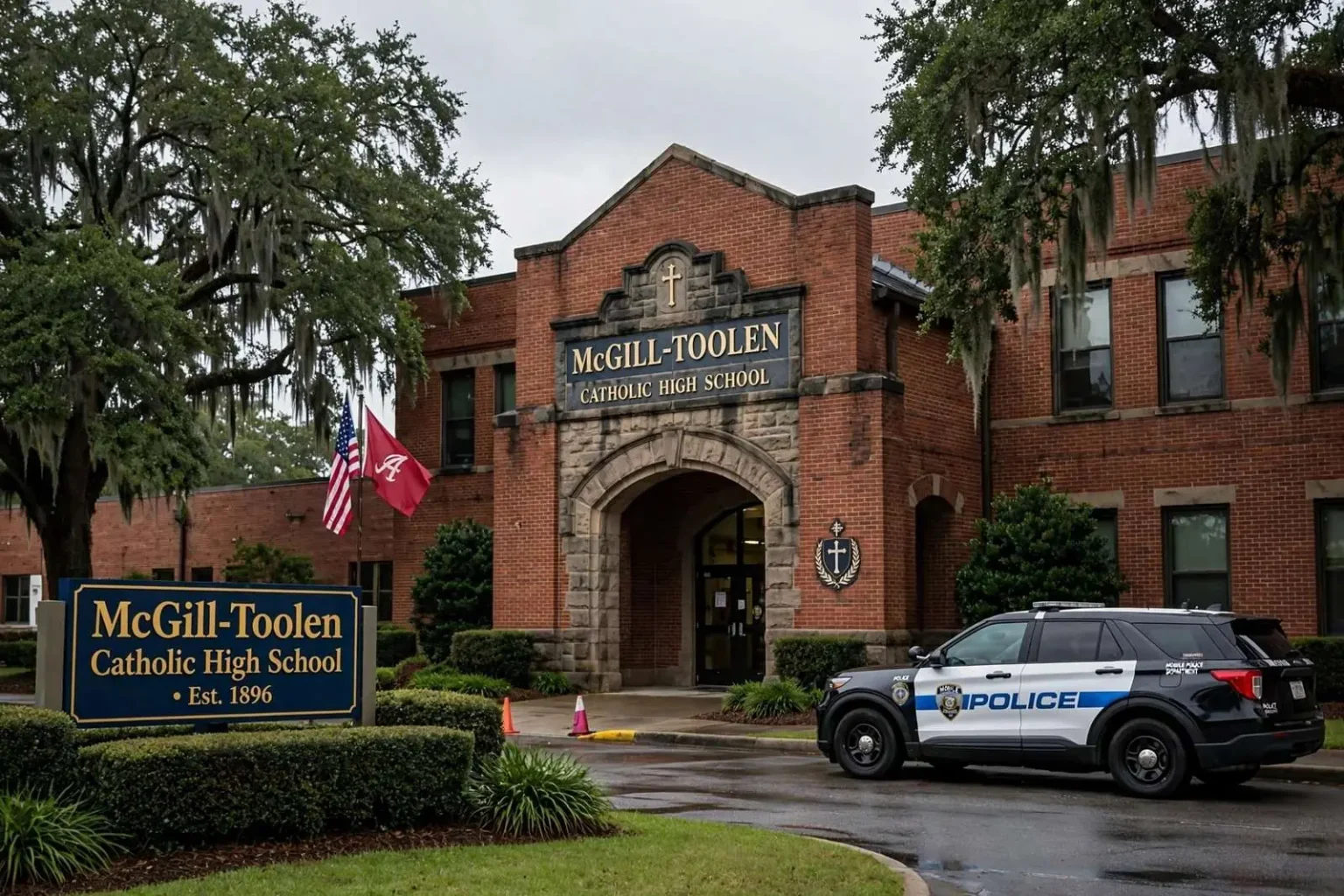
A threat posted to social media targeting McGill-Toolen Catholic High School led to a teenager’s arrest last week and prompted new scrutiny of how the Mobile private school communicates safety concerns to parents. The episode, resolved without any reported violence, has nonetheless become a case study in the split-second judgments school administrators face when a threat surfaces online: act quietly or sound the alarm.
Mobile police say a parent alerted officers after learning of a social media post threatening physical harm to students at the school. The tip set in motion a rapid investigation that stretched from the school’s campus in Mobile to the digital trail behind the post itself, and ended with a juvenile in custody within days of the report.
The teenager identified in the post, who was not enrolled at McGill-Toolen, was arrested and charged with making a terrorist threat, then taken to the Strickland Youth Center, the secure juvenile detention facility that serves Mobile County. Because the suspect is a minor, few details about the case have been made public, and proceedings in juvenile court are closed to the public and press by design. Under Alabama law, making a terrorist threat is a felony offense, and prosecutors treat threats against schools with particular seriousness regardless of whether the person making them claims they were jokes.
School officials confirmed that no alert was sent to parents on the day the threat was reported and investigated. McGill-Toolen’s Director of Advancement, Kim Dunne, said the situation was resolved quickly by school administrators and police, and that officials determined at the time a parent notification wasn’t necessary.
The notification question
The decision to stay silent during the investigation is the part of the episode that has drawn the most attention from families. Administrators weighed whether an alert would help parents protect their children or simply spread alarm during hours when police were already moving on the suspect, and concluded the situation was contained. Only after media coverage of the incident appeared over the weekend did the school send parents an email the following Monday morning clarifying what had happened.
That sequence left some parents learning about the threat from news reports rather than from the school itself, and the gap between the arrest and the email became the focal point of a broader debate. Dunne said the school has several tools available for notifying families when administrators determine a threat is credible enough to warrant it, including email and text alerts and a system known as IRIS — Immediate Response Information System — which lets parents choose how they’re contacted, whether by phone call, voicemail or text message.
Multi-channel systems like IRIS have become standard equipment for schools across the country in the years since campus safety became a permanent national concern. The design philosophy is simple: in an emergency, no single communication method reaches every family quickly, so parents register their preferences and the school can push a message through every channel at once. Schools use the same infrastructure for weather closures and early dismissals, which keeps the system tested even when no threat is involved.
Mobile Police Department spokesman Terence Perkins said officers stepped up patrols around the campus following the arrest as a precaution, though he said investigators do not expect further incidents connected to the threat. Visible patrols in the days after a threat serve two purposes: they reassure families dropping off students, and they put any potential copycat on notice that police are watching.
Perkins said his department treats any report of a threat against a school as serious, regardless of how it’s communicated, and urged anyone with knowledge of a potential threat to contact police promptly using the department’s non-emergency line so officers can begin an investigation. The tip in this case came from a parent, and police credit that kind of prompt reporting with giving investigators time to work before any harm could occur.
The arrest and what happens next
The teenager’s arrest followed the familiar path for juvenile cases in Mobile County. After being taken into custody, the minor was transported to the Strickland Youth Center rather than an adult facility, reflecting state law that separates juvenile detainees from the adult jail population. A detention hearing typically follows within days, where a judge decides whether the minor remains in custody or is released to a guardian while the case moves forward.
The charge itself, making a terrorist threat, has become one of the most commonly filed offenses in cases involving social media threats against schools. Investigators and prosecutors are careful to distinguish between credible threats and careless posts, but the statute gives law enforcement a tool to intervene early, and police departments nationwide have adopted a posture of arresting first and letting the courts sort out intent.
For McGill-Toolen, one of the largest private schools in the Mobile area with a long history in the city’s Catholic education tradition, the episode tested crisis procedures that most days exist only in binders. Administrators coordinated with police, monitored the campus and made the call not to alarm parents during an active investigation — a judgment call that some families have since questioned and that the school has acknowledged deserves review.
The incident has raised broader questions among some McGill-Toolen parents about when schools should proactively communicate about safety matters, and where the line should fall between transparency and avoiding unnecessary panic. Parents on both sides of the question acknowledge the difficulty: a premature alert about an unverified threat can cause chaos, trigger traffic jams at pickup lines and, in some cases, make an evacuation or lockdown harder to manage — but a delayed alert can leave families feeling shut out of decisions about their own children’s safety.
Safety experts who study school crisis communication generally argue for a middle path: notify parents early that the school is aware of a potential concern and is working with law enforcement, even when details are limited, so the first message families receive doesn’t come from rumor or a news broadcast. Whether McGill-Toolen adjusts its practice in that direction remains to be seen, but the school’s follow-up email signals an awareness that silence, even well-intentioned, carries a cost in parent trust.
A familiar dilemma for schools everywhere
The McGill-Toolen case is hardly unique. School districts and private schools across Alabama and the nation have wrestled with the same calculation as social media has accelerated both the spread of threats and the speed with which parents learn of them. A decade ago, a whispered rumor in a hallway might take days to reach parents; today, a screenshot can circulate through hundreds of family phones before administrators have even confirmed it is real.
That new reality has pushed schools toward written crisis plans that specify in advance who decides whether to notify parents, on what timeline and through which channels, precisely so the decision doesn’t have to be improvised under pressure. Law enforcement agencies, for their part, have built stronger working relationships with school security staff so that a threat report moves immediately to the officers who can act on it.
For Mobile police, the department’s message to the public emphasized partnership: parents and students who see something troubling online should report it quickly, and the department will treat it seriously. The McGill-Toolen episode ended without injury, with a juvenile in custody and with extra patrols around campus as classes continued — but also with a school community talking openly about how the next such threat should be communicated, and whether the policies on the books match the expectations of the families they serve.
McGill-Toolen occupies a distinctive place in Mobile’s educational landscape. Rooted in a Catholic school tradition that dates back more than a century and a half in the city, the school draws students from across Mobile County and competes in athletics at the highest classifications in the state. Its families tend to be deeply engaged, which is one reason the notification question resonated so quickly after the news coverage appeared.
Private schools face particular communication challenges because they lack the district-level communication departments that large public systems maintain. At a standalone school, the decision to alert families often rests with a small leadership team working in real time, and those administrators must balance the school’s relationship with families against the advice of police who may prefer that details stay quiet during an active investigation.
In this case, the police investigation appears to have moved exactly as designed: a parent’s report, a fast identification of the juvenile behind the post, an arrest and a charge, all before any harm occurred. Officials involved have pointed to that outcome as evidence the system worked, even as they acknowledge the communication piece could be revisited. Dunne’s account of the school’s reasoning — that administrators and police resolved the situation quickly and judged an immediate alert unnecessary — was the school’s first public explanation of why families heard nothing until the following week.
What happens to the juvenile defendant will unfold largely outside public view, as juvenile law intends. If the case proceeds to adjudication, the proceedings will be closed, and any disposition will be shaped by the youth’s age, record and the recommendations of probation staff. The victim in such cases, in a real sense, is the school community itself, and the outcome most families say they want is simple: no repeat, and a clear word next time about what is happening and when.