A Mobile man was sentenced to four years in federal prison this week after admitting his role in a large-scale operation distributing spice, a synthetic drug that had drawn increasing law enforcement attention across the Gulf Coast in recent years.
Harshadbhai Patel, 39, received a 48-month federal prison sentence during a hearing at the federal courthouse in Mobile. Senior U.S. District Court Judge Charles Butler Jr. also ordered Patel to serve three years of supervised release once he completes his prison term.
The sentence capped a case that began with an ordinary traffic stop and grew into one of the more significant spice prosecutions the Mobile federal court has seen, spanning two states and a seizure of thousands of packets of the synthetic drug along with hundreds of thousands of dollars in assets.
Spice — sold under a rotating list of brand names in packets often labeled as potpourri or incense — had become a persistent problem for Gulf Coast law enforcement in the years leading up to the case. The drug’s packaging promised a legal high, but its chemical contents produced effects far more dangerous than marijuana, sending users to emergency rooms and prompting repeated changes to state and federal drug laws.
From a Traffic Stop to a Two-State Case
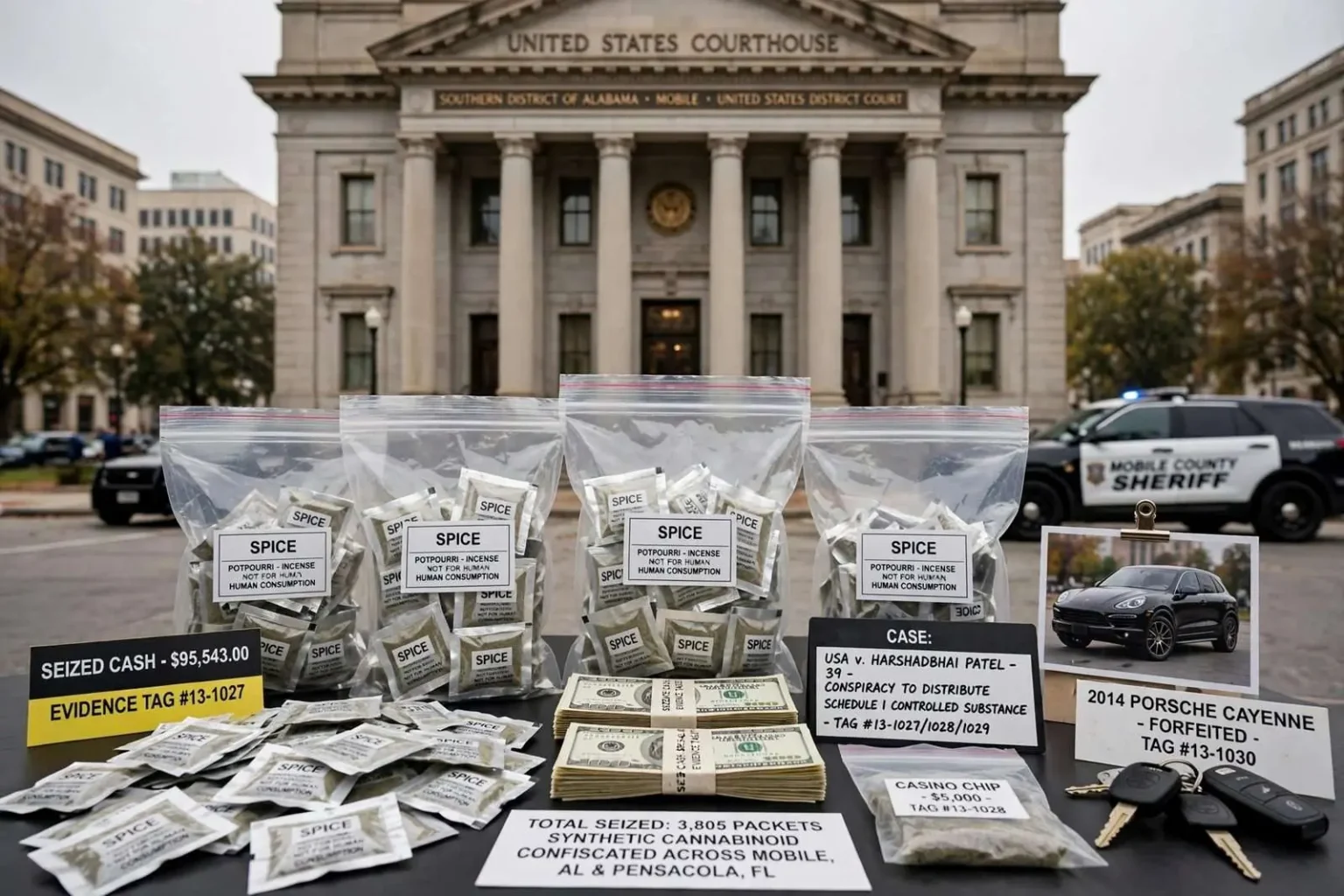
The case traces back to October 2013, when the Mobile County Sheriff’s Office arrested Patel during a traffic stop. Deputies searching his 2014 Porsche Cayenne during that stop found 50 bags of spice along with $95,543 in cash, according to court records.
A traffic stop is one of the most common starting points for drug trafficking cases, and this one quickly revealed that deputies had encountered something larger than personal possession. Fifty bags of the synthetic drug, alongside cash measured in five figures, pointed toward distribution rather than use.
Investigators did not stop at the vehicle search. Officers went on to search Patel’s Mobile apartment, a convenience store connected to him, and a second apartment he kept in Pensacola, Florida. Those searches turned up thousands of additional packets of the synthetic drug, with court records showing a total of 3,805 packets of spice confiscated across all the locations.
The geographic reach of the searches illustrated how distribution operations cross state lines while remaining rooted in everyday businesses. A convenience store in Mobile and an apartment in Pensacola are separated by an hour’s drive along Interstate 10, one of the primary freight and travel corridors of the Gulf Coast — and, historically, a route that drug traffickers have used to move product between markets.
Following the seizure, federal and local investigators worked jointly on the case, tracing the operation from a single traffic stop to properties in two states. That cooperation between the sheriff’s office and federal prosecutors is standard practice in cases involving large quantities of controlled substances, since federal charges carry sentencing structures built for trafficking-scale operations.
The Guilty Plea
Patel pleaded guilty in May to a federal charge of conspiracy to possess with intent to distribute a Schedule I controlled substance, the classification federal law applies to spice and similar synthetic cannabinoids.
The conspiracy charge is a workhorse of federal drug prosecution. Rather than charging each packet or each sale separately, prosecutors use conspiracy law to capture the full scope of an operation — the agreement to possess and distribute, supported by the evidence of what investigators seized.
Schedule I designation places a substance in the most restrictive category of the federal Controlled Substances Act, reserved for drugs deemed to have a high potential for abuse and no accepted medical use. That classification matters at sentencing, because it exposes defendants to the statute’s most serious penalty ranges.
As part of his sentencing, Patel was ordered to forfeit more than $338,000 to the federal government. That figure includes the $95,543 seized from his SUV during the initial traffic stop, a $5,000 casino chip found in his possession, and $237,699.53 that had been sitting in one of his bank accounts.
Patel was also ordered to forfeit the Porsche Cayenne itself.
Asset forfeiture of this kind follows the money through a trafficking operation. Federal prosecutors treat the vehicle used in the conduct, the cash carried during arrests and the bank balances accumulated from sales as proceeds of the crime, subject to seizure and forfeiture upon conviction. The result strips the financial incentive from the operation rather than simply punishing it with prison time.
The forfeiture total in the Patel case — more than $338,000 in cash and assets, plus a luxury SUV — speaks to the profitability that synthetic drug distribution could reach before enforcement caught up. Synthetic cannabinoids were cheap to produce and package, and their retail markup in head shops, convenience stores and informal networks was substantial.
The Spice Problem on the Gulf Coast
Spice, sold under various brand names, mimics the effects of marijuana but has been linked to serious health complications, prompting federal and state governments to place many of its chemical variants under stricter drug schedules over the past decade.
The drug earned its place on law enforcement priority lists through the damage visible in emergency rooms. Users of synthetic cannabinoids have suffered seizures, kidney injury, psychosis and, in severe outbreaks, deaths — consequences far beyond those associated with the plant the products imitate. Because manufacturers constantly altered the chemical formulas to evade existing laws, regulators found themselves amending schedules repeatedly, playing a persistent game of catch-up.
Alabama was among the states that moved against the products early, banning many of the compounds found in spice after hospitals across the state reported spikes in admissions tied to the drug. The state’s experience mirrored that of the Gulf Coast more broadly, where the substances circulated through convenience stores, smoke shops and street-level networks under labels that disguised their contents.
For enforcement agencies, the trade presented unusual challenges. Packets labeled as incense or potpourri carried no obvious drug indication, and laboratory testing was required to identify the specific compounds inside. Prosecutions therefore depended on forensic work that could keep pace with the chemicals’ constant evolution.
Convenience stores occupied a special place in the enforcement picture because they combined accessible retail space with heavy cash traffic. When investigators in the Patel case searched a store connected to the defendant, they were following a pattern seen across the region: retail businesses serving as distribution points for packets of synthetic drugs sold alongside ordinary merchandise.
The volume seized in the Mobile case — 3,805 packets in total — made it one of the more significant spice prosecutions to come out of the Mobile federal court system in recent years, both in terms of the volume of product seized and the scope of the financial forfeiture.
What the Sentence Signals
The 48-month prison term and three years of supervised release place Patel’s punishment within the range federal courts typically impose for conspiracy cases involving Schedule I substances at trafficking scale, adjusted for the quantities involved and the defendant’s role in the operation.
Supervised release extends federal oversight well beyond the prison term. A defendant who completes his sentence remains under conditions set by the court — reporting requirements, restrictions on association and travel, and the possibility of return to prison for violations — for three additional years after release.
For local investigators, the outcome demonstrated the value of following a routine stop to its conclusion. The case moved from a suspicious vehicle on a Mobile County road to searches in two states, a federal conviction and the recovery of more than $338,000 in proceeds — a chain built on cooperation between deputies, federal agents and prosecutors.
The case also documented, in court records, the economics of the Gulf Coast spice trade during the years when synthetic cannabinoids were at their most widespread. Cash stashed in a vehicle, a casino chip in a pocket and a six-figure bank balance together sketch the profit side of an operation that moved thousands of packets through storefronts and street sales.
Federal and local agencies on the Gulf Coast continued to treat synthetic drug distribution as a priority in the years the case covered, and prosecutions like Patel’s served as reference points for investigators building similar files. The combination of a substantial prison term and total asset forfeiture established what awaited those who moved the product at scale.
For the community, the case’s resolution closed a chapter that began with a single traffic stop near Mobile. The packets seized, the money forfeited and the sentence imposed all became part of the region’s broader effort to confront a drug whose dangers had outpaced its legal status for years — and whose distributors, as the Patel case showed, could no longer count on the trade staying profitable for long.