Wilmer Man Killed After Being Struck by Tractor-Trailer on U.S. 98
A 52-year-old Wilmer man was killed early Saturday morning after being struck by a tractor-trailer on U.S. 98 west of Mobile, troopers said.
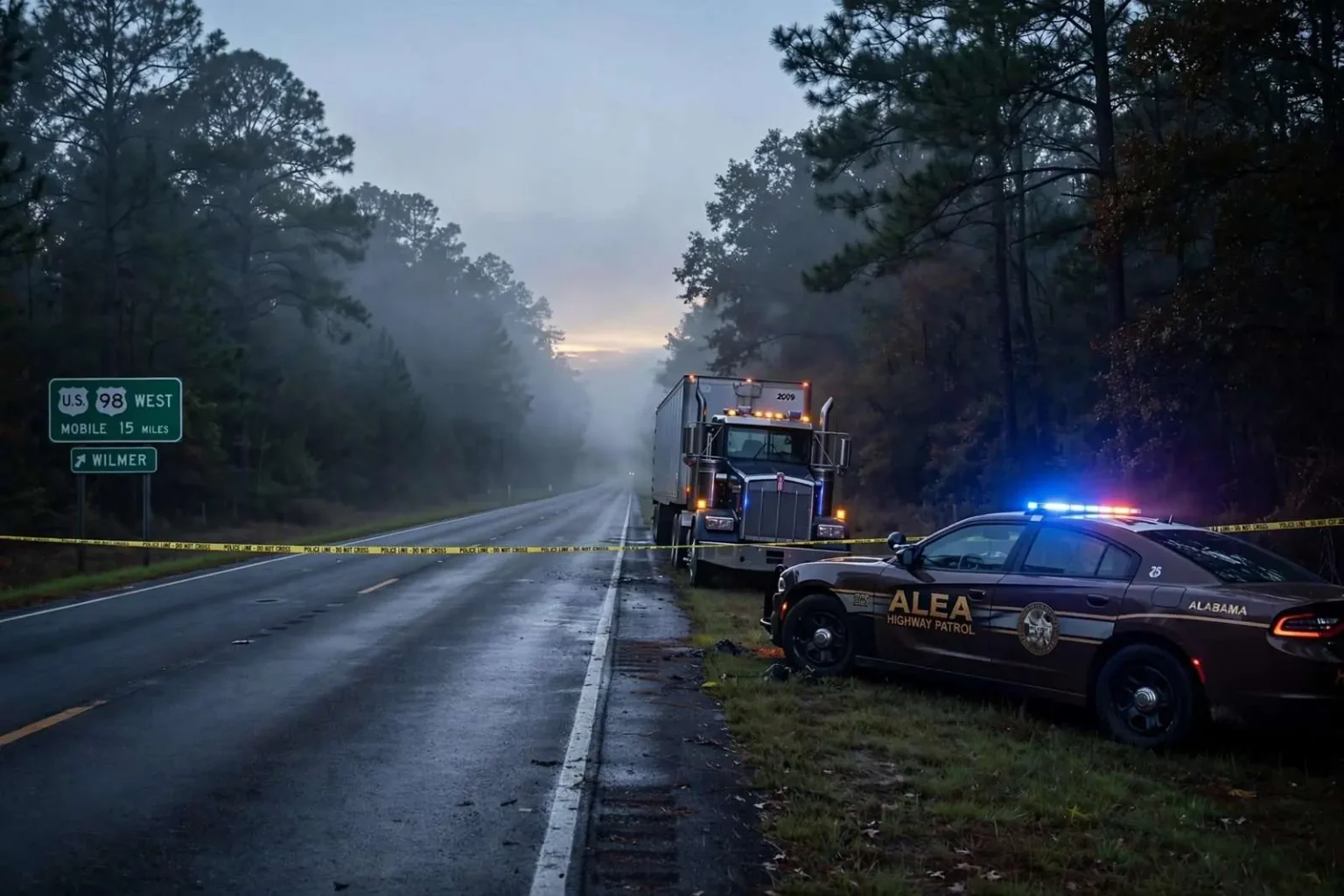
A Wilmer man was killed early Saturday morning after he was struck by a tractor-trailer on U.S. 98 west of Mobile, according to Alabama Law Enforcement Agency troopers. The crash marked the latest fatal pedestrian incident on the rural highway corridor, which has long drawn scrutiny from residents and officials concerned about safety along its unlit stretches. Troopers said the crash happened around 4:50 a.m. on U.S. 98 about 15 miles west of Mobile, in an area of the highway that carries a mix of commercial trucking and rural commuter traffic overnight. At that hour, before sunrise, the roadway is dominated by early freight runs and the occasional commuter, with darkness limiting what drivers can see ahead of them.
Wilbert Lee Moffett, 52, of Wilmer, was struck by a 2009 Kenworth tractor-trailer driven by 67-year-old Lindsey Craig Stockdale of Mobile, according to ALEA Trooper Curtis Summerville. Moffett was pronounced dead at the scene. Stockdale was not injured in the crash. Because the collision occurred on a federal highway outside any municipal police jurisdiction, the investigation fell to state troopers, who handle crashes across unincorporated Mobile County and the rural stretches of highway that connect the area’s small communities.
ALEA troopers said the investigation into the circumstances of the crash was ongoing, and no additional details about what led to the pedestrian being on the roadway at that hour were immediately available. Investigators in crashes of this kind typically work to reconstruct where the pedestrian was walking or standing, whether the roadway shoulder was involved, and what lighting conditions were present at the moment of impact. Troopers also examine the truck’s speed, position and visibility, along with any mechanical factors, before reaching conclusions about the cause.
Early-morning pedestrian crashes on rural highway stretches like U.S. 98 are frequently complicated by low visibility, given the lack of street lighting common on many two-lane roads in western Mobile County. Much of the highway passes through wooded and semi-rural terrain, where there are no sidewalks, few streetlights and shoulders that narrow and disappear in places. Pedestrians on foot before dawn are difficult for drivers to detect at highway speeds, and investigators note that the combination of darkness, speed and limited shoulder space leaves little margin for error on either side.
Wilmer and the U.S. 98 corridor
Wilmer, an unincorporated community in western Mobile County, sits along a stretch of U.S. 98 that connects Mobile to the Mississippi state line and sees a steady flow of freight traffic overnight, given its role as a corridor for trucking between the two states. The community is one of several small settlements along the highway in western Mobile County, an area where residents often live along or near the roadway itself, with driveways opening directly onto the main highway. That mix of residential access and high-speed through traffic has been a defining feature of the corridor for decades.
U.S. 98 serves as one of the primary east-west routes through the region, running from downtown Mobile through the county’s western communities before crossing into Mississippi. For commercial truckers, the route provides a direct connection between the Mobile area and communities across southern Mississippi, and it carries a steady stream of tractor-trailers at all hours alongside the passenger vehicles driven by residents and commuters. The highway’s importance to freight movement means heavy trucks are a constant presence, even in the predawn hours when local traffic is light.
Local residents have periodically raised concerns about pedestrian safety along the highway, particularly in areas without sidewalks or reliable lighting. Over the years, residents in communities along the corridor have described the difficulty of walking along the road to nearby stores, bus stops or neighbors’ homes, where the only option is often the edge of the travel lane itself. Safety advocates have pointed to the corridor’s combination of high speeds, darkness and foot traffic as a persistent hazard, particularly in the hours between midnight and sunrise.
How ALEA investigates fatal crashes
ALEA, which investigates traffic fatalities on state and federal highways across rural Alabama, said additional findings from the crash investigation would be released as they become available. The agency’s Highway Patrol Division handles crash response and reconstruction across most of Alabama’s rural roadways, deploying troopers trained in collision investigation to document the scene, interview witnesses and analyze physical evidence. In fatal cases, the investigation can take weeks or longer to complete, as troopers await laboratory results, vehicle inspections and the formal findings of the medical examiner.
The findings from such investigations matter for several reasons beyond the immediate crash. They determine whether any traffic violations or criminal charges are warranted, they inform the final crash record that contributes to the state’s highway safety data, and they can influence decisions by county and state officials about where to focus safety improvements. In pedestrian fatalities on rural highways, investigators pay particular attention to sight lines, lighting and the point of impact in the roadway, all of which shape the final report.
No further updates on the case had been made public as of the initial report, and the agency continued to ask anyone with information about the crash to come forward. Witnesses who were traveling the corridor around the time of the crash may hold details that help investigators piece together the timeline, including the movements of both the pedestrian and the truck in the moments before impact. ALEA’s practice in fatal crashes is to keep the case open until all investigative threads are resolved, and officials have urged anyone who saw anything relevant to contact the agency.
U.S. 98 remains one of the primary east-west routes through western Mobile County, connecting rural communities like Wilmer to both Mobile and the Mississippi state line, and it carries a steady mix of freight and passenger traffic throughout the overnight hours. The highway’s traffic profile is unlike that of the interstate system, blending long-haul trucking with local residents who live, work and travel along the route daily. That blend is part of what makes safety on the corridor an ongoing concern for the communities it serves.
Troopers said fatal pedestrian crashes on the corridor, while not routine, tend to draw close scrutiny given the limited lighting and shoulder space along much of the highway. Each fatality prompts renewed attention from residents and local officials to the conditions along the route, and to the risks faced by anyone traveling on foot along a highway that was designed primarily for motor vehicle traffic. The stretch near Wilmer, like much of U.S. 98 in western Mobile County, remains a two-lane road where pedestrians, cyclists and drivers share the same narrow right of way.
Pedestrian safety on rural Gulf Coast highways
Safety officials have long noted that rural highways across Alabama present a distinct set of hazards compared with urban streets, where crosswalks, sidewalks and streetlights are more common. On roads like U.S. 98, pedestrians who must travel on foot, whether by necessity or circumstance, face drivers moving at highway speeds with limited time to react to a person in or near the roadway. Darkness compounds the problem, since a pedestrian in dark clothing can be effectively invisible to a driver until the last seconds before impact.
The crash also highlights the broader risks that come with the Gulf Coast region’s heavy freight traffic, as trucks move between the Port of Mobile, the interstate system and the rural corridors that connect communities across two states. For the residents of Wilmer and neighboring communities, the highway is both a lifeline and a hazard, and the death of a local man on the roadway serves as a sobering reminder of the stakes involved each time the balance between foot traffic and fast-moving vehicles is tested.
What happens next in the investigation
In the days and weeks ahead, troopers will complete their documentation of the scene, including measurements of skid marks, debris fields and the final resting positions of the vehicle and the pedestrian. Those physical findings, combined with witness statements and the truck driver’s account, will form the basis of the agency’s conclusions about how the crash occurred. The 2009 Kenworth involved in the collision will also be subject to inspection as part of standard procedure in commercial vehicle crashes, covering factors such as brakes, lights and overall mechanical condition at the time of the incident.
The commercial nature of the vehicle adds another layer to the investigation, since crashes involving tractor-trailers are reviewed with attention to federal motor carrier safety requirements as well as state traffic law. Hours-of-service records, driver logs and the carrier’s safety history can all become relevant in a fatal commercial crash, depending on what investigators find at the scene. No citations or charges had been announced in connection with the crash as of the initial report, and any such decisions would come only after the investigation’s findings are complete.
For the Moffett family and the Wilmer community, the investigation’s eventual findings will provide the fullest available account of what happened on the highway that Saturday morning. Until then, the case remains one of the pedestrian fatalities recorded on Alabama’s rural highways this year, a category that traffic safety officials track closely because of the severity of outcomes when vehicles and people on foot collide at highway speeds. Anyone with information about the crash has been asked to contact ALEA so that troopers can incorporate any additional accounts into the final record.