Mobile County Records Reveal How Some Free Blacks Chose Slavery Before the Civil War
Mobile County probate records show several free Black residents petitioned local judges to become enslaved amid rising hostility before the Civil War.
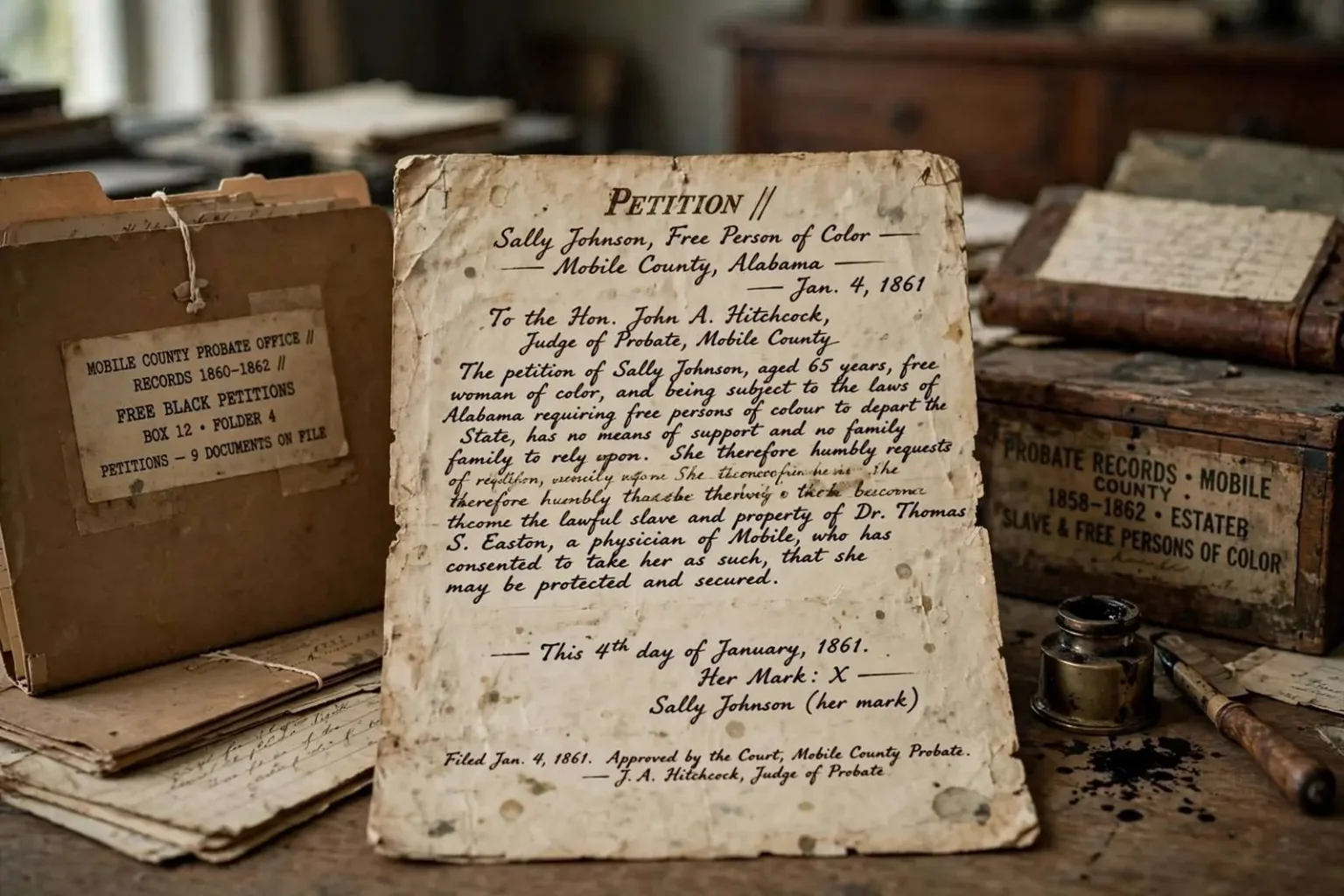
Handwritten petitions tucked away in the Mobile County probate office tell an unsettling story from the eve of the Civil War: several free Black residents of Mobile, facing escalating hostility from state and local governments, asked judges for permission to voluntarily become enslaved. The documents sit in the same office where property deeds, wills and estate files have been recorded for generations, and for decades their significance was easy to overlook. Today they stand as some of the starkest records of how narrow the choices had become for free people of color in Alabama on the brink of secession.
Among them was Sally Johnson, one of more than 800 free Black residents living in Mobile by 1860. On Jan. 4, 1861, the illiterate Johnson signed her petition with an “X,” asking Mobile County Probate Judge John A. Hitchcock to let her become the legal property of Dr. Thomas S. Easton, a University of Pennsylvania-trained physician who agreed to serve as her master. The date itself carries weight: Alabama had just voted to secede from the Union days earlier, and the legal machinery of the state was being reorganized around the defense of slavery.
Johnson’s petition describes her as 65 years old and in poor health, facing pressure to leave the city and state because she was not enslaved. Under the laws of the period, a free Black woman of her age and circumstance had few means of supporting herself legally and no protection from expulsion measures then being discussed in the legislature. Becoming the property of a physician she apparently knew offered a form of security that freedom, as defined by Alabama law at the time, no longer guaranteed.
A Handful of Petitions, A Larger Story
At least nine similar petitions remain on file at the probate office, and archivists believe that number likely represents only a fraction of those filed between 1860 and 1862, a period when Southern states were tightening restrictions on free Black residents ahead of secession. Some petitions may have been lost, misfiled or destroyed over the intervening century and a half. Even in their incomplete state, the records give researchers a rare document-level view of decisions that were almost never written down by the people making them.
Part-time probate archivist Collétte King, who has reviewed the documents, said Johnson’s case in particular struck her as heartbreaking: an elderly woman with no family, caught between conflicting pressures with seemingly nowhere else to turn. King’s work cataloging the records has helped bring the petitions to the attention of historians and the public, decades after they were first placed in the files. The handwriting, phrasing and signatures of each petition preserve details that no secondary account could supply.
Historians say the petitions reflect a broader climate of fear and legal pressure rather than free choice in any conventional sense. A petition asking to be enslaved cannot be read apart from the laws and rhetoric that surrounded it, they argue, and the timing of the filings, clustered in the months around secession, tells its own story. What the documents record is not preference but retreat, a surrender to a system that had closed nearly every other door.
Lonnie Burnett, a Civil War historian at the University of Mobile, said many petitioners likely felt they had no real alternative. His reading of the period places the petitions within a sequence of escalating measures, from licensing requirements to expulsion threats, that made free life in Alabama progressively more precarious. In that context, a voluntary petition reads less like a decision than a last resort.
Alabama lawmakers debated proposals in this period to expel free Black residents from the state entirely, according to Michael W. Fitzgerald, a historian who has written about Mobile’s Reconstruction era. Fitzgerald said white leaders increasingly viewed free Black Alabamians as a destabilizing and even threatening presence, a view reflected in a decade’s worth of state laws designed to restrict their movement and independence. The expulsion debate was not a fringe proposal; it surfaced repeatedly in legislative sessions and in the press of the day, reflecting the hardening attitude that free people of color had no legitimate place in the state’s future.
Mobile’s Distinct Free Black Community
Though free Black residents made up only a small fraction of Alabama’s Black population overall, roughly half of them lived in Mobile, giving the port city’s white leadership particular reason for concern, according to historians. Mobile’s economy depended on the cotton trade, the rail lines and the shipping interests that connected the city to New Orleans, the Caribbean and the ports of the Northeast. A visible population of free Black workers, tradesmen and property holders in that environment did not fit the rigid social order that secession-minded leaders were trying to defend.
The concentration of free Black residents in Mobile also meant that the city’s courts, including the probate office, handled a volume of legal business involving free people of color that had no parallel elsewhere in the state. That is why the petitions survive in Mobile County rather than in the inland counties where slavery was overwhelmingly rural and agricultural. The port city’s records, preserved through war, reconstruction and more than a century of administrative change, now serve as the primary window onto this episode.
Legislative records from the late 1850s show lawmakers passing a series of measures targeting both free and enslaved Black Alabamians, including requirements that slave owners live on-site with those they held in bondage. The on-site residency requirement was aimed at hired-out slaves and absentee ownership, arrangements that reformers of the day claimed loosened discipline and blurred the lines between slavery and freedom. Other measures restricted gatherings, preaching and movement, layering new penalties onto an already restrictive slave code.
By 1860, the cumulative effect was a legal environment in which a free Black resident of Mobile could be licensed, bonded, fined, apprenticed or ordered to leave, depending on the circumstance. Petitioning a probate judge to become enslaved, paradoxical as it sounds, was a legally recognized path that offered a measure of protection from those other mechanisms. The judge’s approval bound the petitioner to a specific owner and, in theory, to a specific place and status.
What the Documents Preserve
The petitions themselves are short documents, often only a few paragraphs, written in the formal legal language of the day by clerks or attorneys acting for petitioners who in many cases could not read or write what they signed. That gap between the voice on the page and the person behind it is one of the features historians find most striking. The “X” that Sally Johnson made on her 1861 petition stands in place of words she was never given the schooling to write.
The probate office’s role in the process is itself a piece of the story. Probate judges handled estates, guardianships and the legal mechanics of property, and a petition to become enslaved was processed in the same manner as any transfer of title. The mundane administrative framing of an extraordinary request is part of what makes the records so difficult to read today: the clerk’s handwriting is neat, the filing was routine, and the person at the center of it was legally disappearing into the very system the paperwork served.
Archivists and historians who have examined the files emphasize that the nine surviving petitions should be understood as a documented minimum. Given the number of free Black residents in Mobile, the span of 1860 to 1862 and the churn of war-time record keeping, the true count of petitions filed is very likely higher. Each rediscovered document adds a name to a roster of people who otherwise left no letters, photographs or graves that researchers have been able to identify.
The records also complicate a common assumption that the line between slavery and freedom was always clear and impermeable. In Mobile on the eve of the Civil War, the line could be crossed in both directions, and in at least a handful of documented cases it was crossed voluntarily, under compulsion of law and circumstance. That reality is what makes the petitions such a valuable and unsettling teaching resource for the region’s history.
A Rare Window Before the War
The Mobile County probate records offer a rare, direct window into how some free Black residents navigated an increasingly hostile legal landscape in the months before the Civil War began, choosing what they may have seen as the least dangerous of a set of terrible options. Historians of the period note that few other counties hold comparable documentation of this specific legal maneuver, which was unusual even by the standards of the slave states. The survival of the Mobile files is largely an accident of record keeping, but their value is now firmly established.
For the city of Mobile, the petitions have become part of a broader reexamination of the local history of slavery and freedom, a history long overshadowed by the city’s antebellum commercial wealth and its later industrial growth. Presentations, articles and classroom materials drawing on the probate files have introduced Johnson’s story to audiences far beyond the courthouse. The documents demonstrate that even in a single clerk’s drawer, the archive of the past can hold stories that reshape how a community understands itself.
The petitions also carry a caution about the language of the sources. Words like “voluntary” and “request,” which appear in the legal phrasing of the documents, describe a process that historians uniformly describe as coerced by law, fear and deprivation. Reading the petitions honestly requires holding both the official language and the historical reality in view at the same time.
History Beneath the Courthouse Floor
The survival of these records is a reminder of how much history sits in county offices across Alabama, often uncataloged and unindexed. County probate systems in the state hold some of the oldest continuous administrative records in the region, and Mobile County’s files stretch back to the earliest days of the city under successive governments. It fell to part-time staff and visiting researchers to recognize the significance of what had been resting in the stacks.
The petitions have drawn attention from academics precisely because they sit at the intersection of several major themes in Southern history: the status of free people of color, the hardening of the slave system in the 1850s, and the legal architecture of secession-era Alabama. Few documents capture all three themes in a single page. The fact that the Mobile files do so in the petitioners’ own marks, however mediated by clerks, gives them unusual force.
Historians such as Fitzgerald, whose work on Mobile’s Civil War and Reconstruction era drew on the city’s newspapers and government records, and Burnett, whose scholarship focuses on the war years, represent a larger body of research that has steadily recovered the details of Mobile’s free Black past. Their interpretations converge on a central point: the petitions were products of a system designed to leave people like Sally Johnson no good options. The documents prove the mechanism, and the historians supply the context that explains why it was used.
For residents of Mobile today, the petitions are a physical link to the more than 800 free Black people counted in the city in 1860, people who worked on the docks, in skilled trades, in shops and in homes across the city while their legal status grew more precarious every year. Most of their stories will never be recovered in detail. The nine petitions that survive are the exception that illuminates the rule.
The probate office continues to preserve the documents as part of its permanent record, and researchers who wish to examine them must work within the same file system where Johnson’s petition was placed more than a century and a half ago. As interest in the records grows, archivists hope that additional petitions or related papers will surface, either in Mobile County or in the collections of descendants of the owners named in the filings. Each new find would deepen the picture of a community navigating the last, darkest days before the Civil War.