New Drug-Testing Machine in Mobile Aims to Cut Jail Overcrowding Tied to Case Backlogs
A new forensic testing machine at the Mobile crime lab is expected to speed up drug case results and help ease jail overcrowding tied to backlogs.
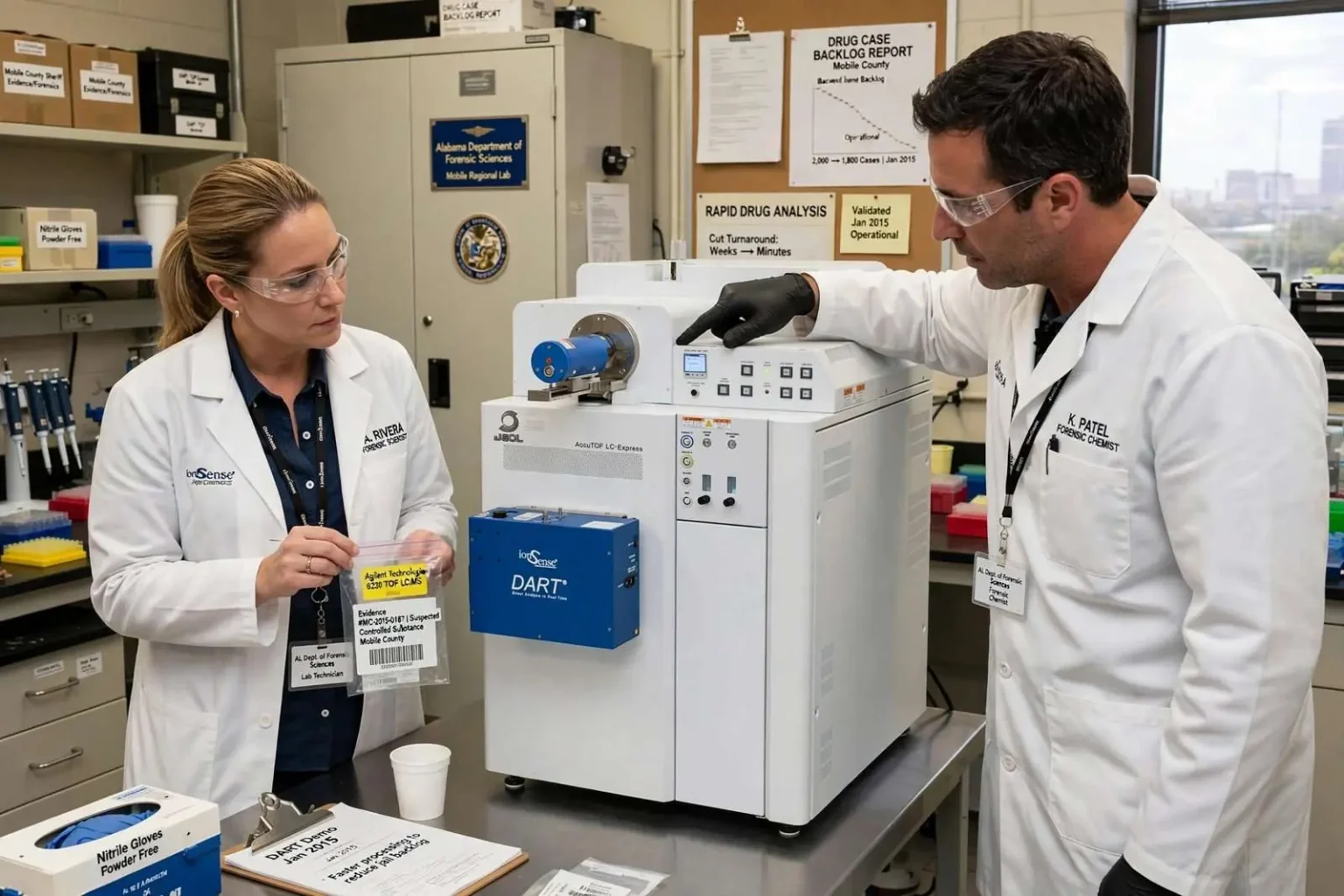
A new piece of forensic equipment at the Alabama Department of Forensic Sciences lab in Mobile is expected to speed up drug testing and ease overcrowding at Mobile County Metro Jail, local officials said during a recent demonstration of the technology. The machine — a DART Agilent TOF unit — arrived at the Mobile lab in July 2014 and was validated for use in January, and officials say it changes the basic math of how drug evidence moves through the criminal justice system here.
Unlike traditional testing methods that require samples to be shipped to a state lab in Montgomery, the DART system can analyze suspected drug evidence on-site in a matter of minutes rather than weeks. DART, which stands for Direct Analysis in Real Time, is an ionization source that allows chemists to analyze samples almost instantly — a fundamental shift from methods that require extensive sample preparation and, historically, transport of evidence to centralized state facilities.
Mobile County Sheriff Sam Cochran said the backlog had become a shared problem for his office, the Mobile County District Attorney’s office and Mobile police, all of which rely on toxicology results to move criminal cases forward. A defendant accused of drug possession cannot be prosecuted on the strength of a field test alone; the case depends on laboratory confirmation, and until that confirmation arrives, defendants sit in jail and cases sit on dockets.
Statewide, officials said, more than 38,000 drug tests were backlogged in 2014, according to figures cited by state Sen. Bill Hightower, leaving both guilty and innocent defendants waiting in jail for results that could determine the outcome of their cases. The backlog was not an abstraction for the people inside it: defendants who could not make bond waited weeks or months for lab results that might show the substance in question was not a controlled drug at all, while prosecutors waited for the confirmations they needed to move proven cases to trial.
How the Machine Was Funded
Hightower worked with Cochran and District Attorney Ashley Rich to secure funding in the 2015 state general fund budget that allowed the Alabama Department of Forensic Sciences to lease the roughly $250,000 machine for the Mobile lab, making it the first crime lab system in the state to use DART technology. The lease arrangement gave the state access to cutting-edge instrumentation without the full capital outlay of an outright purchase, and it marked Mobile as the proving ground for a technology that could eventually spread to other labs.
The funding fight was a local effort by any measure. The sheriff, the district attorney and the area’s state senator made the case in Montgomery that Mobile County’s case backlog was a public safety and taxpayer issue — one that cost counties money every day a defendant sat in jail awaiting lab work that could be done in minutes with the right equipment.
“We all fought for Mobile County, and as a result we got this latest technology and now we can work on the backlog of all of these cases,” Cochran said at the demonstration. Alabama Department of Forensic Sciences Director Michael Sparks called the equipment fundamental to the region’s efforts against drug crime.
What the Backlog Means for the Courts
Rich said the number of pending drug cases awaiting toxicology results in Mobile County had already dropped from about 2,000 to roughly 1,800 in recent years, and she expects the new machine to accelerate that decline further, helping cases move through the court system more quickly. The waiting list is more than a statistic — each case represents a person in jail or under supervision, a prosecutor’s file that cannot move, and court dates that slip while everyone involved waits on a laboratory.
The consequences run in both directions. Defendants who are guilty remain unprosecuted while evidence sits untested, and defendants who are innocent — people whose cases may fall apart once the substance is identified — remain locked up or under threat of prosecution for results they have not received. Jail beds cost Mobile County taxpayers money every night, and overcrowding at the Metro Jail had become one of the county’s most persistent criminal justice problems. Faster lab work is one of the few interventions that attacks overcrowding without changing any other part of the system.
Two lab technicians at the Mobile facility were trained to operate the DART unit, giving the region dedicated capacity for rapid drug analysis and a path to expand use of the technology as volume demands. Instrument validation — the process completed in January — is a critical step for any forensic method, ensuring that results produced by the machine will stand up in court and withstand defense scrutiny.
How DART Changes the Work
Traditional drug analysis requires laboratory chemists to prepare samples through extraction and other steps before testing, a process that takes significant time per sample when multiplied across thousands of submissions. DART’s direct analysis approach ionizes material in open air and feeds the results to a time-of-flight (TOF) mass spectrometer, which identifies compounds by their molecular signatures in minutes. For suspected controlled substances, that means a chemist can screen and confirm samples on the spot, without the shipping delays that came with sending evidence to Montgomery.
The speed matters most at the front end of a case. A person arrested on a drug charge typically has an initial appearance and bond hearing within days — long before traditional lab results arrive. Prosecutors make charging decisions, defense attorneys advise clients, and judges set conditions all before the laboratory confirms what the substance actually is. When confirmation takes weeks, every one of those early decisions is made in a fog; when it takes minutes, the system can operate on facts.
For the Alabama Department of Forensic Sciences, the Mobile deployment also serves as a demonstration project. If the DART unit performs as expected — cutting turnaround times and burning down the backlog — the case for deploying similar units elsewhere in the state becomes much easier to make in future budget cycles.
A Regional Problem With Local Stakes
The drug case backlog that the machine targets is a byproduct of a decade in which controlled substance prosecutions grew across Alabama while laboratory capacity did not. Every drug arrest in Mobile County generates a lab submission, and submissions arrive faster than chemists can clear them. The state’s centralization of testing in Montgomery added transport time to every case from the southern counties, and the queue grew accordingly.
Mobile County’s criminal justice leaders framed the machine’s arrival as a matter of fairness as much as efficiency. Defense attorneys have long noted that clients accused of drug offenses can plead guilty — or lose jobs, housing and family stability while awaiting trial — before laboratory confirmation ever arrives. An innocent person who spends two months in jail before a lab result clears him has suffered an injury no later acquittal repairs. Faster analysis narrows that window for everyone, guilty and innocent alike.
Local officials also connected the backlog to crowding at the Metro Jail, which for years has operated above its designed capacity. Every defendant held pretrial on a drug case that is only waiting for lab work occupies a bed that could house someone charged with a violent offense. Clearing the pending cases awaiting toxicology results — the number Rich said had already fallen from about 2,000 to roughly 1,800 — frees up beds, reduces overtime for jail staff, and eases pressure on a facility stretched thin.
The Demonstration
At the demonstration, officials walked through the machine’s operation for local leaders and media, showing how quickly a suspected controlled substance could be identified without the preparation time traditional methods require. The event was as much a celebration as a demonstration — the culmination of a funding effort that had begun in local offices and ended with a machine on the Mobile lab’s bench, validated and running.
Cochran’s remarks at the event captured the collaboration that made the project possible. The sheriff, the district attorney and the legislative delegation rarely have identical priorities, but the backlog gave them a shared one, and the 2015 budget became the vehicle for the fix. Hightower’s role in securing the appropriation — and in publicizing the statewide backlog figure of more than 38,000 tests — gave the effort its evidence base in Montgomery.
Sparks, the state forensic sciences director, framed the machine’s significance in regional terms: Mobile’s lab serves southwest Alabama, and its turnaround times shape the pace of justice for an entire corner of the state. The DART unit’s arrival puts one of the most advanced analytical tools in forensic drug chemistry to work on a backlog that has grown for years, in the first crime lab system in Alabama to deploy the technology.