Theodore Man Dies After Medical Emergency Leads to I-10 Crash
A Theodore man died after apparently suffering a medical emergency that caused a single-vehicle crash on Interstate 10 in Mobile on Saturday.
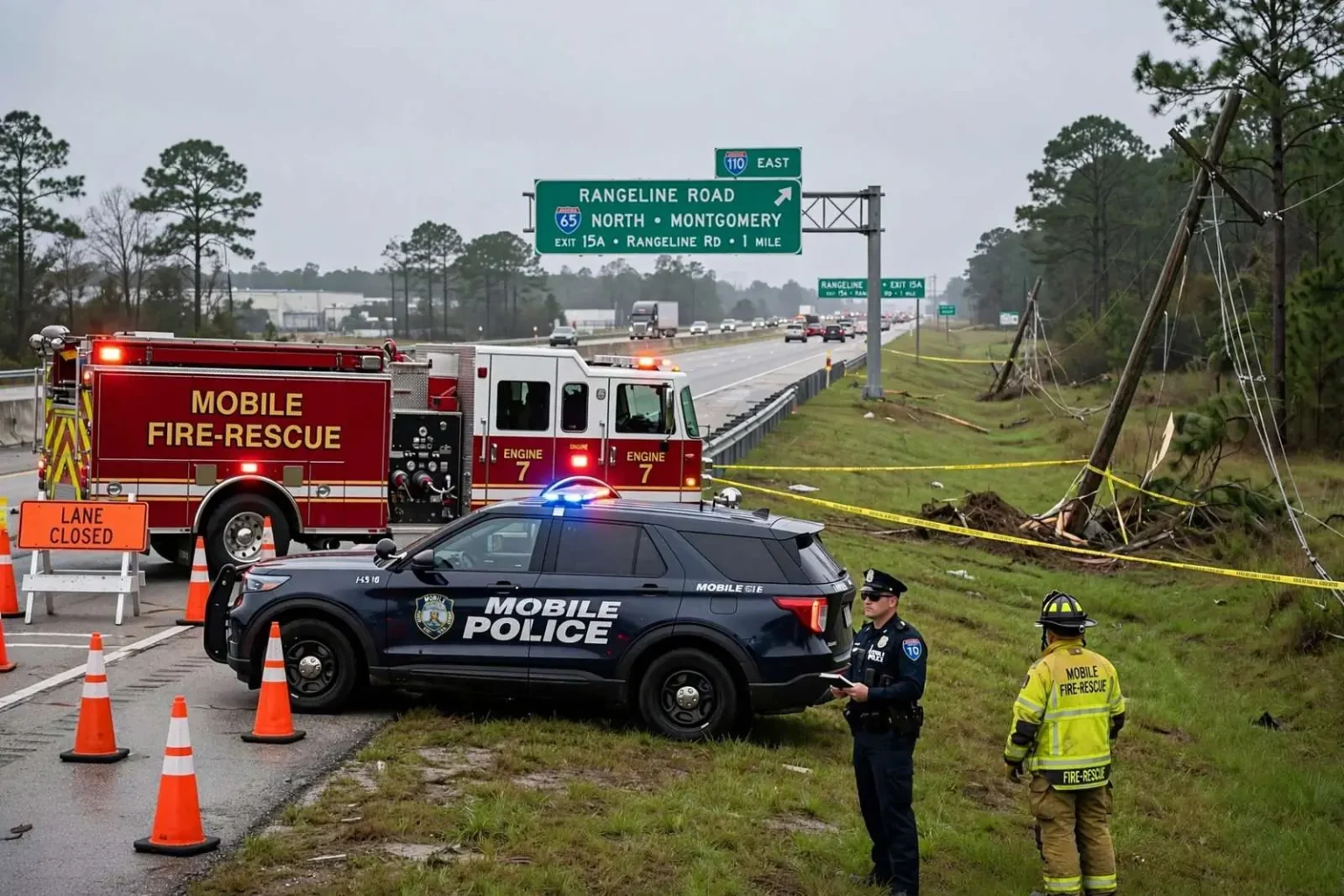
A Theodore man died Saturday after apparently suffering a medical emergency behind the wheel on Interstate 10 in Mobile, according to Mobile police. Benjamin Scott Jernigan, 53, was pronounced dead at Spring Hill Medical Center after his vehicle left the eastbound lanes of I-10 between Rangeline Road and Interstate 65 and struck a pole, according to police spokeswoman Ashley Rains. The incident unfolded during a morning commute period, and although the crash closed part of the roadway while investigators worked, authorities quickly signaled that the driver’s health — not the collision — appeared to be the central issue.
Officers were called to the scene around 8:20 a.m. Rains said a preliminary investigation showed Jernigan’s vehicle traveled about a quarter of a mile off the interstate before striking the pole, and that the vehicle sustained only minor damage. The distance the car covered after leaving the roadway suggested to investigators that the driver was incapacitated for a significant stretch of the event, unable to brake or steer as the vehicle wandered off the shoulder and across the grassy right of way. Motorists who witnessed the car drifting called in reports as it happened, giving dispatchers a real-time account of the vehicle’s path.
Evidence Pointing to a Medical Emergency
Investigators said Jernigan did not appear to have suffered major trauma in the crash itself, reinforcing the initial assessment that a medical episode, rather than the collision, was the primary cause of death. Emergency medical personnel who treated him at the scene and during transport reported findings consistent with a sudden health crisis, though the official cause of death awaited review by the county coroner’s office. In cases of this type, investigators typically examine medical history, speak with family members and consulting physicians, and rule out external factors before closing the file.
Detectives continued investigating the crash into the following week, and police did not report any indication that other vehicles or drivers were involved. The absence of a second vehicle simplified the investigation considerably, eliminating questions about fault or collision mechanics that dominate most fatal crash inquiries. Toxicology testing and medical records review remained the outstanding items as detectives worked to formally document what happened in Jernigan’s final moments on the highway.
Emergency responders from the Mobile Police Department and Mobile Fire-Rescue arrived within minutes of the initial report, closing the affected lanes and diverting eastbound traffic while they worked. The quick closure prevented secondary collisions in an area where drivers routinely travel at highway speeds, but it also created a backup that stretched for miles during the morning hours, a familiar consequence of any incident on the interstate through Mobile.
A Demanding Stretch of Highway
The stretch of I-10 where the crash occurred is one of the busiest corridors in the Mobile area, carrying heavy commuter and commercial traffic between the Bayway and the interchange with I-65, and it has periodically been the site of single-vehicle crashes tied to sudden medical episodes or mechanical failures over the years. The eastbound lanes in that segment funnel traffic toward the Wallace Tunnel and the eastern shore, mixing local commuters with long-haul truckers moving freight through the port city. On any given morning, the combination produces some of the densest traffic volumes in southern Alabama, and any incident — however minor — ripples backward through the line of vehicles for miles.
Rangeline Road, which marks the western edge of the crash site, serves the industrial areas west of the interstate, adding truck traffic to an already demanding mix. Drivers in that corridor navigate merges, elevated sections and closely spaced interchanges, all of which demand sustained attention. When a driver loses consciousness at highway speed, there is little margin for error before the vehicle departs the roadway, which is why investigators place such weight on the path a wandering car travels before it comes to rest.
Distinguishing Medical Crashes From Driver Error
Cases like Jernigan’s underscore a recurring challenge for traffic investigators: distinguishing between crashes caused by driver error and those triggered by a sudden health crisis behind the wheel. The distinction matters for several reasons. It determines whether any traffic citation applies, affects how insurance claims are handled, and shapes what the family is told about their loved one’s final moments. Investigators look for telltale signs — a car that maintains a straight line for long distances, skid marks that are absent entirely, witnesses describing the driver as slumped or unresponsive — that separate a medical event from fatigue, distraction or impairment.
Medical experts note that conditions such as cardiac events, strokes and seizures can strike without warning, sometimes leaving little time for a driver to safely pull over. A driver experiencing a heart attack may have only seconds of awareness before losing the ability to control the vehicle, and at interstate speeds a few seconds covers hundreds of feet. Physicians who treat patients with known risk factors often counsel them about driving, but the first sign of trouble for many victims is the emergency itself, with no opportunity to act on a warning.
For the family, the circumstances offer a painful kind of clarity. Jernigan’s crash left the vehicle barely damaged, and investigators concluded he likely did not endure a violent impact — small mercies that families of similar victims often point to when making sense of a sudden loss. The Theodore community, where Jernigan lived, is a close-knit unincorporated area south of Mobile, and news of his death traveled quickly among neighbors and coworkers.
The investigation also served as a reminder of the coordination required when a driver dies on a major highway. Mobile police secured the scene while fire crews stood by, and the vehicle was examined for mechanical defects before it was removed from the roadway. Utility crews were notified about the struck pole to make sure no electrical or communication lines were compromised. Each of those steps is routine in a fatal crash investigation, but together they take hours, and on a corridor as heavily traveled as I-10 through Mobile, every hour of lane closure compounds the disruption for thousands of drivers.
Medical Emergencies Behind the Wheel: A Wider Problem
Nationwide, transportation safety researchers estimate that a meaningful share of single-vehicle crashes involve a driver who suffered a sudden medical event, and highway agencies have gradually adapted their road design thinking to account for them. Wider clear zones, breakaway poles and mounded grassy medians all reduce the severity of an uncontrolled departure from the roadway. The pole Jernigan’s vehicle struck was set back from the travel lanes, and the quarter-mile drift across open ground likely absorbed much of the car’s momentum before impact — factors that may explain the minor damage investigators documented.
Advocates for driver health screening point to cases like this when arguing for more regular medical reviews for older drivers and for drivers with diagnosed conditions such as epilepsy or severe cardiac disease. Alabama, like most states, relies largely on self-reporting of disqualifying medical conditions during license renewal, which means many at-risk drivers remain on the road until an incident reveals the problem. Balancing personal independence against public safety remains a difficult policy question, and crashes like the one on I-10 sit squarely at the center of that debate.
Mobile police said the investigation into the crash remained open as detectives worked to finalize their findings on what led up to Jernigan’s death. Once the coroner’s findings and any toxicology results were complete, the case would be documented as either a natural-death incident occurring during the operation of a motor vehicle or, if evidence contradicted the medical theory, reclassified for further inquiry. Police thanked the motorists who called 911 to report the drifting vehicle, noting that early, accurate witness reports helped them reconstruct the vehicle’s path and close the affected lanes before additional crashes occurred on the busy eastbound stretch between Rangeline Road and the I-65 interchange.
For now, the case stands as one more entry in the long record of incidents on Mobile’s central interstate corridor — a reminder that the greatest dangers on the highway are not always collisions with other cars, but the sudden, unpredictable failures of the human body at 65 miles per hour.
The Saturday timing of the crash shaped how the region experienced it. Weekend mornings on I-10 through Mobile carry lighter but still substantial traffic — churchgoers, beach-bound travelers heading toward the Eastern Shore, and commercial trucks running on schedules that do not pause for the calendar. The lane closure backed vehicles onto connecting ramps near the I-65 interchange before crews reopened the roadway, and some drivers rerouted through surface streets in Theodore and Tillmans Corner to avoid the delay entirely.
Local first responders have long trained for exactly this scenario. Mobile Fire-Rescue units stationed near the interstate corridor respond to a steady rhythm of crashes, medical calls and vehicle fires on I-10, and the department’s ability to reach a scene quickly often determines whether a driver in cardiac arrest has any chance of survival. Paramedics on scene that morning worked to stabilize Jernigan before transporting him to Spring Hill Medical Center, one of the area’s primary receiving hospitals, but the apparent scope of the medical event proved too severe to overcome.
Police asked anyone who witnessed the vehicle before or during the crash and had not yet spoken with investigators to come forward, a standard request that helps confirm the timeline of a drifting-vehicle incident. Witness accounts established that the car maintained a steady speed along the interstate before beginning its long drift off the roadway, behavior consistent with a driver who had already lost consciousness rather than one swerving to avoid another vehicle.
As the inquiry wrapped its remaining steps, the details that emerged offered Jernigan’s family and neighbors a coherent account of a tragedy no one could have prevented — a healthy-appearing Saturday drive that ended without warning on the highway he had likely traveled countless times, the kind of sudden loss that leaves a community grieving without anyone to blame.