Theodore Man Convicted of Manslaughter in Crash That Killed Retired Teacher
A Mobile County jury convicted a Theodore man of manslaughter in a 2014 crash that killed a retired Baldwin County schoolteacher near Mobile.
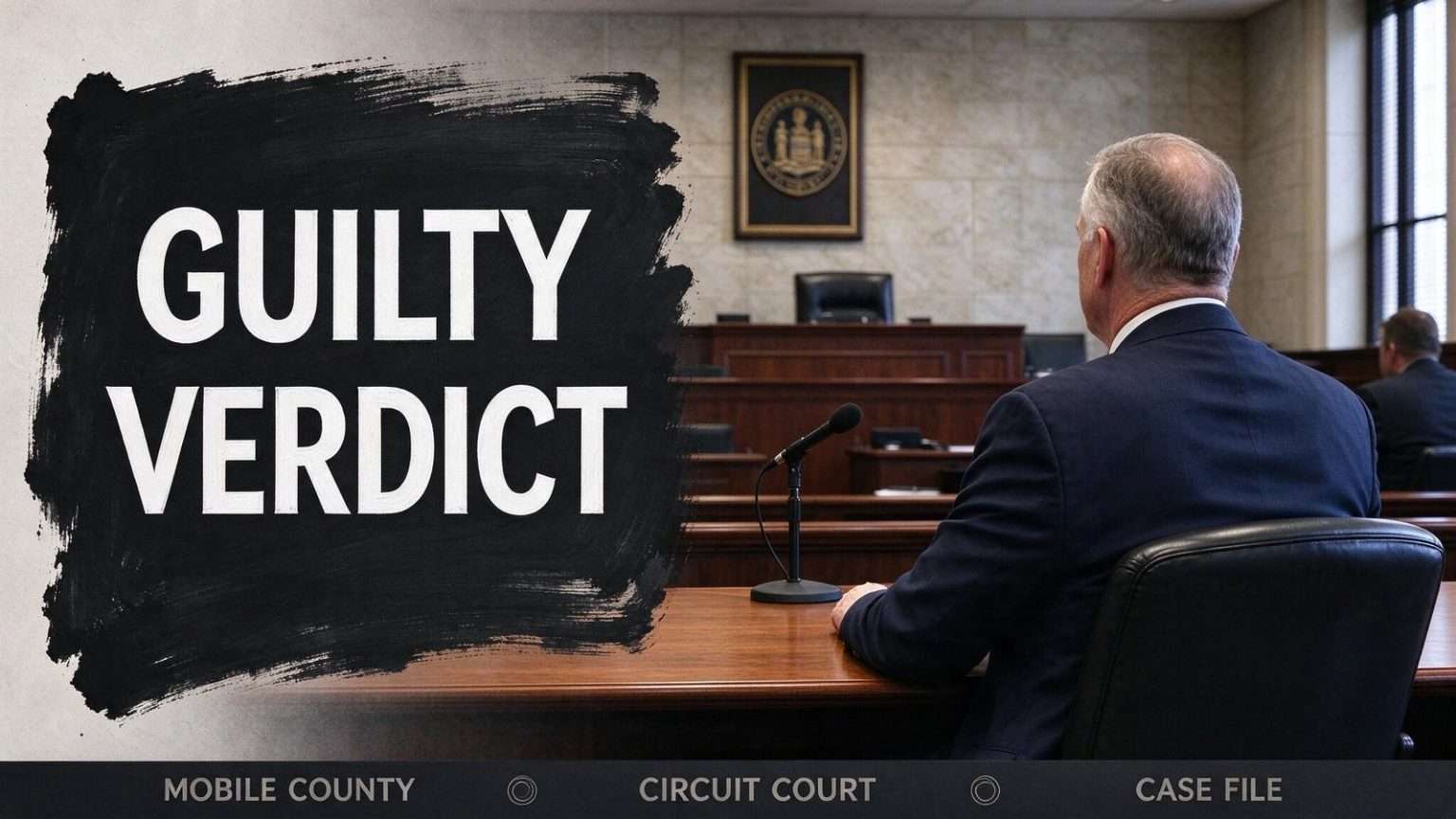
A Mobile County jury convicted a Theodore man of manslaughter following a crash that killed a retired schoolteacher outside a Mobile fast-food restaurant. Jurors deliberated for about 90 minutes before finding Maurice White, 60, guilty in connection with the January 2014 crash that killed 66-year-old Martha Wingo Hinton. The verdict came after a trial in Mobile County Circuit Court and capped a case that had moved steadily through the local justice system since the crash occurred on one of west Mobile’s busiest commercial corridors.
Prosecutors said White was driving under the influence of alcohol and a prescription painkiller when his pickup truck left Schillinger Road and struck a vehicle parked outside a restaurant on Airport Boulevard. Hinton, who was inside the parked vehicle, died at the scene. The collision underscored the hazards that can develop when impaired driving intersects with the close quarters of a commercial parking area, where stopped vehicles, pedestrians and drive-through traffic often sit only feet away from fast-moving roadway traffic.
Schillinger Road and Airport Boulevard form one of the key crossroads of west Mobile, a fast-growing section of the county where residential subdivisions, schools, churches and retail strips have multiplied over recent decades. Airport Boulevard itself stretches across a broad swath of Mobile County, connecting downtown Mobile to the western suburbs and carrying a steady volume of commuter and commercial traffic throughout the day. Intersections and storefronts along that route see constant turning movements and frequent stops, which is why crashes there — particularly those involving vehicles leaving the roadway — tend to draw close attention from both investigators and neighbors.
A Teaching Career Remembered
Hinton, a Robertsdale native, spent years teaching at Loxley Elementary School before retiring. Her career unfolded in Baldwin County classrooms across decades, and news of her death reached far beyond the crash site, touching former students and colleagues on both sides of Mobile Bay. Robertsdale and Loxley sit in the heart of south Baldwin County, communities where elementary schoolteachers often spend entire careers teaching the children and grandchildren of earlier students, building bonds that stretch across generations of local families.
The case drew attention in the Theodore and west Mobile community, where Hinton was remembered by former students and colleagues for her decades spent teaching in Baldwin County classrooms. Residents of Theodore, an unincorporated community southwest of Mobile, followed the court proceedings closely in part because the defendant lived among them and the crash site lay within a short drive of their own daily routes. For many, the case served as a sobering reminder that a single impaired decision on an ordinary afternoon can reach across county lines and alter lives in two different communities at once.
Prosecutors said the case served as a reminder of the dangers of impaired driving on Mobile County’s busier commercial corridors, where parking lots and drive-through lanes sit close to heavily traveled roads. They argued that the jury’s verdict sent a clear message about accountability for drivers who get behind the wheel after drinking or taking impairing medications, regardless of where that decision ultimately leads.
Evidence and the Defense Case
Prosecutors told jurors a portable breath test administered shortly after the crash showed White’s blood-alcohol level was more than twice the legal limit. Under Alabama law, the legal limit for drivers is 0.08 percent, meaning the reading described by prosecutors placed White well above the threshold at which a driver is presumed impaired. Portable breath tests are routinely administered by officers at the scene of suspected impaired-driving crashes, and the results often play a central role in establishing the state’s case in the weeks and months that follow.
White’s defense attorney argued his client had suffered a medical emergency that caused him to lose control of the truck, but jurors rejected that account. The medical-emergency defense is a known strategy in cases involving vehicles that leave the roadway without apparent braking or steering input, and it typically hinges on medical records and expert testimony about conditions that can cause sudden incapacitation. In this case, the jury weighed that explanation against the breath test evidence and the prosecution’s account of alcohol and prescription painkiller use, and deliberated less than two hours before returning the guilty verdict.
The path to trial itself reflected the seriousness with which the case was prosecuted. Mobile police initially arrested White on a manslaughter charge, and a grand jury later indicted him on a charge of reckless murder as well. Under Alabama law, the distinction between the two charges is significant. Manslaughter generally involves recklessly causing the death of another person and carries a maximum sentence of 20 years in prison. Reckless murder, by contrast, involves conduct showing extreme indifference to human life, and it is classified as a Class A felony, exposing a defendant to a far longer sentence if convicted. Prosecutors sometimes pursue both routes and allow the trial process to determine where a defendant’s conduct ultimately falls.
Bond, Release and Court Oversight
Following his conviction, White was booked into Mobile County Metro Jail and released after about 90 minutes on a $15,000 bond, with a judge ordering him to submit to daily alcohol monitoring while the case proceeds. The monitoring requirement is a common condition in cases involving alcohol-related offenses, allowing the court to verify compliance between hearings without holding a defendant in custody. Daily testing also gives prosecutors and the sentencing judge a documented record of the defendant’s behavior during the period between conviction and sentencing, which can influence the final outcome.
Court records show White had no prior arrests in Mobile County before the crash. That absence of a criminal history is a factor defense attorneys typically emphasize at sentencing, arguing for leniency for first-time offenders, while prosecutors in impaired-driving fatalities point instead to the finality of the harm suffered by the victim and her family.
Circuit Court Judge Robert Smith presided over the trial, which drew a small gallery of family members from both sides. The presence of relatives of both the defendant and the victim gave the proceedings an emotional weight that persisted from jury selection through the reading of the verdict, and family members were in attendance as the jury’s decision was announced in open court.
What Comes Next in the Case
A hearing to review a pre-sentencing investigation report was expected later in the month, ahead of formal sentencing. In Alabama felony cases, a pre-sentencing investigation is prepared by probation officials and typically covers the defendant’s background, criminal history, employment and personal circumstances, along with input from the victim’s family. The finished report gives the sentencing judge a structured picture of the case beyond the trial evidence, and both sides are given an opportunity to respond to its contents before the sentence is imposed.
Sentencing was expected to follow within weeks of the pre-sentencing report’s completion. Because manslaughter carries a maximum sentence of 20 years in prison under Alabama law, the hearing will determine how close to that ceiling White’s sentence will fall. Judges weighing such sentences commonly consider the circumstances of the offense, the defendant’s history, statements from the victim’s family and the recommendations contained in the pre-sentencing report.
A Broader Lesson for Mobile County Drivers
Beyond the courtroom, the case became part of a recurring conversation in Mobile County about impaired driving and the risks it creates in areas where roadways and commercial developments overlap. Traffic-safety advocates in the region have long pointed out that corridors like Airport Boulevard combine high speeds and heavy traffic with dozens of access points where vehicles enter, exit and park throughout the day. A driver who drifts out of a travel lane in such an environment can reach a parked car, a storefront or a pedestrian within seconds.
Impairment by prescription medication, as alleged in this case alongside alcohol, remains an underappreciated danger on Alabama roads. State law treats driving under the influence of any substance that impairs the ability to drive — including lawful prescription drugs — the same as driving under the influence of alcohol. Safety officials regularly urge residents who take pain medications or other impairing prescriptions to consult their physicians and pharmacists about driving, and to arrange alternative transportation when a medication’s effects are uncertain.
For the family and former students of Martha Wingo Hinton, the verdict provided a measure of accountability after months of waiting. The retired teacher’s death transformed an ordinary stretch of Airport Boulevard into the site of a tragedy that resonated from her hometown of Robertsdale to the Theodore neighborhood where the defendant lived. As the case moves to sentencing, the focus in both communities now shifts to the punishment phase, where the court will weigh a decades-long teaching career cut short against a first offense that carried consequences no bond condition or monitoring program can reverse.