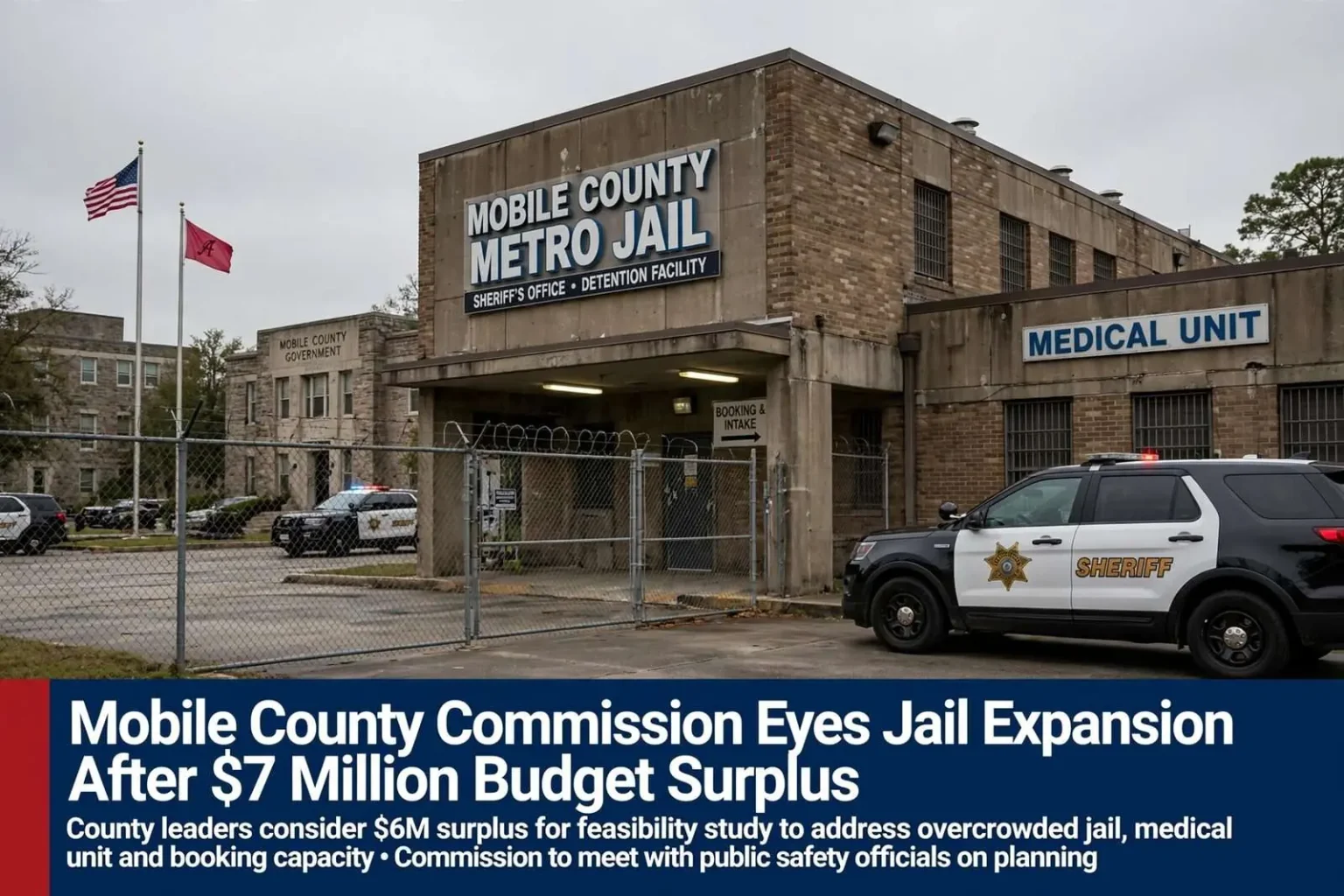
Mobile County Commission Eyes Jail Expansion After $7 Million Budget Surplus
Mobile County officials are considering a feasibility study on expanding the county jail after finance officials reported a roughly $7 million surplus.
The Mobile County Commission is weighing how to spend roughly $7 million in unexpected budget surplus, with a jail expansion emerging as a leading contender for the money. Finance Director Michelle Herman told commissioners the surplus developed after a combination of cost-cutting measures, a modest rise in sales tax revenue and proceeds from county property sales.
About $1 million of the surplus was already used to give county employees a 2.5 percent raise two months early, along with a one-time $500 payment. The early raise and the bonus were popular moves with the county’s workforce, but they left the bulk of the windfall — around $6 million — on the table for a commission that rarely gets unencumbered money of that size to spend.
Commission President Connie Hudson said the remaining balance should go toward infrastructure and building needs that have been waiting for funding, and that she plans to push for a feasibility study on expanding Mobile County Metro Jail. The suggestion put the county’s largest recurring operational headache at the top of the list for its largest one-time budget windfall in recent memory.
A sheriff’s plea for space
Sheriff Sam Cochran said he welcomed the discussion, calling jail capacity “one of the biggest challenges the county faces.” He pointed to the facility’s small medical unit and booking area as priorities for any expansion, noting that cramped conditions make it harder to safely process inmates and treat those who are sick.
The medical unit is a particular pressure point. Jails are, in practice, among the largest health care providers in any county, taking in detainees whose chronic conditions, injuries, mental illness and addiction go with them through the door. When a facility’s medical space is too small, sick inmates are managed wherever space allows, medications are harder to control, and staff face greater risk — costs that show up in litigation, overtime and liability rather than in a line item labeled “expansion.”
The booking area presents a parallel problem. Every arrest made by Mobile County deputies, Mobile police and municipal departments across the county funnels through the jail’s intake, and overcrowding at that single choke point slows every agency upstream. Officers who spend hours waiting to book a detainee are officers not on the street, which is why sheriffs across the country treat booking capacity as a countywide public safety issue rather than a jailhouse detail.
“Managing chaos” and a Pascagoula comparison
Commissioner Jerry Carl, who has described the aging facility as a constant exercise in “managing chaos,” toured a similar expansion project underway at a jail in Pascagoula, Mississippi, and said the investment needed for a comparable project in Mobile County would likely run into the tens of millions of dollars.
That arithmetic is the crux of the county’s dilemma. A $6 million surplus cannot build a jail addition that will cost several times that amount, but it can fund the engineering, architectural and planning work — the feasibility study Hudson wants — that turns an aspiration into a bond proposal with real numbers attached. Counties typically finance projects of that scale through bonded debt, which requires a clear scope and cost estimate before anything is borrowed.
The Pascagoula project gave commissioners a working model close to home: a Gulf Coast county jail of comparable vintage expanding in place rather than building new, with construction sequenced so the facility can keep operating — and keep holding inmates — while the work proceeds. Mobile County does not have the option of emptying its jail during construction, so lessons from a neighboring state’s project carry practical weight.
The Searcy Hospital effect
Cochran also said the closure of Searcy Hospital, the state’s former psychiatric facility, has added pressure on the jail as it takes in more inmates with mental health needs. The state’s decision to close its aging psychiatric hospitals and shift patients to community-based care moved a burden the county had never been equipped to carry: people in crisis, arrested rather than treated, arriving at a jail with no clinical infrastructure designed for them.
The pattern has repeated in counties across Alabama as state facilities have closed. Jails have become the default holding point for people experiencing psychiatric emergencies, and sheriffs have become, by necessity, the operators of some of the state’s largest de facto mental health facilities — without the staff, the space or the reimbursement to match. Cochran’s point to the commission was that any honest plan for jail expansion has to treat mental health capacity as a core requirement, not an afterthought.
Hudson said she intends to bring together local public safety officials in the coming weeks to map out shared goals before any construction plans move forward. She cautioned that a formal feasibility study, covering location, cost and scope, needs to come first. “There’s a lot of details, and the devil is always in the details,” she said.
A jail that has outgrown its walls
The jail has been expanded twice since it was built, but neither of those expansions kept pace with the population it now serves or addressed the medical and booking shortfalls Cochran identified. Each addition added beds, but beds alone do not solve the operational problems of a facility whose intake, medical and program space were designed for a smaller, different era of jail operations.
The Mobile County Commission, a three-member body that also controls the county’s road, health and general government budgets, will ultimately have to weigh the jail against every other claim on the surplus. Hudson’s framework — fund the study first, convene public safety officials, then decide — is designed to give commissioners a defensible basis for what would be the county’s most expensive building commitment in years.
For now, the $6 million remains available, the sheriff’s warnings remain on the record, and the county has a rare opportunity to plan rather than react. Whether the surplus becomes the seed of a full expansion or simply the down payment on a study, the decision the commission makes this budget cycle will shape how Mobile County handles its inmates, its mentally ill detainees and its crowded intake lines for years to come.
What the surplus says about county finances
The very existence of a $7 million surplus marked a notable turn for a county budget that spent lean years watching every line item. Herman’s accounting — cost-cutting, a modest rise in sales tax revenue and proceeds from property sales — reflects the three usual engines of local government windfalls, and each carries a lesson for how the money should be treated. Sales tax gains track the health of the regional economy and can recede as quickly as they arrive; property sale proceeds are one-time money by definition. Budget officers generally warn against committing recurring expenses to non-recurring revenue, which is why commissioners have gravitated toward a capital project rather than new ongoing programs.
The decision to spend $1 million on the early employee raise and $500 bonuses consumed the most politically popular share of the surplus in a single stroke. County employees had gone without meaningful raises through the lean years, and commissioners who backed the early increase argued the workforce had earned it. But the move also sharpened the question of what to do with the rest: money spent on salaries is gone permanently, while money spent on a building asset stays on the county’s books for decades.
Infrastructure advocates on the commission have made exactly that argument. Roads, courthouses, drainage projects and the jail all carry backlogs of deferred maintenance from the years when capital spending was squeezed, and Hudson’s position — that the remaining surplus should address “infrastructure and building needs that have been waiting for funding” — treats the windfall as a chance to clear a piece of that backlog rather than expand the county’s recurring obligations.
The feasibility study she proposes would also force a public accounting of just how bad the jail’s situation has become. Studies of that kind document population trends, staffing levels, medical incidents and compliance risks, and they give commissioners — and taxpayers — a common set of facts before tens of millions of dollars are committed. Whatever the study concludes, the debate over Mobile County’s jail has now formally moved from the sheriff’s annual budget requests to the commission’s own agenda, which is precisely where the county’s elected leadership says the decision belongs.
Jail administrators elsewhere on the Gulf Coast have watched the same dynamic play out at their own facilities, which is why the Pascagoula tour mattered to commissioners weighing Mobile’s options. Expansion projects of this scale succeed or fail on details invisible from the outside — how intake is sequenced, where medical segregation sits relative to housing, how food service and laundry scale with new beds — and seeing another county work through those decisions in real time gave Mobile’s leadership a concrete reference point for its own study.
The county’s public safety officials, whom Hudson plans to convene in the coming weeks, will bring their own lists of priorities to that conversation. Municipal police departments care about booking wait times, the sheriff cares about housing and medical space, and judges and prosecutors care about transport, holding and court security. A feasibility study that captures all of those requirements at the start is far more likely to produce a project the county can actually build — and a cost estimate the commission can defend when the bond question comes back to the public.