Prichard Launches Workforce Program to Give Residents a Path to Careers
A new Prichard job-training initiative is pairing local residents with Mobile County employers, aiming to chip away at the city's high unemployment rate.
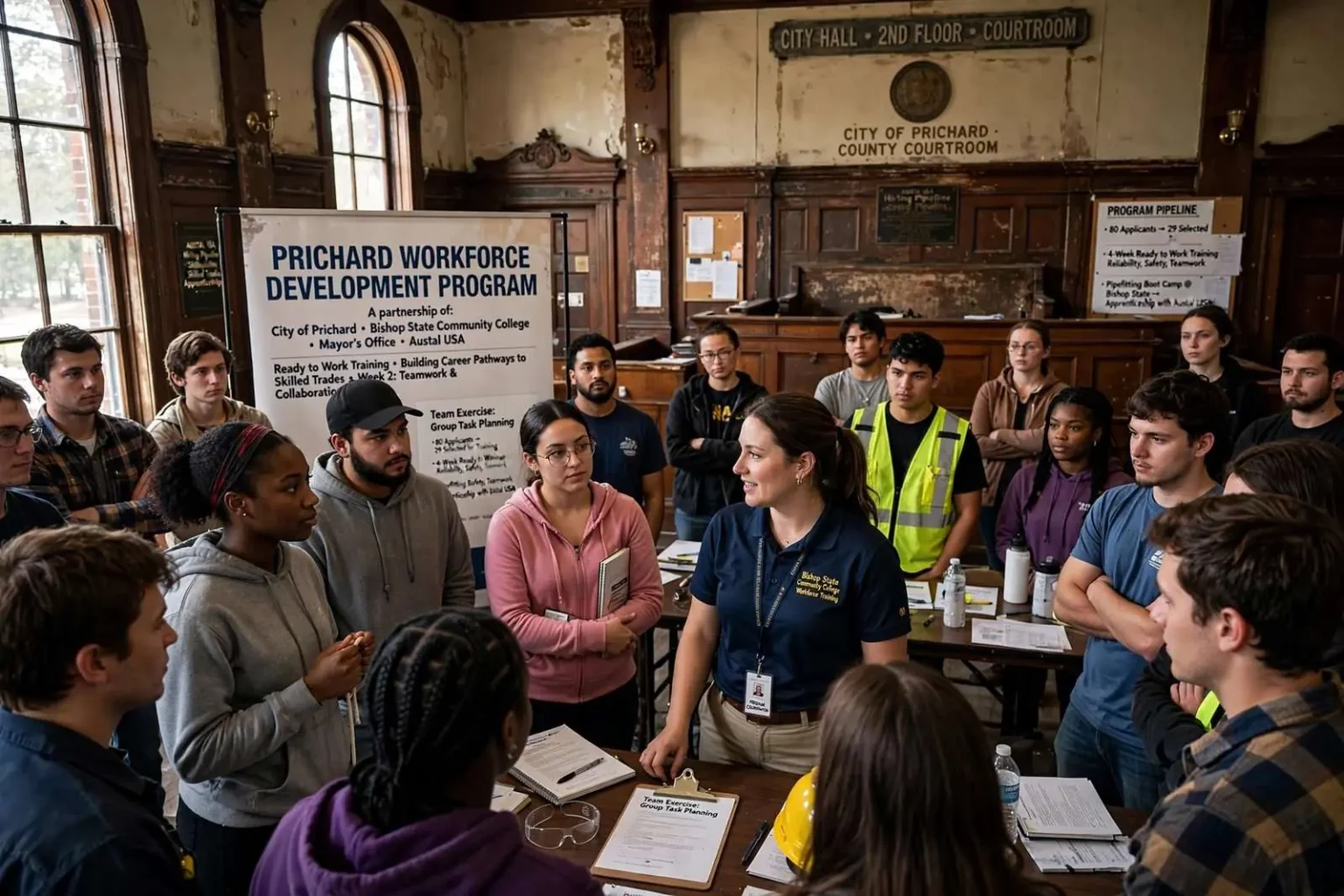
Inside a converted courtroom on the second floor of Prichard’s former City Hall, two dozen residents gathered recently to practice teamwork exercises as part of the city’s new Workforce Development Program, an effort aimed at connecting Prichard residents with real career opportunities rather than short-term jobs.
The program, created through a partnership between the Prichard City Council, Bishop State Community College, the Mayor’s Office and shipbuilder Austal USA, is designed to prepare participants for skilled trades. The arrangement puts a community college’s training infrastructure, a shipyard’s hiring pipeline and the city’s outreach apparatus behind a single goal: moving residents who want to work into training that leads to jobs they can build a life on.
Organizers said the first class of roughly two dozen students, ranging in age from 18 to 31, represents the initial wave of what they hope becomes an ongoing pipeline into the local workforce. The age range matters to organizers, who see young adults as the group most likely to leave the city in search of opportunity and most likely to stay if a path opens before they go.
Participants described a mix of motivations for joining, from wanting more stable income to seeking a genuine career rather than another entry-level job. One young mother of three said she left a position at a local hospital’s janitorial staff after being selected by Austal to compete for an apprenticeship, describing welding and pipefitting as fields she’d long been drawn to. Her account captured what organizers say distinguishes this effort from previous job fairs: the employer did the selecting, and the destination is a recognized apprenticeship rather than a temporary placement.
From 80 Applicants to a First Class
Roughly 80 people applied for the program’s first round, and Austal selected 29 to begin Ready to Work training in Prichard. The selection ratio reflects the scale of interest in a city where good-paying industrial work is scarce, and it gave organizers an immediate metric for gauging demand among residents of working age.
After four weeks, organizers expect 12 to 15 of those participants to move on to a pipefitting boot camp at Bishop State before the strongest performers advance into formal apprenticeships with the shipbuilder. The funnel narrows by design: the initial weeks test reliability, teamwork and basic skills, and the boot camp compresses months of trade fundamentals into an intensive format that Austal’s trainers and Bishop State instructors jointly deliver.
Ready to Work is Alabama’s established entry ramp into industrial employment, a training track that has operated across the state’s community college system for years and produces credentialed candidates for manufacturers along the Gulf Coast corridor. The credential tells employers that a candidate has demonstrated the work habits, safety fundamentals and baseline skills that industry recruiters look for, and it gives participants who do not advance to the boot camp a portable qualification for other openings.
The choice of Bishop State as the training partner ties the program to an institution Prichard residents already know. The two-year college, headquartered in nearby Mobile with deep roots in the region’s historically Black educational network, has long served neighborhoods across Mobile County, and its campus sites put short commutes within reach of Prichard households without reliable transportation.
The Numbers Behind the Initiative
City officials point to stark numbers behind the initiative. Among Alabama cities with populations over 25,000, Prichard has posted one of the highest unemployment rates in the state, trailing only Selma. Local organizers say the rate is several points higher than both the statewide average and neighboring Mobile’s rate, a gap that persists despite the city sitting a short drive from one of the Gulf Coast’s largest industrial employment centers.
Austal USA’s shipyard operations on the Mobile River have made the company one of the region’s largest industrial employers, building vessels for the U.S. Navy and Coast Guard and drawing welders, pipefitters, painters and shipfitters from across the coastal counties. The shipbuilding boom along the Gulf has generated sustained demand for trades workers, and yards like Austal have struggled at times to fill classes of apprentices from the local labor pool, a mismatch the Prichard program is built to attack directly.
An administrative assistant to the City Council who helped organize the program said the broader goal is to keep young residents from leaving Prichard to find opportunity elsewhere, noting that a lack of local jobs has long drained the city of its working-age population. The pattern is familiar across older industrial cities: young people depart for cities with stronger job markets, the population ages, and the local economy loses the consumers and workers that keep businesses open.
The former City Hall itself carries symbolic weight in that effort. The building once housed the machinery of city government before the administration moved to newer quarters, and its courtroom, where disputes about the city’s direction were once argued, now hosts residents practicing the cooperation skills industrial employers screen for. Organizers did not have to rent a facility; they repurposed one the city already owned, an economy that fits a city operating under tight budgets.
What Participants Are Working Toward
For the students, the arithmetic of the program is straightforward. An apprenticeship with a major shipbuilder leads to wages and benefits well above what entry-level service and janitorial positions pay in the region, and the trades themselves, welding and pipefitting in particular, carry credentials that travel. A journeyman card earned at a Gulf shipyard holds value at industrial employers across the region, giving workers options that stay local rather than forcing families to relocate.
The teamwork exercises that filled the converted courtroom may look soft next to welding booths, but organizers and employers describe them as the decisive filter. Shipyard work depends on crews coordinating in confined, hazardous spaces, and the workers who fail in industrial settings often fail on reliability and cooperation rather than skill. Screening for those traits in the first four weeks protects both the employer’s investment and the participant’s chance of finishing what they started.
The application process itself taught organizers something about the city they serve. Eighty applicants came forward once word spread through the council district and city hall, a turnout that confirmed what the unemployment statistics suggested: residents want industrial work and will compete for a structured path into it. The screening that produced the first 29 also generated a list of qualified alternates whom organizers hope to route into future rounds.
City leaders frame the program as the first move in a longer strategy rather than a one-time grant project. If the pipeline produces a steady flow of Prichard residents into Austal’s workforce, the model can extend to other employers along the coast, and the city’s role, identifying and preparing candidates, becomes a permanent function rather than a single initiative. The council’s partnership role signals that this is a municipal priority, not just a college program with city endorsement.
The program also arrives amid broader regional attention to workforce development along the Gulf Coast, where shipyards, aerospace suppliers and manufacturing plants have collectively struggled to fill skilled positions even as unemployment in nearby cities remains elevated. Workforce intermediaries across the region have built similar partnerships between employers and community colleges, and the Prichard model’s distinguishing feature is the city government’s direct hand in recruiting from its own population, using the trust residents extend to city hall to reach candidates whom advertising alone might miss.
Organizers are already thinking about the second round even as the first class works through its opening weeks. The 51 applicants who were not selected remain potential candidates for future classes, and the experience of screening them, testing aptitudes, noting which applicants lacked transportation or high school credentials, gives the city a clearer picture of the barriers between its residents and industrial employment.
The four-week training window now underway will provide the first measurable results. If the expected 12 to 15 participants advance to the pipefitting boot camp at Bishop State, and if the strongest among them convert to Austal apprenticeships, the program will have demonstrated the full pipeline from a Prichard classroom to a shipyard job in a single season, and the applicants who lined up behind the first 29 will have reason to expect the next class.
For the young mother who left the hospital janitorial staff to compete for an apprenticeship, and for the others practicing teamwork in the old courtroom, the stakes are personal: a career in the trades rather than another job. For the city, the calculation is civic. Every resident who builds a shipbuilding career without leaving Prichard is a data point against the departure that has shaped the city’s recent history, and the first class’s progress over the coming weeks will begin to tell whether the pipeline holds.