Citronelle Man Returned in 2007 Murder Investigation
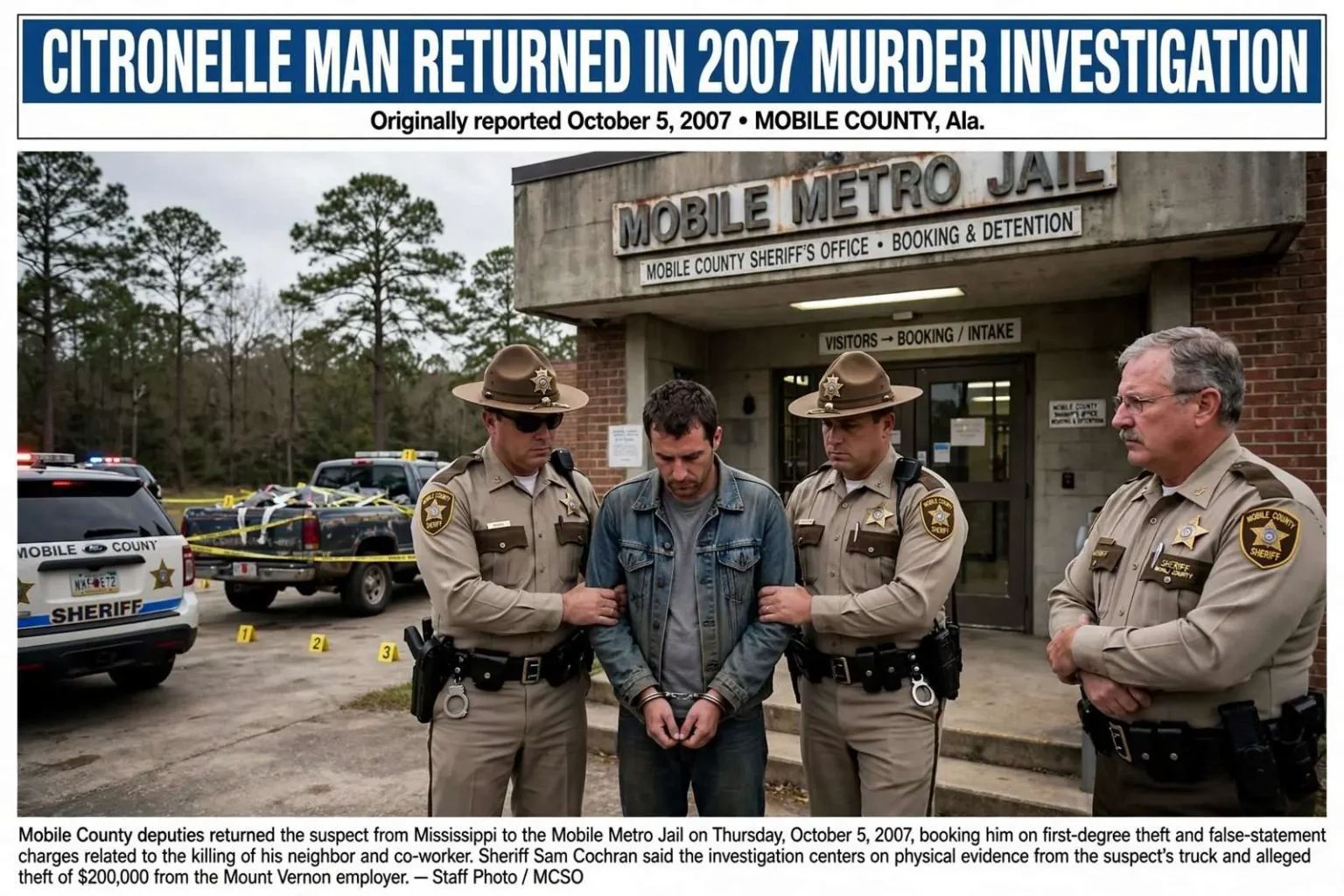
Mobile County deputies returned a man from Mississippi in October 2007 as a suspect in the killing of a Citronelle-area neighbor and co-worker, according to WKRG.
Originally reported October 5, 2007.
MOBILE COUNTY, Ala. — Mobile County deputies returned a man from Mississippi to Mobile Metro Jail in October 2007 as a suspect in the killing of his neighbor and co-worker, according to an archived local news report from the period.
The report said the victim had been found shot to death inside the suspect’s truck weeks earlier, a circumstance that made the vehicle central to the investigation from the start. Deputies located the man across the state line in Mississippi and brought him back to the Mobile Metro Jail, where he was booked on the charges that had accumulated while he was away.
At the time, the man had not been charged with murder. He was charged with first-degree theft and with reporting false statements to law enforcement — charges that reflected the direction the investigation had taken in the weeks after the killing, as detectives worked to reconcile the physical evidence with the accounts the suspect had provided.
Sheriff Sam Cochran said investigators believed physical evidence and inconsistencies in the suspect’s accounts were part of the case. Authorities also alleged that the suspect had staged an injury in an attempt to divert the investigation — an element that, if proven, would have painted the staging as a deliberate effort to steer detectives away from the truth of what happened.
The sheriff also said the investigation involved an alleged theft of $200,000 from the Mount Vernon employer where the two men worked together. That allegation formed the basis of the first-degree theft charge and linked the killing to a financial thread that investigators pursued alongside the homicide evidence.
The Investigation as It Stood in 2007
The case as described in the archived reporting combined elements that detectives treat with particular weight: a victim connected to the suspect by both neighborhood and workplace, a killing that occurred in property belonging to the suspect, and a suspect who left the state in the weeks that followed. Each of those on its own would warrant scrutiny; together, they shaped the investigation that brought deputies to Mississippi to retrieve the man.
The physical evidence Cochran referenced would have included whatever forensic material the truck yielded, along with the records and testimony documenting the alleged $200,000 theft from the employer. Investigators alleged that the suspect’s statements to law enforcement shifted in ways that conflicted with that evidence, and the charge of reporting false statements to police grew directly from those alleged inconsistencies.
The alleged staged injury stands out as the investigation’s most unusual element. Detectives alleged that the suspect presented an injury meant to suggest he was himself a victim of violence — the kind of misdirection that, in homicide investigations, often becomes a focus of scrutiny precisely because it requires forethought. The allegation tied together the false-statement charge and the broader suspicion that the suspect was actively working to shape how investigators read the case.
The Charges — and What They Carried
First-degree theft in Alabama involves stolen property above the felony threshold, and a $200,000 allegation places the charge far into that range. The charge carried substantial prison exposure on its own, independent of any murder prosecution that might follow. The false-statement charge — reporting false information to law enforcement — is a separate offense aimed at the act of misleading investigators, and it is often charged when detectives believe a suspect has actively constructed a false narrative during a criminal inquiry.
The decision to book the man on those charges rather than murder reflected where the case stood in October 2007: investigators had enough to hold him on the theft and false-statement allegations, while the murder case continued to build. Prosecutors weigh the evidence they believe they can prove beyond a reasonable doubt before filing a murder charge.
This historical article avoids graphic detail and does not state any later charges, trial result or court outcome. What the archived reporting records is a moment in the case’s early life — a suspect returned from Mississippi, lodged in the Mobile Metro Jail, and facing charges that told the first chapter of a story investigators were still assembling.
The North Mobile County Setting
Citronelle and Mount Vernon sit in the northern reaches of Mobile County, small communities separated from the city of Mobile by twenty-some miles of pine forest and farmland. In towns of that size, a killing is a rare and consuming event, and the connection between victim and suspect — neighbors who also worked at the same Mount Vernon employer — meant the case touched a single, tightly woven community from two directions at once.
The employer at the center of the alleged theft became part of the story as well. A $200,000 loss alleged against an employee reaches beyond a company’s ledgers into its sense of trust, and in a rural workplace where workers know one another’s families, the allegation that a theft of that scale preceded a co-worker’s killing put the community at the center of one of the year’s most serious cases.
Mobile Metro Jail, the booking point for the county’s major cases, houses defendants awaiting the resolution of felony charges across the county. The suspect’s return from Mississippi followed the standard extradition mechanics between the two states — a governor’s warrant process that, in neighboring states, typically moves on a timescale of days to weeks once the paperwork is complete.
Extradition and the Return to Mobile
The return from Mississippi marked a procedural milestone in the case. When a suspect facing Alabama charges is found in another state, the requisition process begins with paperwork between prosecutors and the two governors’ offices, and the suspect has the option to fight extradition or waive it and return voluntarily. The speed of the return in this case — weeks, not months, after the killing — suggested the process moved without extended contest, putting the man in the Mobile Metro Jail by early October.
Once back in Mobile County, the case moved into the standard early stages: booking, an initial appearance before a judge, and the pretrial process. For investigators, the return also reopened the opportunity to question the suspect in custody, with the inconsistencies Cochran described forming the baseline against which any new statements would be measured.
The weeks between the victim’s death and the arrest had been spent on the work that defined the case: processing the truck, documenting the alleged theft from the employer, interviewing co-workers and neighbors in Citronelle and Mount Vernon, and tracking the suspect into Mississippi. The arrest converted that investigation into charges, and the return to Mobile County converted the charges into a case the courts would take up.
Sheriff Cochran and the County’s Major-Case Work
Sam Cochran, who served as Mobile County’s sheriff for decades before his retirement, built his tenure around major-case investigation and cooperation among the county’s law enforcement agencies. His public comments on this case — physical evidence, inconsistent accounts, a staged injury, a $200,000 theft — laid out the theory investigators were following as they weighed what charges would ultimately attach.
Sheriff’s offices handle homicide investigations across unincorporated Mobile County and its small municipalities, where the county provides the detective resources that towns like Citronelle and Mount Vernon cannot maintain on their own. The Mobile County Sheriff’s Office major-case work in the northern part of the county routinely covers cases that begin in rural settings and end in the county’s downtown courts and jail.
For the communities where the case began, the sheriff’s account of the investigation offered the public outline of what detectives believed had happened: a theft that reached the level of a serious felony, a killing that claimed a neighbor and co-worker, and a suspect whose account of events investigators did not believe. What the courts would ultimately make of that theory was, in October 2007, still an open question — one this historical record deliberately leaves where the archived reporting left it.
The relationship between the two charges and the homicide remained the case’s defining question. Investigators alleged that the theft and the killing were connected — a $200,000 loss, a victim who worked at the same employer, and a suspect whose departure for Mississippi followed the discovery of the body. Whether that circumstantial architecture would grow into a murder case, and what the trial evidence would show about the night the victim died, were matters for the prosecutors and courts that came after the reporting that forms this record.
Cases from this era of Mobile County crime news survive mainly in archives like the one that preserved this report, and retelling them serves the communities where they happened: the victim’s story, the investigators’ work, and the legal process that followed are part of the public record of what the county went through in the fall of 2007.