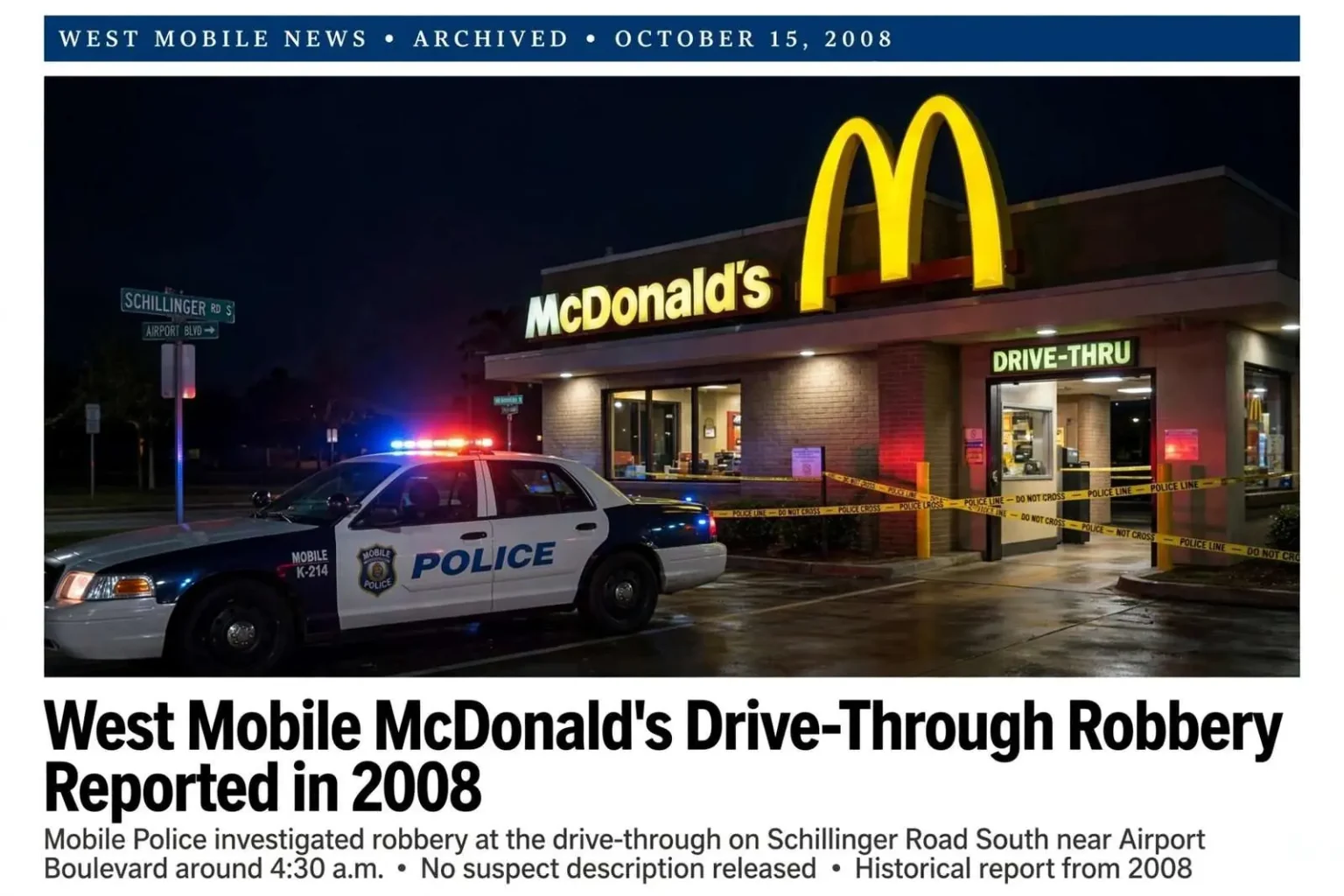
Historical report preserved from an archived 2008 local news story.
Mobile Police investigated a robbery at a McDonald’s drive-through on Schillinger Road South near Airport Boulevard in 2008, according to an archived local news report. Police said the robbery happened about 4:30 a.m. and involved a man who approached the drive-through window. No further description was released in the report. This article records an early police investigation and does not state whether a suspect was later identified or arrested. The original request for tips is not reproduced as a current alert.
The details that survive from the archived account sketch a familiar late-night crime scenario. A fast-food restaurant’s drive-through lane, staffed overnight by a skeleton crew, is one of the few places in west Mobile where cash, a worker and an open window come together at half past four in the morning. A man approached the window during those hours, and a robbery followed. Whatever else was said at the time, the archived report preserved little more: no description beyond the man’s sex, no account of what was taken, and no word on whether a weapon was shown.
The timing said something about the target. McDonald’s locations with overnight drive-through service keep a narrow channel of business running through the small hours — a steady drip of third-shift workers, early commuters and late-night regulars. The window at 4:30 a.m. would typically have one employee minding it, with one or two more inside. To the kind of person who robs a restaurant, the arithmetic of that hour is obvious: minimal staffing, a drawer already fattened by the previous evening, and a location set back from the intersections of two of west Mobile’s busiest roads.
The Schillinger and Airport crossroads
Schillinger Road South runs north-south through west Mobile’s bedroom neighborhoods, meeting Airport Boulevard at one of the area’s workhorse intersections. The corridor around it filled with retail pads, restaurants and strip centers as Mobile’s growth pushed west through the 1990s and 2000s, and a McDonald’s anchoring a corner near that junction fits the pattern exactly. By 2008 the area was busy well past dark, with its own rhythm of closing-time crowds and the quiet that follows.
That busyness is a mixed blessing for the businesses along it. Daytime, the corridors around Schillinger and Airport generate steady sales and a natural security presence of passing traffic. Overnight, the same properties sit isolated: wide parking lots, dark service areas behind the buildings, and a drive-through window as the only lit point of contact with the outside world. Police beats in west Mobile have long counted the overnight food-service windows among the more exposed retail locations in the district.
For the restaurant’s crew, the immediate aftermath of such a robbery is practical as much as traumatic. Managers secure the till, call police, and preserve whatever the cameras recorded — and by 2008, drive-through cameras had been standard equipment at major fast-food chains for years, positioned to capture vehicles and, at some angles, the window itself. Whether any usable image came from this case is not recorded in the archived report.
How Mobile Police work a commercial robbery
The Mobile Police Department’s response to a robbery call like this one follows a settled sequence. The first officers on scene check the employees for injuries, secure the scene and take the initial account; the robbery detective follows, walking the drive-through lane, reviewing the camera angles and collecting the description that will go out to patrols and, if it is released publicly, to the news. In this case, the archived account suggests the description available was thin — a man, nothing more preserved.
That thinness is not unusual for a window robbery. Approaches to a drive-through happen fast, often in poor light and at an awkward angle, and a clerk at arm’s length from a stranger at 4:30 a.m. is rarely in a position to study him. Unless the man lingered, drove a distinctive vehicle or left something behind, the investigative trail narrows quickly to the cameras, any discarded items along the probable escape route, and whatever the register records show about the timing.
Detectives would also pull the pattern file. Robbers of overnight food windows are frequently repeat actors, and investigators check recent robberies at similar targets — other drive-throughs, convenience stores, anything with overnight cash — for matching method, description or timing. In a city of Mobile’s size, the robbery pattern work runs continuously, and a single archived story about one window represents one entry in that longer ledger.
What the chains changed
Robberies like this one are part of the reason overnight fast-food operations look the way they do now. Chains have spent decades layering precautions around the late-night window: time-release safes that keep little more than pocket cash at the till, drop safes that employees cannot reopen, camera coverage on every lane, and training scripts for clerks that emphasize handing over the money rather than resisting. Some locations restricted overnight service to the drive-through only — locking the lobby — precisely because the window lane gave workers a barrier and a camera on every customer.
Those measures have measurably reduced losses, though they have never eliminated the crime. A person determined to rob a window can still do so, which is why the archived report’s original appeal for tips mattered when it ran. Witnesses from the overnight hours — a driver in line ahead of or behind the man, a customer who noticed a vehicle idling — are often the only people who saw more than the clerk did. In an archived case like this one, there is no current tip line to call, and this article does not recreate one; the value of the record now is historical.
For west Mobile readers, the case is also a small piece of the area’s growth story. The Schillinger and Airport corridors were then at the edge of the city’s westward expansion, full of new retail and new overnight shifts to serve it. The same expansion produced the lighting, the cameras and the staffing decisions that every overnight restaurant there operates under today — lessons written, in part, by 4:30 a.m. incidents like the one police investigated on Schillinger Road South in 2008.
The archived report leaves the case at its beginning: a robbery investigated, a description withheld, and no recorded conclusion. It stands as a preserved snapshot of one west Mobile night — and of the routine, often invisible police work that follows when a drive-through window becomes a crime scene.
Overnight work and overnight risk
The economics of a 4:30 a.m. robbery start with who is awake and working at that hour. West Mobile’s overnight population in 2008 included hospital shifts, plant workers, delivery drivers, and the crews who stock the region’s stores before dawn. The restaurants and fuel stations along Schillinger Road South and Airport Boulevard served that world, and the drive-through window was its front door. Robbery, where it found these businesses, found them in those hours more than any other.
Workers on overnight shifts carried the risk most directly. Fast-food clerks at that hour were often the youngest and least experienced members of a store’s staff, working alone at the window with management elsewhere in the building or off-site. The industry’s security training of the era acknowledged the imbalance: comply, observe, report. The archived report’s account — a man approaching the window, a robbery, no reported injuries — fits the compliance script that workers are coached to follow.
The neighborhood around the intersection, meanwhile, experienced these incidents as statistics on a map. West Mobile’s residential subdivisions of the 2000s sat minutes from the commercial strips, and armed robberies at food windows were the crime most likely to touch the edge between the two — committed by someone who arrived by car, worked the corridor and left within minutes. Police district meetings of the era routinely paired reports of these robberies with advice for businesses: keep lots lit, keep cameras running, keep cash low.
Why archived cases still matter
There is a reason to preserve even an incomplete account like this one. Local news archives are the rough draft of a city’s history, and the small crimes that never lead to trials still shape the places where they happened. The 2008 Schillinger Road South robbery is part of the record of how west Mobile’s commercial corridors grew, how their overnight businesses protected themselves, and what Mobile Police faced as the city’s footprint pushed west.
The gaps in the record are part of that history too. A report that preserves no description, no outcome and no arrests reflects the reality of a working investigation at its earliest stage — and of how much detail never reaches the public even when a case is eventually solved. Many archived robbery stories end without an epilogue; readers who lived through the era remember the appeals for tips on the evening news, and rarely learn which of them found their answers.
What can be said with confidence is what the archived report preserves: Mobile Police investigated a robbery at the McDonald’s drive-through on Schillinger Road South near Airport Boulevard in 2008, it happened about 4:30 a.m., and it involved a man who approached the window. The rest — the description that may have been developed, the camera review, the outcome — remains in the department’s files rather than the public record. For a historical archive, that foundation is the story: one west Mobile morning, one window, and the investigation that followed.