Shoplifting Attempt Outside Theodore-Area Grocery Store Escalates Into Gunfire
A steak shoplifting attempt outside a Rouses supermarket on Theodore Dawes Road escalated into a gunpoint standoff and gunfire, Mobile police said.
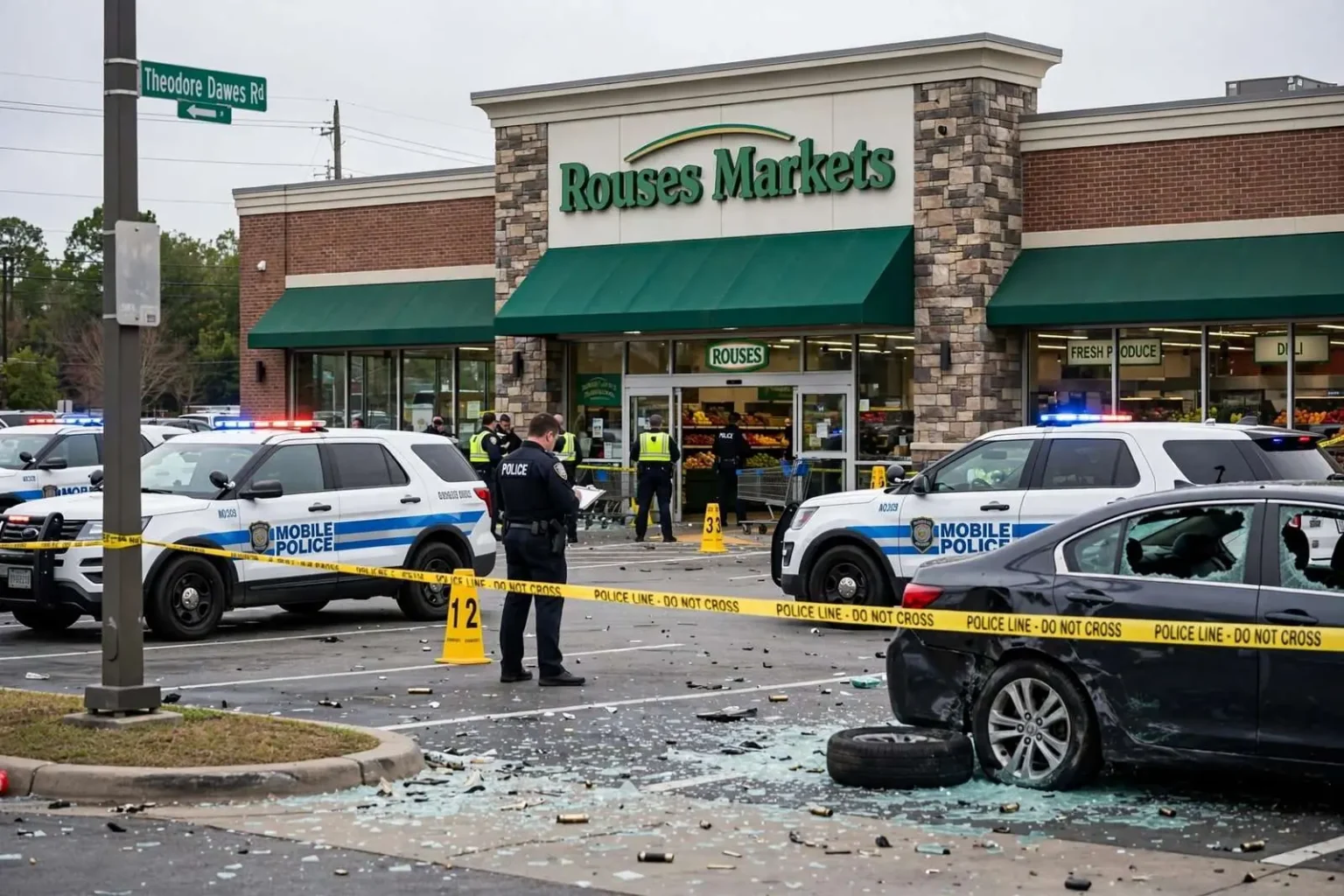
A routine shoplifting attempt outside a Mobile-area grocery store turned into a tense armed standoff, and ultimately gunfire, after a man accused of stealing steaks pulled a gun on a loss prevention officer trying to stop him. The midday confrontation, which unfolded in a busy parking lot along Theodore Dawes Road, ended with one man in custody and a bystander credited with stepping in to protect another person’s life.
According to the Mobile Police Department, 60-year-old Donnie James Moore shoplifted several steaks from a Rouses Supermarket on Theodore Dawes Road shortly before officers arrived around 12:20 p.m. on a Friday afternoon. When a store loss prevention officer confronted him, Moore reportedly pushed past the employee and made his way toward his car in the parking lot.
Bystander Opens Fire
Once at his vehicle, police say Moore retrieved a firearm and pointed it at the loss prevention officer, who responded by drawing his own weapon and aiming it back at Moore. For a moment, the two men stood facing each other across the parking lot, neither willing to lower a weapon, as customers and employees took cover behind vehicles and inside the store.
As the standoff unfolded, a bystander sitting in a nearby car became involved, pulling out his own gun and pointing it at Moore before either of the other two men had decided whether to fire. That bystander then fired multiple shots at Moore’s car. Moore, uninjured, jumped into his vehicle and sped away from the parking lot, leaving behind a scene of shattered glass and shell casings that officers would spend the afternoon documenting.
Officers located him a short time later nearby, where he was attempting to change one of his car’s tires, which had apparently been damaged during the shooting. The damaged tire had left Moore stranded close to the scene, and responding officers took him into custody without further incident. He was transported to the Mobile County Metro Jail to face charges stemming from the confrontation.
Police said the bystander who fired the shots would not face charges, characterizing his actions as defense of another person. A police spokesman said that when someone witnesses a situation where deadly force appears imminent, they have the legal right to intervene to protect another person. The decision to clear the bystander reflected that standard: with Moore pointing a gun at the loss prevention officer, the witness who opened fire was acting to stop an imminent threat to someone else’s life.
From Theft to Robbery
Moore was arrested and charged with first-degree robbery, a more serious charge than simple shoplifting because he used force — in the form of pulling a gun — during the theft. Under Alabama law, the introduction of a deadly weapon into a theft elevates what would otherwise be a misdemeanor property offense into a felony that carries years of prison exposure. The distinction matters legally: prosecutors charge based on the totality of what happened, and once a gun came out in the parking lot, the case was no longer about steaks.
According to Mobile County Metro Jail records, Moore has a lengthy arrest history dating back to 1987, including previous charges for robbery, theft and burglary. That record spans nearly four decades in the local court system and will factor into how the case proceeds from here, from bond considerations to potential sentencing if a conviction follows.
The case will now move through the Mobile County District Attorney’s office, which will review the evidence — including witness statements, surveillance footage from the store, and the accounts of the loss prevention officer and the bystander — before presenting it in court. Charges of first-degree robbery are among the more serious property-related felonies on the books, and the outcome will depend on the facts that investigators assembled in the hours after the parking lot shootout.
How Retail Theft Escalates
The incident highlights how quickly routine retail theft calls can escalate into life-threatening confrontations. Loss prevention officers are trained to observe and report theft, but when a suspect responds to a confrontation with a weapon, the situation instantly moves beyond the scope of a shoplifting stop and into the territory of armed response. Retailers across the Gulf South have grappled with this dynamic, as organized and repeat theft has pushed more encounters into parking lots where suspects have vehicles — and sometimes weapons — within reach.
Law enforcement officials generally advise store employees and loss prevention personnel to avoid physical confrontations with suspected thieves precisely because of the unpredictable danger. A theft of a few hundred dollars in merchandise is recoverable; an exchange of gunfire in a parking lot full of shoppers is not. That calculus is one reason retailers increasingly coordinate with police on repeat offenders rather than relying solely on stop-and-detain tactics.
For the customers and employees at the Rouses store on Theodore Dawes Road, the Friday afternoon episode was a jarring interruption of an ordinary errand. Grocery store parking lots are among the most familiar, unremarkable spaces in daily life, and the speed with which a stolen package of steaks became an armed standoff illustrates how little separates an ordinary afternoon from a dangerous one.
Defense of Another Person Under Alabama Law
The bystander’s decision to open fire placed him squarely within Alabama’s defense-of-others provisions. State law recognizes that a person who reasonably believes deadly force is necessary to protect a third party from imminent death or serious physical injury may use that force, and Mobile police said plainly that the man will not face charges. The spokesman’s framing — that a witness to an imminent deadly threat has the legal right to intervene — tracks the statute and reflects how prosecutors evaluate these cases after the fact.
Legal observers note that such interventions carry enormous risk for the person who intervenes. A bystander who misreads a situation, hits an unintended target, or arrives as events are still unfolding can create liability for themselves and add chaos to an already dangerous scene. In this case, the sequence was clear: Moore had pointed a firearm at the loss prevention officer, the officer had his weapon drawn in response, and the standoff had reached the point where deadly force appeared imminent. The bystander’s shots at Moore’s vehicle ended the impasse without injury to anyone.
The outcome — an arrest without injuries — is unusual in incidents involving exchanged gunfire. Police credited the rapid response and the fact that Moore’s flight ended within minutes when his damaged tire left him stranded nearby. Officers processed the scene, collected statements from the loss prevention officer, the bystander and witnesses, and worked to reconstruct the exact sequence of movements in the parking lot for the case file.
What Comes Next in the Case
With Moore in custody at the Metro Jail, the first-degree robbery charge moves into the court system. A first appearance before a judge will address bond, and the District Attorney’s office will take the case to a grand jury to seek an indictment. The felony classification means Moore faces potentially significant prison time if convicted, and his decades-long arrest history will be part of the record the court weighs.
The loss prevention officer’s actions — pursuing the suspect, drawing his weapon only after Moore produced a gun, and ultimately surviving the standoff uninjured — will be reviewed as part of the department’s standard investigation. Store personnel cooperated with officers at the scene, providing surveillance footage and witness lists that will anchor the prosecution’s account of how a shoplifting stop became a shootout.
For the Theodore community, the episode serves as a reminder of both the volatility of retail theft confrontations and the split-second decisions ordinary people can face. Police reiterated that individuals who witness crimes should first call 911 when possible, and that the decision to intervene with force carries legal and physical consequences that demand careful judgment. In this case, investigators concluded that judgment was sound — the threat was real, the response was justified, and a dangerous afternoon ended with the suspect in custody and everyone else alive.
The Rouses Market on Theodore Dawes Road reopened its normal operations as the afternoon wore on, but the scene outside lingered in the memories of those who watched it unfold. Employees who had taken cover inside returned to registers and shelves, and customers resumed their shopping trips — some pausing to talk with officers about what they had seen from the parking lot. Investigators remained on site into the afternoon, marking evidence positions and photographing the vehicles involved.
Shoplifting calls are among the most common police responses in retail corridors like Theodore Dawes Road, where grocery stores, restaurants and strip malls line one of the busiest commercial stretches in Theodore. The vast majority end without incident: a suspect is detained, merchandise is recovered, and paperwork follows. It is the rare case — like this one — that becomes a neighborhood talking point, precisely because the escalation is so unexpected.
Police did not release the name of the loss prevention officer or the bystander, consistent with their practice in incidents where no charges result and the individuals are not public figures. The spokesman’s account of the sequence, drawn from witness statements and physical evidence, forms the official record of an afternoon when a stolen package of steaks triggered a parking lot standoff that could easily have ended in death — and instead ended with a stranded suspect, a spent tire, and a bystander whose split-second decision was judged legally justified.