Mobile History: The Story Behind Festorazzis Coffee Saloon on Royal Street
How Captain Silvester Festorazzi, an Italian immigrant and Confederate veteran, built one of downtown Mobile's beloved 19th-century coffee saloons.
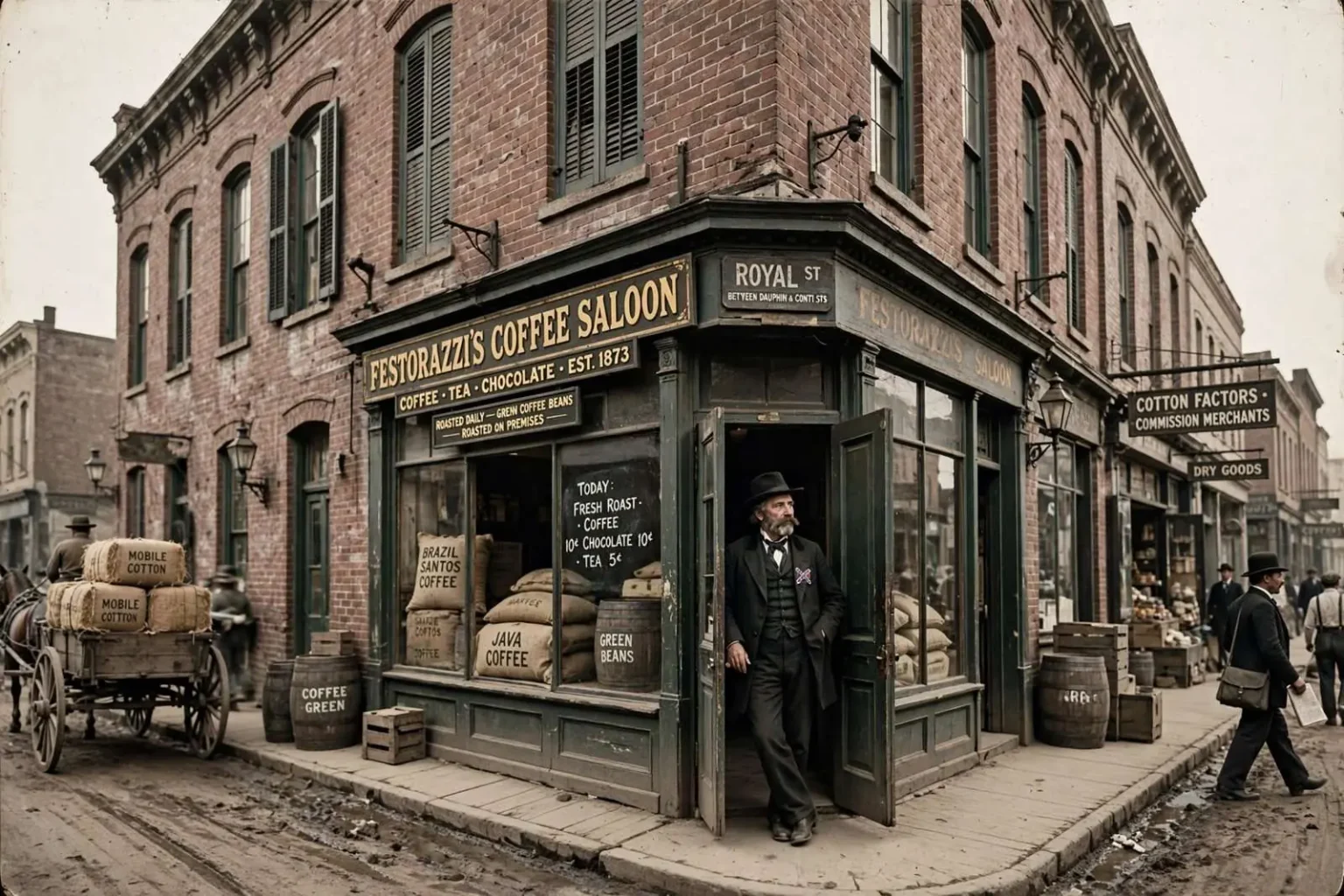
Long before coffee shops became a fixture of nearly every American downtown, Mobile had one that locals considered without equal: Festorazzis Coffee Saloon, a Royal Street institution that opened in 1873 and became a byword for the city’s 19th-century social life. The account below draws on the history recorded in Caldwell Delaney’s “Craighead’s Mobile,” a foundational text for understanding the Port City’s development.
To understand why Festorazzis mattered, one must first understand Mobile in the 1870s. The city was still recovering from the Civil War and the federal occupation that followed. The port, once the third busiest in the nation for cotton exports, had seen its trade disrupted by the Union blockade. But by the early 1870s, cotton was moving again, the railroad connections to Montgomery and New Orleans were operational, and Mobile’s population had rebounded to roughly 32,000 — making it Alabama’s largest city and a critical Gulf Coast commercial hub.
From Soldier to Shopkeeper
The saloon’s proprietor, Captain Silvester Festorazzi, was a native of Italy who settled in Mobile before the Civil War. In 1861 he organized the Southern Star Guards, a company made up largely of the city’s Italian and Spanish residents, and served as their commander. The unit was attached to the 21st Alabama Infantry Regiment and saw action through the war, with nearly every eligible Italian and Spanish resident of Mobile said to have joined its ranks.
The 21st Alabama fought at Shiloh, endured the siege of Vicksburg, and participated in the defense of Mobile Bay and Spanish Fort in the war’s final months. Festorazzi’s leadership of a company drawn from the city’s immigrant community spoke to the complex loyalties of Mobile’s foreign-born residents, many of whom had become naturalized citizens and viewed the Confederacy as their adopted country’s cause.
After the war, Festorazzi received a formal pardon issued in the name of President Andrew Johnson, restoring the rights he had forfeited by taking part in the rebellion. The pardon, dated 1865, survives in the Mobile Public Library archives — a single sheet of paper bearing the president’s signature that allowed the captain to vote, hold office, and conduct business without legal encumbrance. He returned to civilian life in Mobile and, in 1873, put up a new building on the west side of Royal Street between Dauphin and Conti streets to house his coffee business. The location placed him in the heart of Mobile’s commercial district, within walking distance of the riverfront, the customs house, and the offices of the cotton factors who drove the city’s economy.
A Coffee Saloon Like No Other
In 19th-century Mobile, the term “coffee saloon” simply meant coffee shop, and the city had several. Andrew Dacovich’s and John Lawrence’s were both well known, but neither, according to Delaney’s account, was quite like Festorazzis. Coffee was the house specialty. Captain Festorazzi bought his beans green, then parched and ground them himself, brewing no more than a gallon at a time even when business was brisk enough to require repeating the process throughout the day.
This attention to freshness set Festorazzis apart in an era when most establishments bought pre-roasted beans that could sit for weeks. The captain’s Italian heritage informed his approach; in the Mediterranean coffee culture he knew, the ritual of preparation was as important as the drink itself. Mobile’s humid climate posed a challenge for storing green beans, but Festorazzi maintained a cool, dry cellar beneath the shop where he kept his stock in sealed tin canisters, rotating inventory to ensure no batch sat longer than two weeks.
The beans came through the port of Mobile, often on the same ships that carried cotton out. Festorazzi developed relationships with importers who brought in coffee from Brazil, Colombia, and the Dutch East Indies. He favored a blend of Brazilian Santos and Java beans, roasted to a medium-dark profile that produced what regulars described as a “rich, winey body with no bitterness” — a flavor profile that anticipated the specialty coffee movement by more than a century.
Tea, chocolate and milk were also served, the milk poured into a tall glass set in a saucer with a spoon so customers could crumble cake into it. The kitchen was limited by design. There was no cooking to order beyond a cold ham sandwich, which could be served fried, with toast on the side if a customer requested it. The simplicity was deliberate — Festorazzi wanted his patrons to linger over conversation, not rush through a meal.
The Social Center of Royal Street
What made Festorazzis a Mobile institution was less the menu than the clientele. The saloon became the de facto meeting place for the city’s professional class — lawyers, judges, cotton brokers, ship captains, and politicians. Deals were struck, cases discussed, and alliances formed over the captain’s coffee. Delaney writes that “no gentleman in Mobile was considered fully informed until he had taken his morning cup at Festorazzis.”
The saloon’s layout encouraged this. A long mahogany counter ran the length of the room, with high stools for those in a hurry. Along the walls, small marble-topped tables with bentwood chairs created intimate nooks for longer conversations. Gas lamps, later replaced by electric fixtures, cast a warm glow that made the space feel like an extension of a private club rather than a public business. A large mirror behind the counter reflected the street outside, letting patrons keep an eye on the comings and goings of Royal Street without turning their heads.
Captain Festorazzi himself was a constant presence, moving between the counter and the tables, greeting regulars by name, remembering how each took his coffee. His military bearing — he wore his Confederate veterans’ badge on his lapel well into the 1890s — commanded respect, but his manner was warm and unpretentious. He knew the news of the city before it reached the papers, and a word from the captain could make or break a reputation. Judges from the nearby Mobile County Courthouse were known to stop in before morning sessions; cotton factors checked telegraph summaries of New York and Liverpool prices while they drank.
The Italian Community in Postwar Mobile
Festorazzis also served as a cultural anchor for Mobile’s Italian community, which numbered several hundred by the 1880s. Many had arrived as laborers to work on the railroads or in the shipyards, but a significant number established themselves as merchants, fruit vendors, and tradesmen. The Southern Star Guards, which Festorazzi had commanded, became a benevolent society after the war, providing mutual aid to widows and orphans of Italian veterans.
The saloon hosted the society’s meetings, and Festorazzi often acted as an informal translator and advocate for newer immigrants navigating city bureaucracy. His standing in both the Italian community and the broader Mobile establishment made him a bridge between worlds. When the city considered an ordinance in 1887 that would have restricted pushcart vendors — many of them Italian — Festorazzi lobbied successfully for an exemption for honorably discharged veterans. He also helped establish the Italian Cemetery section at Magnolia Cemetery, where many of the Southern Star Guards now rest.
The Italian presence in Mobile predated Festorazzi. Sicilian fishermen had settled along the bay as early as the 1830s, and by the 1850s, Italian merchants operated grocery stores and fruit stands throughout the city. But the war and its aftermath accelerated their integration. The Southern Star Guards’ service gave the community a visible stake in Mobile’s fate, and Festorazzi’s prominence made that stake tangible. His coffee saloon became, in effect, the community’s unofficial consulate — a place where Italian was spoken as freely as English, where letters from the old country were read aloud, and where new arrivals could find work and lodging through word of mouth.
Later Years and Legacy
Festorazzi operated the coffee saloon until his death in 1901 at the age of 78. His son, Silvester Jr., took over for a time, but the business never quite regained its former prominence. The rise of hotels with their own dining rooms, the spread of soda fountains in drugstores, and the eventual arrival of national coffee brands changed the landscape. The building on Royal Street housed a succession of other businesses — a tailor, a jewelry store, a real estate office — before being demolished in the 1960s during urban renewal that reshaped much of downtown Mobile.
Today, no plaque marks the site where Festorazzis stood. But in the archives of the Mobile Public Library’s local history collection, the captain’s pardon signed by Andrew Johnson survives, along with a handwritten ledger showing daily receipts from 1883 — most entries just a few cents per cup. They are quiet reminders of a time when a single shop on Royal Street was, for a few hours each morning, the place where Mobile made itself known to itself. The Royal Street of today, with its art galleries, antique shops, and restaurants, bears little resemblance to the bustling commercial artery of Festorazzi’s day. But the pattern he established — a local business rooted in craft, community, and conversation — remains a template for what makes Mobile’s downtown distinctive.