Fire Investigators Rule Parklane Apartments Blaze Intentional
Mobile fire officials say a blaze that sent a woman leaping from a balcony at Parklane Apartments was deliberately set, causing about $20,000 in damage.
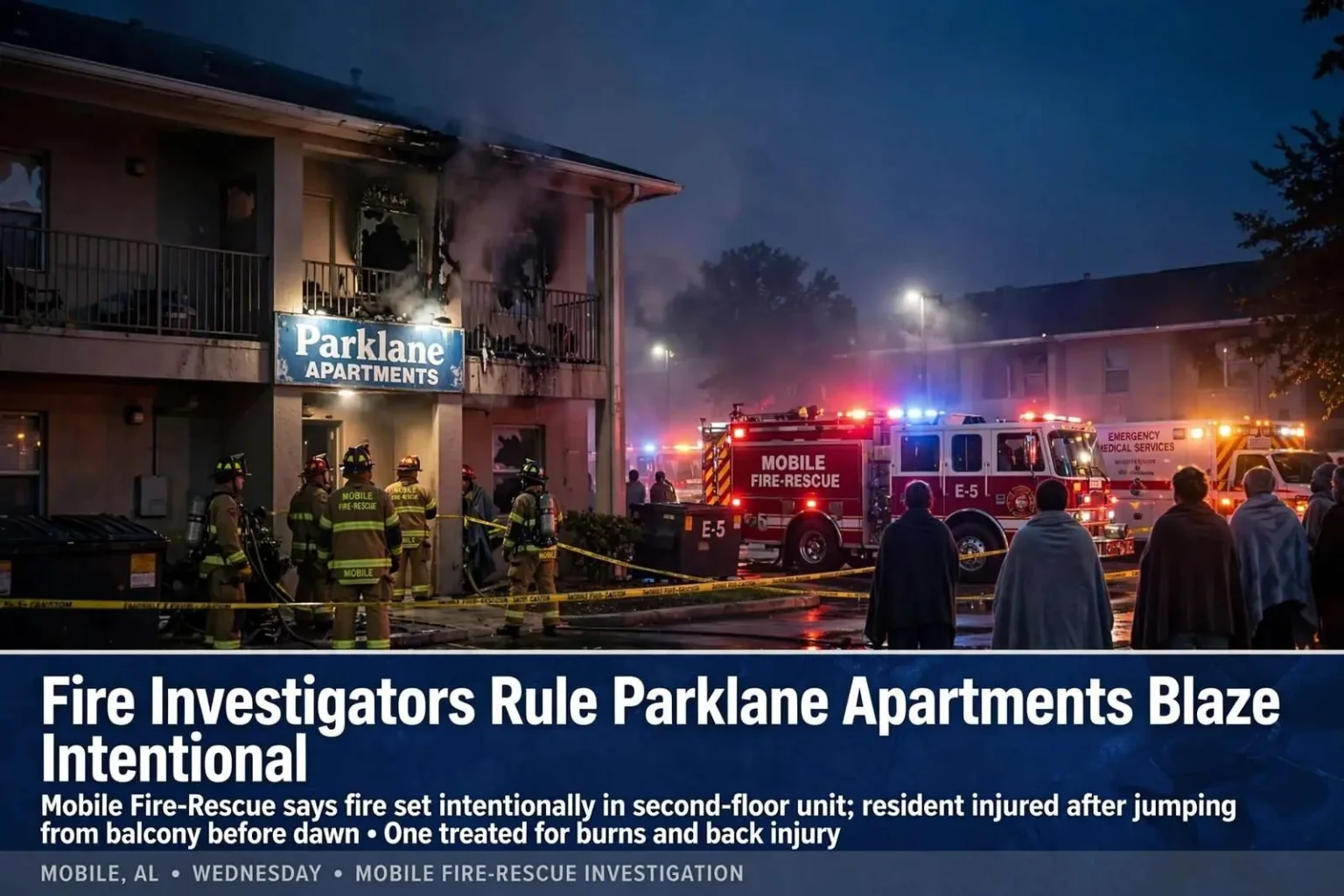
Fire investigators in Mobile have determined that a fire that broke out at Parklane Apartments earlier in the week was set on purpose, according to officials with Mobile Fire-Rescue Department. The classification closed the investigative phase of a blaze that began before dawn and sent one resident to the ground from a second-floor balcony to escape.
The blaze started before dawn, around 4:45 a.m. on a Wednesday, inside a second-floor unit at the complex located near the Greater Gulf State Fairgrounds. Fires in that hour present particular dangers: most residents are asleep, darkness complicates evacuation, and response times are tested by empty streets. The complex sits in a busy corridor of west Mobile where the fairgrounds draw large crowds for seasonal events, and neighboring buildings stood close enough that early containment mattered greatly.
A woman living in the apartment escaped by climbing over her balcony railing and dropping to the ground below, suffering a back injury and minor burns in the process. Her decision to drop rather than remain inside a burning unit likely saved her life, though the fall from the second floor left her hurt. She was among those transported by the ambulances that responded to the scene.
Department spokesman Steve Huffman said investigators believe the resident set fire to her own couch, and that the incident appears to be tied to an ongoing struggle with mental illness rather than any criminal intent involving others. Huffman noted the woman is known to experience auditory hallucinations, and that fire crews do not suspect anyone else played a role in starting the blaze.
A chaotic pre-dawn response
Neighbors described a chaotic scene as emergency crews arrived, with at least five fire engines and two ambulances responding to the complex in the pre-dawn hours. The heavy response reflects both the hour and the uncertainty of a structure fire in an occupied building, where crews must be prepared for rescues on multiple floors even when the fire itself proves small. Waking residents poured onto walkways and parking lots as sirens converged on the complex.
Firefighters were able to keep the fire contained largely to the couch and the immediate area, though smoke and heat damage spread through the rest of the unit. Smoke, not flame, does most of the damage in fires that are caught early, and the distinction between a burned couch and a destroyed apartment came down to the speed of the engine companies’ arrival. Damage from the fire is estimated at roughly $20,000.
The incident illustrates how quickly furniture fires escalate indoors. A couch burning in a living room can reach flashover conditions — the moment when every combustible surface in a room ignites at once — in a matter of minutes, and modern synthetic furnishings burn hotter and faster than the natural-fiber furniture of decades past. Fire officials routinely warn that a couch fire left unattended for even a short time can render an apartment unsurvivable.
What happens next
With the cause now officially classified as intentional, the matter has been turned over to the Mobile County District Attorney’s Office, which will decide how to proceed. Huffman said that in cases like this, where a fire appears linked to a mental health crisis rather than malice, authorities often lean toward connecting the individual with treatment and support services rather than pursuing criminal charges.
That discretionary space exists because prosecutors weigh intent, capacity and public safety together. A fire that endangered a building full of neighbors is a serious matter, but charging decisions in cases involving acute mental illness typically balance accountability against the likelihood that treatment, supervision or civil commitment will prevent a recurrence. The District Attorney’s Office will review the investigative file before determining whether charges are warranted.
Fire officials did not indicate whether the resident faced any immediate danger requirements or evaluation as a result of the incident, but said the department’s primary concern was ensuring she received appropriate care following her injuries. Her injuries — a back injury and minor burns — were treated after her escape, and her condition has been part of the ongoing consideration of how the case proceeds.
A busy summer for Mobile fire crews
The incident adds to a string of apartment and residential fires that have kept Mobile-area fire crews busy this summer, and comes as local officials continue to highlight the intersection between untreated mental illness and public safety incidents in the community. Summer fire seasons strain departments with a mix of causes, from cooling equipment failures to cooking accidents, and each occupied-building fire demands a full assignment of apparatus regardless of its ultimate size.
The connection between mental health crises and emergency response has become a growing subject of public discussion in Mobile and cities across the country. Departments and police agencies increasingly encounter individuals in crisis during calls that begin as something else entirely, and city leaders have debated how to route such calls toward treatment resources rather than repeated emergency responses. This fire, arising in the middle of the night from a couch set alight by a resident experiencing hallucinations, fits the pattern officials describe.
No other residents of the apartment complex were reported injured, and the building remained otherwise occupied following the fire. Residents of neighboring units returned to their homes after crews cleared the scene, though some faced lingering smoke odor and the disruption of a damaged unit in their building. The Red Cross and similar organizations typically assist families displaced by apartment fires in Mobile, though in this case the fire remained confined to a single unit.
Mobile Fire-Rescue reminded residents that furniture fires can spread rapidly in enclosed living spaces and urged anyone experiencing a mental health crisis to seek help rather than resorting to dangerous behavior. Fire officials also encourage apartment dwellers to know two ways out of their unit, to keep balcony areas clear of combustibles, and to treat any smoke alarm activation as a reason to leave immediately — lessons that, in this case, one resident learned from a second-floor railing with flames behind her.
The five-engine assignment that rolled on the Parklane fire is standard for a reported structure fire in an occupied Mobile building, and it illustrates the scale of resources a single alarm can consume. Each engine carries a crew of firefighters and hundreds of gallons of water; ambulances stage for potential casualties; and a battalion chief assumes command of the scene. When the fire proves small, as this one did, most of that apparatus is released within the hour, but the department staffs for the fire that might have been, not the one that was.
Fires and the fairgrounds corridor
The neighborhood around the Greater Gulf State Fairgrounds is a dense patchwork of apartment complexes, duplexes and older commercial buildings, the kind of housing mix where fire spreads quickly if a blaze reaches common walls or shared attics. Fire inspectors keep particular attention on multifamily buildings in such corridors, and firefighters who work the area know its hydrant gaps and narrow drive approaches well. The quick containment at Parklane credited to early-morning crews prevented a routine couch fire from becoming a multiple-family displacement.
Mental health advocates in the Mobile area point to cases like this when arguing for expanded crisis services. A person experiencing auditory hallucinations in the middle of the night, with no one to call and no plan, can turn a private struggle into a public emergency within minutes. Mobile’s crisis response resources exist, advocates say, but awareness of them remains limited, and the people most at risk are often the least likely to know where to turn before a situation escalates to sirens and fire engines.
The Department’s public messaging after the fire leaned into that reality. Rather than focusing solely on the fire’s classification as intentional, officials emphasized the path they wished had been taken: a call to a crisis line, a conversation with a provider, a trip to an emergency room. The cost of that night — a woman’s injuries, $20,000 in damage, five engines in the dark — dwarfs the cost of the phone call that could have prevented it.
For Parklane residents, the episode ends with a damaged apartment, a neighbor in need of care, and a building that stood. For the fire department, it joins a summer’s worth of responses that have tested crews and, in the telling of officials like Huffman, underscored an uncomfortable truth: that Mobile’s fire calls increasingly begin not with faulty wiring or unattended cooking, but with the untreated struggles of the people inside the burning rooms.
Fire officials closed their statement with a reminder aimed at every resident of the complex and the city beyond it: working smoke alarms and a practiced escape plan remain the difference between a close call and a tragedy. The woman who climbed her balcony railing and dropped to the ground had no time to consult a plan, but her instinct to leave immediately — rather than pause, gather belongings, or wait for rescue — is exactly the behavior firefighters hope every apartment dweller would repeat in her place.