Mobile Employers Say ‘Soft Skills’ Gap, Not Technical Skills, Drives Turnover
Mobile-area employers say tardiness, absenteeism and weak teamwork, not lack of technical skills, are the leading causes of new-hire turnover.
Mobile-area employers say the biggest threat to keeping new hires on the job isn’t a lack of technical know-how — it’s a shortage of what workforce trainers call “soft skills,” the everyday habits like showing up on time, following instructions and working well with others. Across the industries that power the local economy, from shipyards to hospitals to construction sites, trainers and human resources managers describe the same pattern: workers who can learn a trade but struggle with the workplace behaviors that keep them employed. The issue has become central to how the region prepares its workforce for the large industrial projects anchored along the Mobile River and beyond.
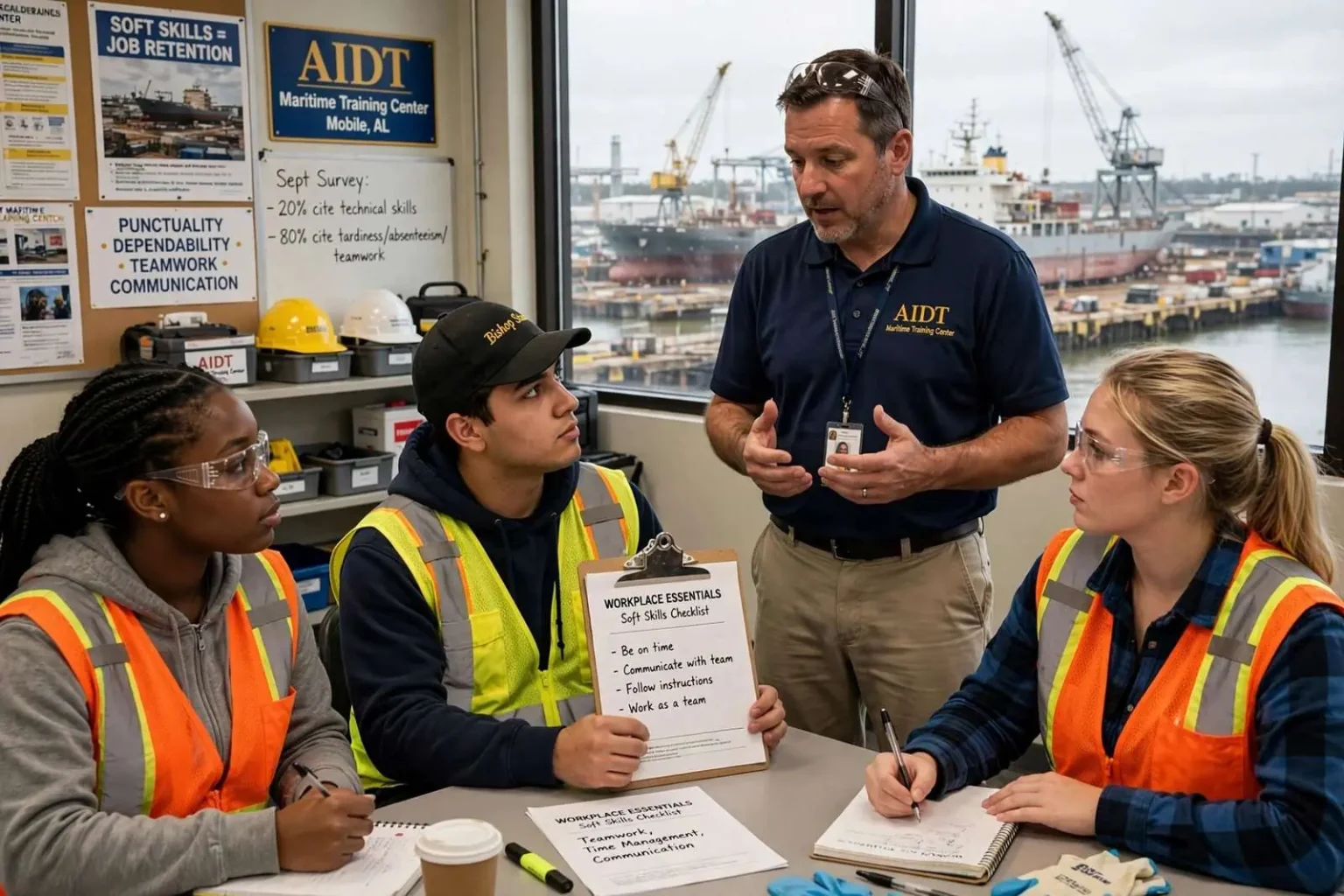
At the AIDT Maritime Training Center in Mobile, project coordinator and master trainer Tony Hopper said tardiness and absenteeism remain the leading cause of turnover across the maritime trades, where industry-wide turnover runs near 38 percent. Against that backdrop, the center’s numbers stand out: roughly 87 percent of its graduates are still employed by the same company six months after being hired. Hopper credits that retention rate largely to the program’s emphasis on soft-skills training alongside technical instruction, an approach that treats punctuality, communication and attitude as skills to be taught rather than traits to be assumed.
Soft skills are generally described as the personal habits and attitudes that shape how an employee interacts with coworkers and approaches the job, distinct from the more easily measured technical or “hard” skills tied to a specific trade. A welder’s certification proves the hard skill; whether that welder arrives on time, accepts criticism and cooperates with a crew is the soft side of the ledger. Employers say the second category determines careers more often than the first, particularly for workers in their first formal jobs.
What Employers Say They Need
Ryan Lee, workforce development manager for Mobile shipbuilder Austal USA, keeps a short list of must-have soft skills: work ethic, dependability, basic comprehension, the ability to follow instructions, critical thinking and leadership. None of those items appear on a technical certification, yet Lee said they are what determine whether a new hire succeeds on a production floor where thousands of workers coordinate on a single vessel. He described the gap as a systemic issue affecting employers across Mobile and beyond, not one confined to shipbuilding.
The scale of the problem shows up clearly in survey data gathered locally. A September 2014 survey of 27 area employers conducted by the Southwest Alabama Workforce Development Council found that fewer than 20 percent of respondents cited a lack of technical skills as the main reason for terminating young employees between the ages of 18 and 24. The employers, spanning aviation, healthcare, construction, maritime and manufacturing, instead pointed overwhelmingly to tardiness, absenteeism and an inability to function as part of a team, according to the council’s executive director, Laura Chandler. In other words, when young workers lost jobs in Mobile, it was rarely because their hands could not do the work.
Training Institutions Respond
The findings have pushed local training institutions to respond directly, weaving workplace behavior into curricula that once covered only technical content. Kathy Thompson, dean of technical education and workforce development at Bishop State Community College, said employers consistently emphasize that new hires need to do more than simply show up — they need to engage and function as team players. In response, Bishop State plans to launch a required “Workplace Essentials” course this fall covering problem solving, workplace conduct, goal setting, interpersonal skills, teamwork, time management and decision-making. The college will also fold the same material into its existing technical programs, so the lessons reach students already deep in their chosen trades.
Bishop State is not acting alone. Similar coursework has recently been added at the Alabama Aviation Center and at Enterprise State Community College’s Mobile satellite campus, extending the approach to aviation maintenance and other technical fields. Soft-skills instruction already makes up a substantial share of AIDT’s statewide training curriculum, meaning the state’s own industrial training agency treats workplace behavior as a core subject rather than an afterthought. The pattern across these institutions is consistent: the earlier and more explicitly the habits are taught, the better graduates hold onto jobs.
Coaching Beyond the Classroom
At the Maritime Training Center, the work extends past scheduled lessons. Industry coordinator Heidi Kearton has taken to informally counseling students on her own time about interview attire, resume writing and follow-up etiquette — practical details that can decide whether a qualified candidate ever gets a foot in the door. Trainers say that kind of coaching addresses a blind spot for many first-generation workers and career changers, who may have the technical ability an employer needs but little experience with the unwritten rules of getting hired and staying hired.
The gap reaches beyond the trades into office and technology careers as well. Margaux Kaynard, an HR and recruiting executive for an outsourcing firm expanding its Mobile operations with more than 100 open positions, said the company looks for candidates who combine strong technical ability with the communication skills to explain their work clearly to clients. That pairing, she said, is often harder to find than raw coding talent alone. Her observation mirrors what the trades have found: technical skill gets a candidate considered, but soft skills get the candidate hired and kept.
A Statewide Push
Workforce officials say the push toward soft-skills training reflects a broader statewide effort, with the Alabama Community College System and the Alabama Board of Education both working to address the gap as part of the state’s workforce development priorities. Alabama’s economic development strategy leans heavily on convincing large manufacturers that the state can supply a reliable workforce, and employers who publicly report turnover driven by behavior rather than skill threaten that pitch. Embedding workplace essentials into community college and training center programs is the state’s most direct answer.
For Mobile, the stakes are amplified by the scale of the industries hiring here. Shipbuilding, aviation, healthcare and logistics all draw from the same pool of young workers, and each new hire who leaves early because of attendance or attitude represents a recruiting and training cost the employer absorbs all over again. The 38 percent industry-wide turnover in the maritime trades illustrates the churn, and the training center’s 87 percent six-month retention figure illustrates what deliberate soft-skills instruction can do against it.
The message local employers and trainers are converging on is straightforward: technical skills can be taught on the job faster than habits can be fixed after hiring, so the habits need attention first. Programs like the one at Bishop State, the coaching at AIDT and the coursework spreading through the Alabama Aviation Center and Enterprise State’s Mobile campus all aim to deliver those habits before a worker’s first day rather than after a first termination. For the region’s employers, closing the soft-skills gap has become as important to workforce development as any piece of technical equipment in the classroom.
The emphasis on workplace behavior is a shift from how workforce training operated a generation ago, when programs measured success almost entirely by the technical skills a student could demonstrate. Alabama’s training infrastructure has evolved alongside that thinking. AIDT, the state’s workforce training agency, has spent decades preparing workers for manufacturers arriving in Alabama, and its experience across hundreds of plant openings has reinforced the same lesson employers repeat in Mobile: production lines stall less often from missing certifications than from missing dependability.
The local economy gives that lesson particular weight. Mobile’s shipbuilding and maritime sector supports thousands of jobs along the waterfront, and Austal USA’s production operations depend on crews whose reliability determines whether schedules hold. Hospitals across the city, construction firms working across the Gulf Coast and aviation employers training new technicians all draw from the same labor market, which is why employers in five different sectors responded to the workforce council’s survey with such similar concerns. When 18- to 24-year-old employees lose jobs across aviation, healthcare, construction, maritime and manufacturing for the same reasons, the pattern points to a preparation gap rather than an industry-specific one.
Trainers also note that soft skills can be practiced and improved like any other skill, which is the premise behind required courses such as Bishop State’s Workplace Essentials. Goal setting, time management and teamwork exercises give students repetitions before a paycheck depends on them, and workplace conduct standards make explicit what many employers otherwise leave unspoken. The institutions adding this content are effectively moving the first weeks of on-the-job correction into the classroom, where a mistake costs an assignment instead of a job.
Employers who have partnered with the training programs describe the results in practical terms: fewer no-shows in the first weeks, more productive crews and smoother handoffs between shifts. Those improvements compound across a large workforce, which is why the region’s largest employers have become some of the strongest advocates for embedding workplace essentials into every technical program the area’s colleges and training centers offer.