Bank-Owned Saltaire Property on Mobile Bay Sells to Fairhope Builder
A stalled 287-acre bayfront development sold for more than $1.2 million, while a Gulf Shores restaurant, a Foley entertainment complex and a reggae-themed eatery kept the coastal real estate market humming.
One of the Mobile Bay area’s most closely watched stalled developments changed hands this week, headlining a busy stretch of coastal real estate activity from the causeway to the beaches.
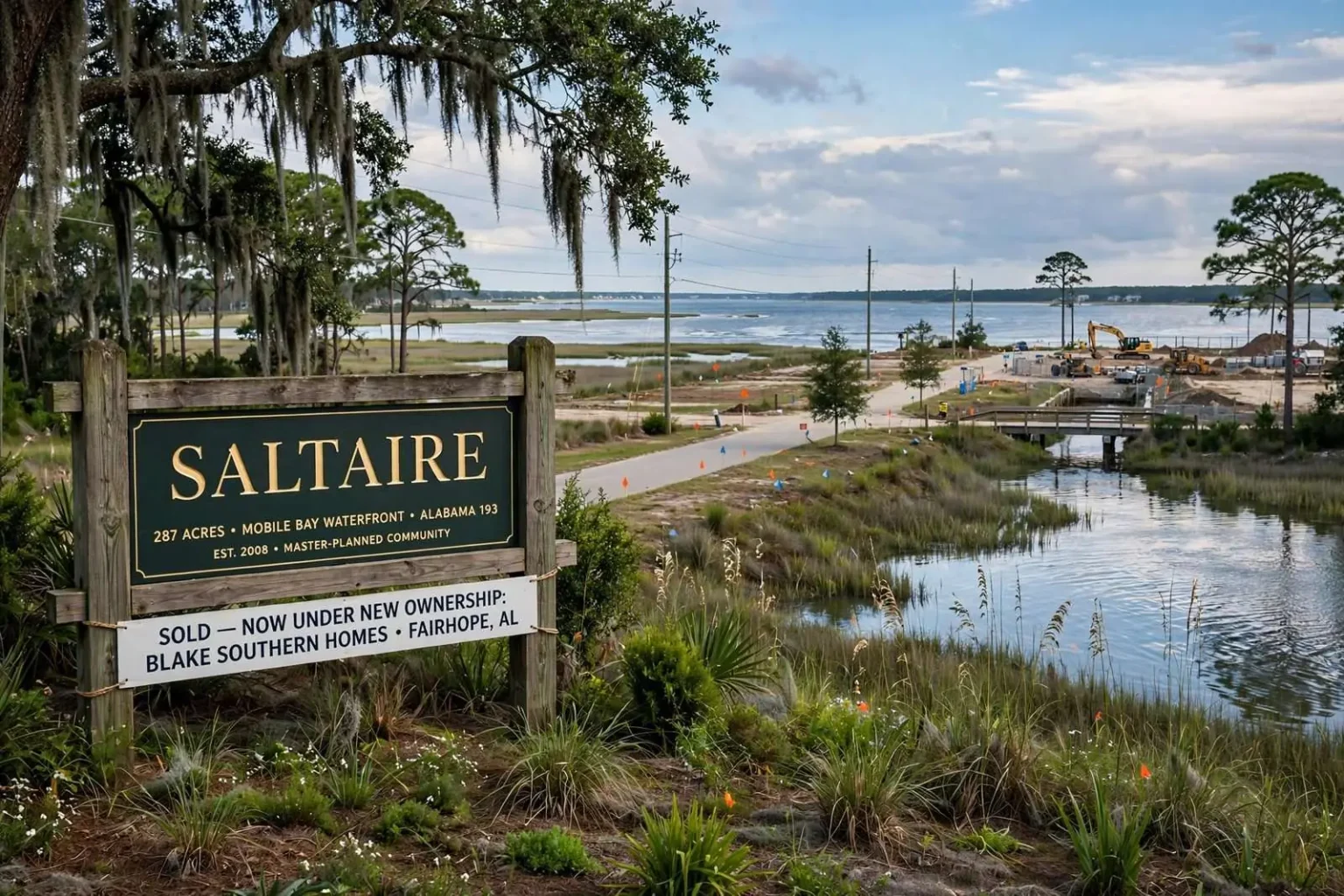
Saltaire finds a new owner The bank-owned Saltaire property on Mobile Bay sold to Blake Southern Homes for more than $1.2 million, according to court records and Blake Whitney Thompson, a partner in the Fairhope-based home building firm. Thompson is also managing director of Black Orchid Equity of St. Petersburg, Florida, which acquires asset-based businesses and real estate.
The purchase includes 287 acres off Alabama 193, along with 100 developed home lots and 12 waterfront lots. John Vallas of Vallas Realty represented the sellers, and Surety Land Title handled the transaction.
The location is central to the property’s story. Alabama 193 runs south from the Mobile area through Theodore and down toward the bay communities of southern Mobile County, crossing some of the most scenic waterfront acreage on the western shore. Land along that corridor offers residents a bayfront lifestyle at a fraction of Eastern Shore prices, with a commute that puts downtown Mobile within reasonable reach. Buyers who might otherwise have joined the migration across the Causeway to Daphne or Fairhope had, in the original vision for Saltaire, a western-shore alternative close to home.
Blake Southern Homes’ builder partners are Bill Spriggs and Mark Schlauder, who also own Colony Homes; they planned to begin construction on several spec homes with a goal of building 100 houses in the mixed-use community during the year.
Speculative construction — homes built on the builder’s capital before a buyer is under contract — represents a calculated bet on demand. In a recovering market, spec homes serve as instant inventory for relocating families and buyers who cannot wait out a six-month build, and their success is often the clearest signal that a subdivision has found its footing. A goal of 100 homes in a single year would rank the effort among the busiest start-up communities on the bay.
The investors framed the project as a bayfront alternative to crossing the bay to subdivisions on the Eastern Shore. They intended to use the master plan originally drawn for what was to be a 500-acre town with 1,250 homes, a fitness center, park, stores, two stocked lakes and restaurants.
Ambitious mixed-use plans of that scale were the signature of the boom years along the Gulf Coast, when developers envisioned self-contained communities that blended housing, recreation and retail. The depth of that ambition — a fitness center, stocked lakes, restaurants and shops woven among 1,250 homes — reflected the confidence of an era when coastal Alabama was adding residents faster than nearly any region in the state. The infrastructure that survives such projects long after the plans fade is often their most durable legacy: roads graded and paved, lakes excavated, utilities stubbed to empty lots, all waiting for the market to return.
The buyers’ decision to work within that existing master plan rather than redraw it speaks to its enduring logic. Entitlements, engineering and site work represent years of accumulated investment, and a plan that places waterfront lots around stocked lakes with a town-center core remains a sound template even after the market that produced it has passed. Adapting the phasing — starting with spec homes on developed lots rather than launching all of the amenity package at once — fits a recovery-market playbook: prove demand section by section, then expand.
About nine custom homes had been built at Saltaire before work stopped in 2008, when a local lender pulled financing. By then roughly $19 million had been invested in infrastructure, including the lakes, a bridge and roads. Developer Logan Gewin retained more than 100 acres on the southern side of the property.
The collapse of the original project traced the arc of the national real estate downturn with painful precision. When credit markets seized in 2008, community banks across the Gulf Coast called in construction loans, and developments that depended on phased financing simply stopped — often leaving finished roads, underground utilities and entrance monuments leading to empty lots. Saltaire’s roughly $19 million in infrastructure meant the new owners acquired land where the most expensive and time-consuming work had already been completed, an advantage that raw acreage elsewhere could not match.
Bank-owned sales of that kind also reset the economics. The original developer had carried land costs priced for the boom; the lender’s disposition of the property allowed new builders to enter at a basis that made competitive home pricing possible again. For buyers who had watched the project stall, the transaction represented the difference between a frozen asset and a functioning neighborhood — streets that would fill with construction crews rather than sit empty behind locked gates.
Gewin’s retained acreage on the southern side of the property preserved a piece of the original vision for the founding family, and left open the possibility of future phases tied to the community’s progress. Large retained tracts beside active subdivisions are common in Gulf Coast developments, giving original landowners a stake in the success of the buyers who take over the first sections.
Gulf Shores Activity
In Gulf Shores, the owners of Mojo’s paid $335,000 for the former Smart & Sassy store and two lots behind it, with plans to open in front of the Gulf Coast Zoo. David Swiger of Swiger & Co. Realtors handled that transaction.
Swiger also reported that Luna B’s Nursery on Alabama 59 had drawn a new owner from north Alabama and was set to reopen.
Nursery and garden businesses occupy a particular niche in coastal economies, serving landscapers, beachfront property owners and the constant replanting that salt air and storms demand. A buyer arriving from north Alabama to take over an established coastal nursery suggests that operators in other parts of the state saw opportunity in the Gulf Shores market — precisely the kind of outside investment that a recovering local economy works hardest to attract.
For real estate professionals along the coast, a week that produced both a seven-figure land sale and a handful of small commercial deals was notable for its breadth. The market had spent years generating little activity of either kind: large developments sat frozen in lenders’ portfolios, and small business owners hesitated to sign anything longer than a lease. Seeing both ends of the market move in the same week offered the clearest evidence yet that capital — from out-of-state equity groups to hometown restaurant operators — had decided the Gulf Coast’s turnaround was real.
The Gulf Shores deals, modest next to Saltaire’s seven-figure sale, tell their own story about the pace of recovery along the coast. Small commercial transactions — a restaurant taking over a former retail store, a nursery changing hands — are the fine grain of a local economy, and their revival usually follows the larger residential market by a year or two. When owners of established businesses start buying their own buildings again, it signals confidence that the tourist trade and the year-round population will support the investment.
Alabama 59, the highway corridor where the nursery sits, is the commercial spine of Gulf Shores, carrying beach traffic from the interstate all the way to the sand. Property along that route lives and dies by the visitor economy, and a reopened nursery adds to the mix of homegrown businesses that serve both tourists and the growing number of full-time residents who call the beach communities home. The city’s growth in recent years has steadily blurred the line between resort town and suburb, and the retail strip that follows the highway reflects that evolution.
The planned Mojo’s location in front of the Gulf Coast Zoo placed it along another of the city’s destination anchors. Attractions generate foot traffic that neighboring businesses feed on, and restaurant operators who buy their own property near a steady draw are positioning for the long season rather than a single summer. Owning the land and lots behind the store also gives the operators room to expand parking or additional facilities as demand allows — flexibility that leasing never provides.
A Coast Coming Back to Life
Together, the week’s transactions sketched a real estate market in transition. The Saltaire sale cleared one of the largest question marks hanging over the Mobile Bay market, converting a stalled, bank-held development into an active construction plan with a specific goal of 100 homes. Around the bay, smaller deals in Gulf Shores showed operators of established businesses betting their own money on the coast’s future.
Court records that accompanied the Saltaire sale will continue to be watched by industry observers, because the terms and structure of bank dispositions of this size set reference points for other lenders still holding distressed coastal assets. Every successful sale of a stalled development raises the value of the remaining inventory of distressed land, as buyers and sellers alike gain a fresh, market-tested price for what such properties are actually worth in the current environment. In that sense, the Saltaire transaction does work beyond its own boundary lines: it reprices, at least provisionally, a whole category of Gulf Coast real estate that had gone unpriced for years.
For the communities along the Causeway and the bay’s western shore, the stakes were more than financial. Developments like Saltaire were designed to knit vacant acreage into the region’s fabric — adding tax base, residents and commercial activity to southern Mobile County. A revival of the project under new ownership promised to resume that process, with lakes, roads and bridge already in place waiting for the houses to follow.