Prichard’s ‘Get Hired’ Job Fair Caps Off Week-Long Workforce Training Push
Prichard hosted a job fair with employers like Alorica and Franklin Primary Health Center after a week-long soft skills training workshop for residents.
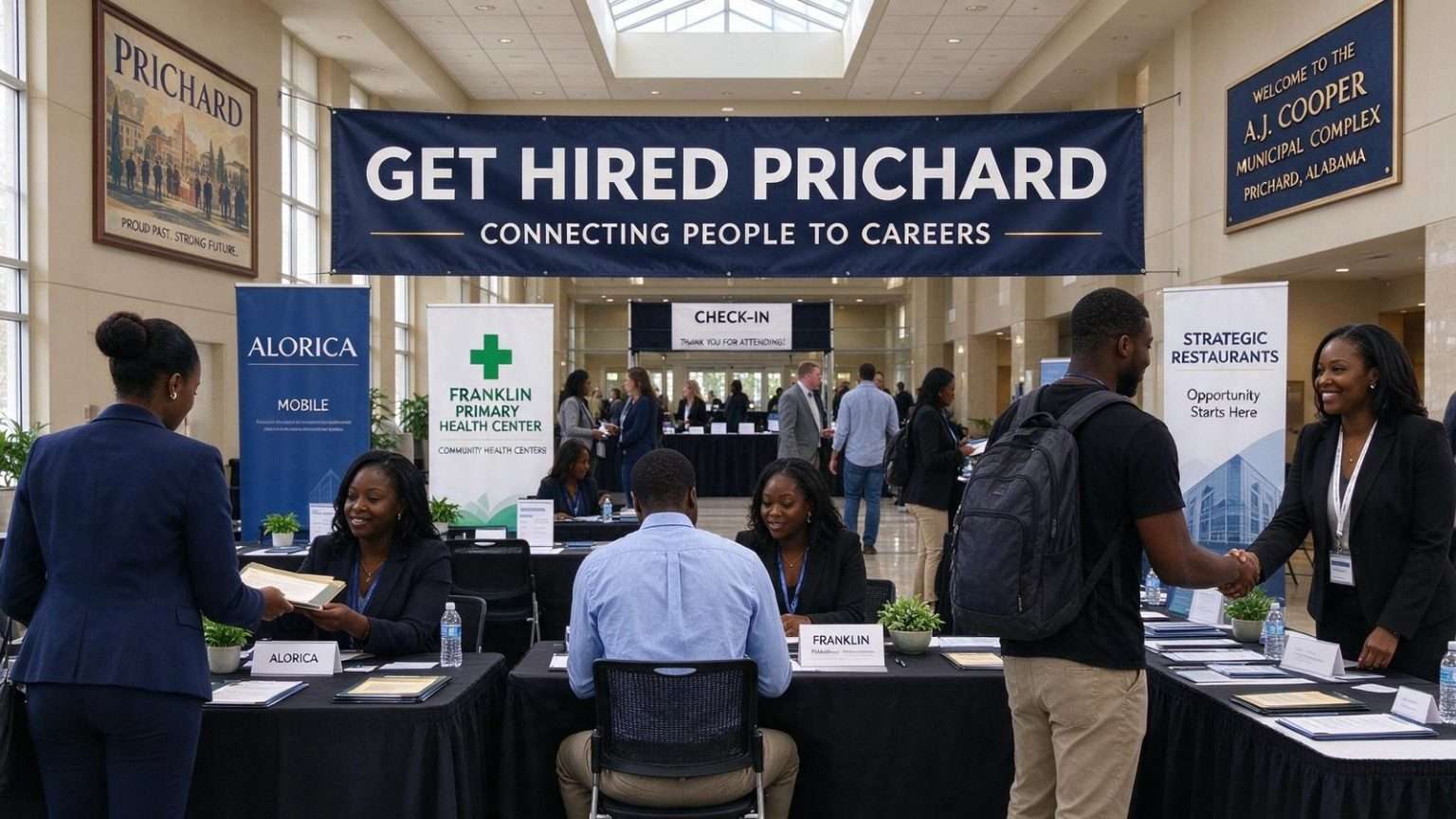
Employers from across southwest Alabama gathered at Prichard’s A.J. Cooper Municipal Complex for a four-hour “Get Hired Prichard” job fair, part of the city’s broader push to connect residents with local employment opportunities.
Representatives from Alorica, Strategic Restaurants, Franklin Primary Health Center and other area businesses were on hand to meet job seekers. The fair served as the capstone event for a week-long soft skills training workshop that had kicked off the previous Monday.
According to workshop organizer Helen Wright, 78 people registered for the training, which was designed to help participants sharpen the kind of interview and workplace-readiness skills employers often look for before making a hire. The pairing was deliberate: residents who spent the week practicing resumes, interview answers and workplace habits walked into the fair on its final day already primed to make a better impression than a cold walk-up ever allows.
That structure — training first, hiring event second — has become the preferred model for workforce programs across the country, and for good reason. Job fairs alone tend to produce stacks of applications and few hires, because many applicants lack the presentation skills that turn a conversation into a job offer. By putting 78 residents through a week of preparation before employers arrived, the organizers aimed to change the odds on both sides of the table.
The Employers in the Room
The mix of employers reflected the actual job base of the Mobile area. Alorica, a national customer-experience and call center company with a major Mobile operation, hires at volume and offers entry-level positions with training provided, the kind of openings that suit workers entering or re-entering the workforce. Call center work has been one of Mobile’s steady sources of jobs for two decades, paying modest wages but requiring no advanced credentials and offering schedules that many workers can build around family obligations.
Strategic Restaurants, a franchise restaurant operator, represents the food service side of the local economy, an industry that perpetually hires and promotes from within. Entry-level restaurant work is often dismissed, but the industry’s ladder — crew to shift leader to management — is real, and for workers without degrees it remains one of the most accessible paths to a salary. Franklin Primary Health Center, meanwhile, brought the healthcare sector into the room: a community health organization that has served the Gulf Coast for decades and employs everyone from administrative staff to clinical professionals across its network of clinics.
For job seekers, having those employers in one room for four hours compressed a job search that might otherwise take weeks of separate applications into a single afternoon of conversations.
City officials described the job fair and the workshop that preceded it as part of Prichard’s ongoing workforce development efforts, an initiative aimed at improving employment prospects for residents in a city that has faced economic headwinds in recent years.
Prichard’s economic story is well known across Alabama. Once a thriving industrial suburb of Mobile with a population that peaked near 50,000 in the 1960s, the city spent decades shedding manufacturing jobs and residents, and its population has fallen to roughly a quarter of that peak. The loss of industry hit the city’s tax base hard, and the city’s well-publicized financial struggles — including a nationally watched pension crisis that forced cuts to retiree benefits — made economic development a matter of survival rather than ambition.
Workforce development is one of the few levers a small city can pull directly. Prichard cannot annex its way to growth or lure a factory with incentives the way larger cities can, but it can connect its residents — many of whom commute to jobs in Mobile and across the county — to the employers who are hiring, and it can prepare those residents to win the jobs they apply for. Programs like the “Get Hired” fair operate on exactly that logic.
The A.J. Cooper Municipal Complex, the city hall campus that bears the name of a former mayor, has become the hub for that work, hosting the training sessions, fairs and public meetings that knit the city’s civic life together. Holding the fair there signals that the city government itself is behind the effort, not merely permitting it.
Apprenticeships Underway Next Door
The job fair coincided with another workforce initiative unfolding nearby. More than 20 students were working toward pipefitter apprenticeships with shipbuilder Austal USA inside Prichard’s old City Hall building at the same time the job fair was underway, underscoring the range of career pathways the city has tried to promote alongside traditional job placement, from immediate hiring events to longer-term technical apprenticeship programs.
The Austal connection matters. The Mobile shipbuilder, which constructs vessels for the U.S. Navy at its massive yard on the Mobile River, has struggled at times to fill the skilled trades positions its production lines require, and pipefitters are among the trades in constant demand. An apprenticeship hosted inside Prichard’s old City Hall puts shipyard-track training directly inside a community that needs the jobs, and students who complete the program step into work that pays well above the area’s service-sector wages.
It also diversifies the pipeline. Shipyard trades have historically drawn workers from across the region, and communities like Prichard — with high unemployment and a short commute to the yard — are natural sources of talent that the industry has not always reached. Placing the training site in the city removes the transportation barrier that keeps many would-be apprentices out of programs offered across the bay or downtown.
The two efforts running in parallel illustrate a division of labor in workforce strategy. A job fair solves for immediacy: residents need work now, employers have openings now, and a four-hour event can match the two. An apprenticeship solves for trajectory: a student spends months learning a trade and exits with skills that compound over a career. A city of Prichard’s size needs both, and officials have increasingly framed them as parts of a single pipeline rather than competing programs.
Skills Training as Economic Strategy
The 78 residents who registered for the week-long workshop represent more than a headcount. Soft skills training — punctuality, communication, interview technique, workplace expectations — addresses the gap that employers report most consistently when they describe why entry-level hires fail: not technical inability, but unpreparedness for the routines of steady work. Programs that teach those habits before the first day on the job measurably improve retention, and retention is what converts a hire into a career.
Officials have pointed to partnerships with local employers and technical training providers as central to Prichard’s efforts to rebuild its employment base. Programs like the soft skills workshop and the accompanying job fair are intended to be recurring components of that strategy, giving residents multiple entry points into the local job market depending on where they start.
The week’s events also say something about how small-city economic development has changed. A generation ago, a city like Prichard would have recruited with tax abatements and industrial park land, hoping to import an employer. Today the recruitment plays out person by person: prepare residents, connect them to the employers already hiring in the region, and let the wages flow home. The employers at the fair — a call center, a restaurant operator, a health center — were already in the Mobile area; the fair’s work was making sure Prichard residents had their shot at those jobs.
The model depends on repetition. One fair and one workshop change a few dozen trajectories; a standing cycle of them, run every quarter with rotating employer partners, changes a city’s employment base over time. Officials described the events as recurring components of the workforce strategy, and the old City Hall apprenticeship site — a building the city once worked out of — has been converted into exactly the kind of permanent training infrastructure that outlasts any single event.
For the residents who spent the week preparing and the afternoon meeting employers, the payoff is individual and immediate: an application that lands, an interview that goes well, a start date. For the city, the arithmetic is slower but real. Every Prichard resident who moves from unemployment into steady work is a household with income, a family with stability, and a city with a slightly stronger base than the year before. That is the theory behind “Get Hired Prichard,” and last week’s events put it into practice — 78 residents trained, employers in the room, and apprentices building shipyard careers down the street.
The employers’ stakes are worth noting as well. Companies like Alorica live and die by hiring pipelines, and a community event that pre-screens and pre-trains applicants lowers their cost per hire. Franklin Primary Health Center’s presence reflected the healthcare sector’s chronic staffing needs, which reach from clinical roles into the front-desk and administrative positions that keep a network of clinics running. Restaurant operators face some of the highest turnover rates in the economy and treat every hiring pool as a resource. A city that delivers prepared applicants is, in effect, doing recruiting work the employers would otherwise pay for, and that is what keeps them coming back to the next fair.