House District 98 Race Pits Bracy Against Biggs and Flott Over Prichard Utilities, Jobs
Three candidates for Alabama House District 98, covering Mobile, Prichard and Saraland, clashed over utility reform, wages and taxes ahead of the vote.
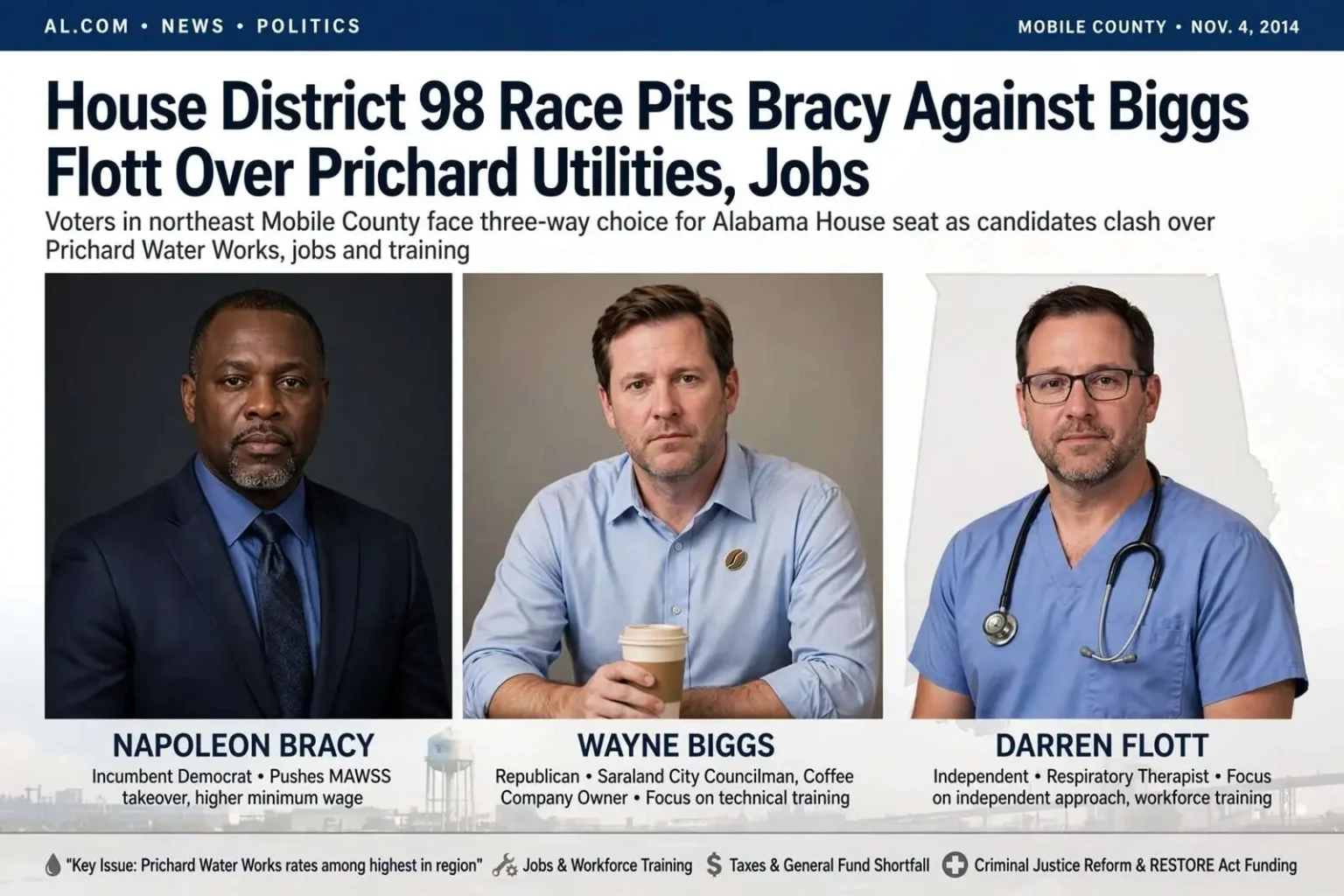
Voters in a slice of northeast Mobile County that stretches through parts of Mobile, Prichard and Saraland faced a three-way choice for their seat in the Alabama House of Representatives, with incumbent Democrat Napoleon Bracy defending his record against Republican Wayne Biggs and independent candidate Darren Flott.
Biggs, a Saraland city councilman who also runs a coffee company, framed his campaign around economic development and technical training, pointing to dual-enrollment programs that let high schoolers pair a diploma with a trade certification such as welding. Bracy, seeking another term, pointed to his push for workforce development and a higher minimum wage for companies doing business with the state, arguing the district’s employers too often bring in outside workers because the local labor pool isn’t trained for the jobs available. Flott, a respiratory therapist who mounted an independent bid after being disqualified from the Democratic primary over a past write-in campaign, echoed much of Bracy’s platform while casting himself as more independent-minded.
The sharpest divide centered on the long-running dispute over the Prichard Water Works and Sewer Board, whose customers pay some of the highest utility rates in the region. Bracy has spent much of his term pushing legislation that would let the Mobile Area Water and Sewer System absorb the Prichard system, an effort voters approved twice only to see it blocked first by a state Supreme Court ruling and then by a long-term management contract Prichard’s board had already signed. Bracy said he was reviewing whether that contract could withstand a legal challenge, calling the rate burden on Prichard customers close to a civil rights issue given how it falls on a lower-income community. Biggs countered that he had met repeatedly with Prichard’s mayor, who opposed a MAWSS takeover, and said he would not support handing over tens of millions of dollars in utility assets without a plan to strengthen Prichard, Chickasaw, Satsuma and Creola economically first. Flott said he would defer to conversations with Prichard’s mayor and council before taking a position.
On education, Bracy and Flott both singled out the Alabama Accountability Act, the school-choice law that offers tax credits to families who move children out of struggling public schools, as the Legislature’s biggest recent misstep. Biggs instead pointed to the state’s adoption of Common Core academic standards, saying lawmakers should have stepped in to stop it.
All three candidates said they opposed raising taxes to address a projected shortfall in the state’s General Fund, though their proposed fixes differed: Bracy wants to close corporate tax loopholes for out-of-state businesses, Biggs wants to audit state programs for waste, and Flott said he would need to study the budget further. The candidates were similarly aligned on criminal justice, each favoring alternative sentencing and expanded vocational training over building new prisons, and each said money from Alabama’s share of BP oil spill fines under the RESTORE Act should be steered toward economic development and job training in the district.
About the RESTORE Act
The RESTORE Act, passed by Congress in 2012, directs 80 percent of the Clean Water Act civil and administrative penalties paid by parties responsible for the 2010 Deepwater Horizon oil spill into a Gulf Coast Restoration Trust Fund, which is divided among the five Gulf states for environmental and economic recovery projects. Members of the Alabama House of Representatives serve four-year terms, and the general election in this race was held Nov. 4, 2014.