Political Observers Name South Alabama’s Rising Stars
A survey of political insiders across Mobile and Baldwin counties turned up a long list of up-and-coming names, from young council members to legislators eyeing higher office.
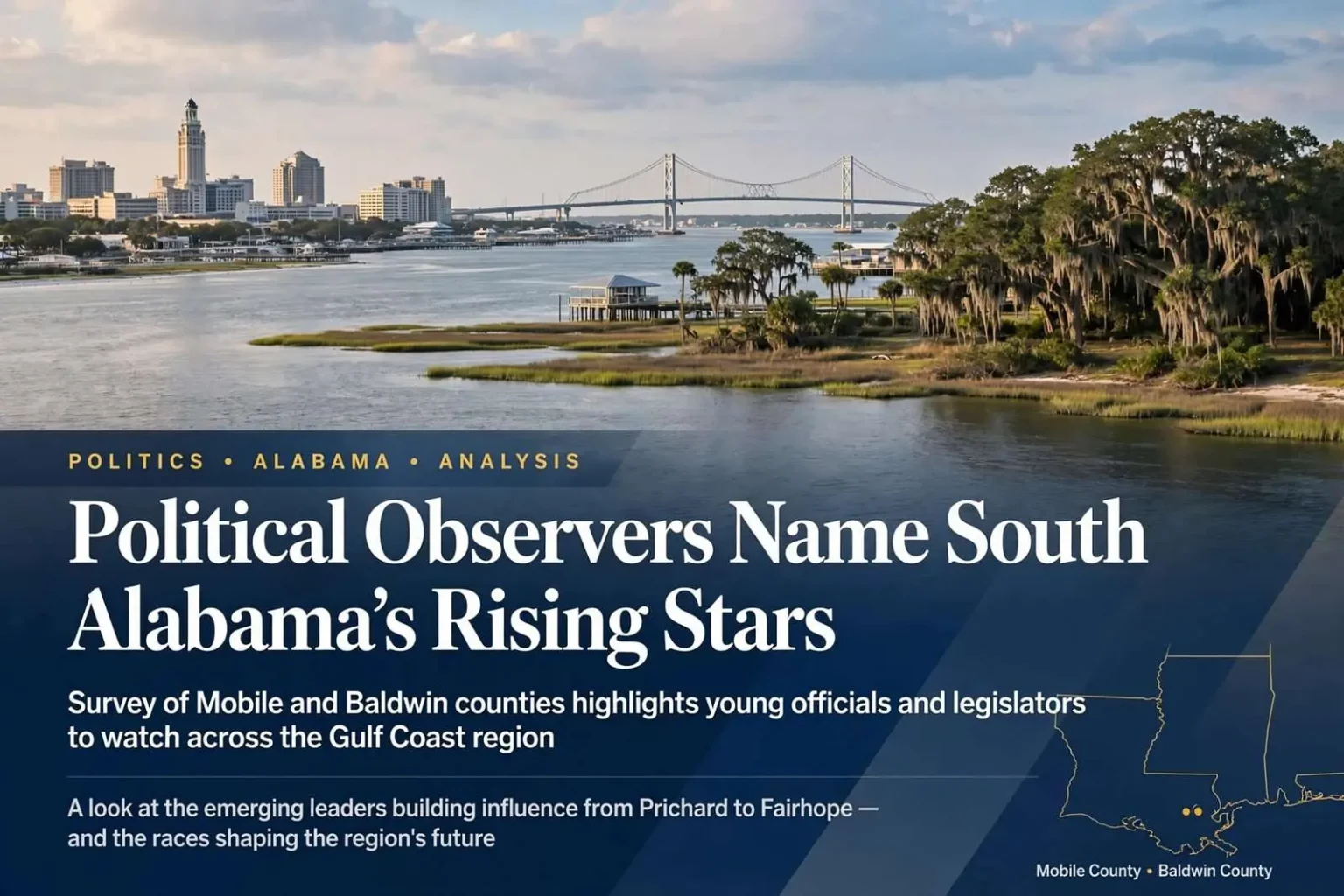
Who were the political “up and comers” across South Alabama? A survey of political insiders in Mobile and Baldwin counties, some speaking on the record and some not, produced a long and varied list of names to watch, from young city council members to state legislators already being sized up for higher office. The respondents were given no restrictions on age or experience, and their answers ranged widely. To keep the exercise consistent, none were identified outright, though several offered candid, sometimes competing, assessments of the region’s emerging talent.
The exercise reflected a simple truth about politics along the central Gulf Coast: Mobile and Baldwin counties together anchor one of the most politically active regions in the state, and the people who run campaigns, staff legislative offices, and sit on municipal boards tend to know one another well. That familiarity makes informal surveys like this one a useful early indicator of which figures are building reputations beyond their own districts, long before formal announcements are ever made.
Younger local officials
Several names surfaced repeatedly. Prichard City Council leader Napoleon Bracy was described as a sharp, hard-working figure in his early thirties. Bracy represents a city that has faced persistent budget and economic development challenges for years, and observers noted that anyone who can build a working majority on the Prichard council while still in his early thirties has demonstrated a set of skills that translates well beyond city hall.
Mobile County school board member Levon Manzie drew praise as “smarter than he lets on,” a quiet observer who had been paying attention longer than many realized. The county school system is one of the largest districts in Alabama, and a board seat that covers it exposes a member to budgeting, construction, personnel and testing policy on a scale few municipal offices can match. Insiders who praised Manzie pointed to that preparation as an underappreciated asset for anyone weighing a future run for legislative or countywide office.
Chickasaw City Councilman Adam Bourne was cited for an impressive win in an older community and a working knowledge of election law from his time in the attorney general’s office. Chickasaw, a small city in the northern part of Mobile County that incorporated as its own municipality in 2008, presented a difficult landscape for a newcomer, and Bourne’s ability to win there impressed respondents who follow municipal politics closely. His legal background, meanwhile, was viewed as a practical advantage in a state where ballot access rules, campaign finance requirements and recount procedures can decide close contests as surely as door-knocking does.
On the north end of the county, one insider flagged rookie Saraland City Councilman Joe McDonald as a potential reformer of that city’s established alliances, and noted council president Howard Rubenstein as a possible future candidate for mayor. Saraland has grown into one of the fastest-developing cities in the county, with an expanding tax base and a school system that has drawn families from across the area, and its city government has long been dominated by a close-knit group of officials. Any figure positioned to shake up those alliances, respondents suggested, is worth watching.
Legislators to watch
Among lawmakers, Grove Hill’s Marc Keahey drew the most attention. Described as young, well-connected and politically gifted, Keahey was noted as preparing a run for the state Senate seat left vacant by the late Pat Lindsey. Lindsey’s death created a vacancy in a Senate district that sweeps across a broad stretch of southwest Alabama, taking in parts of Mobile County and a series of rural counties up toward Grove Hill and the Black Belt’s edge, and the contest to replace him was already shaping up as one of the region’s most consequential races.
“I think that Rep. Marc Keahey is one of the real bright stars rising in South Alabama,” one executive said, adding a hope that the Senate race would not come too soon. The comment captured a common tension in these assessments: insiders often want promising legislators to accumulate more experience before leaping to a bigger stage, even as they acknowledge the pull of an open seat when one appears. A Senate seat offers longer terms, a wider constituency and a stronger platform than a House post, and vacancies rarely stay open long.
On the Republican side, Bayou La Batre’s Spencer Collier was praised as a straight-shooter who stood up for constituents, and south Mobile’s Jim Barton was called a “quiet consensus builder who never burns a bridge.” Collier’s district includes one of the state’s most distinctive communities — a seafood town whose fleet and processing plants have weathered hurricanes, imports and the aftermath of the BP oil spill — and the reputation he earned defending that constituency clearly registered with the insiders surveyed. Barton, whose south Mobile County district stretches toward the Gulf, has built his standing through coalition work in the House, where budget fights reward members who can assemble votes without leaving grudges behind.
In Baldwin County, state Sen. Trip Pittman was repeatedly mentioned as someone who could pursue higher office if he chose. Baldwin is the state’s fastest-growing county, a place where population gains from Daphne and Fairhope down to Gulf Shores have steadily increased its weight in state politics, and its legislators are watched accordingly. Pittman’s name surfaced in connection with posts well above the Senate, a reflection of how respondents view both his personal standing and the political base he would carry into any race.
Beyond the courthouse
Several respondents looked past current officeholders. Karlos Finley, a former assistant district attorney then in private practice, was called a rising star for his continued work with young people and clear ambition for office, with more than one insider predicting a future in policy or its enforcement. Prosecutorial and legal-community backgrounds have long served as springboards in Mobile County politics, and Finley’s combination of courtroom experience and youth outreach made him one of the few non-officeholders to draw repeated mentions.
Baldwin County figures such as Fairhope municipal judge Haymes Snedeker were described as well positioned for the county bench. A municipal judgeship offers steady visibility inside the legal community, and in a county where judicial races are often the most competitive items on the ballot, respondents viewed Snedeker as a natural candidate whenever a circuit or district judgeship opened.
The exercise also surfaced statewide speculation, with names floated for Congress, lieutenant governor and even future governor’s races. That kind of talk is a staple of any early ranking, and respondents treated it accordingly — as a measure of perceived ceiling rather than any committed plan. Still, the breadth of the speculation said something about the region’s self-image. South Alabama has at times felt underrepresented at the statehouse in Montgomery relative to its population and economic output, and insiders here have long argued that the region’s bench deserves a larger share of statewide attention.
Why the region’s bench matters
The value of a list like this lies less in any single name than in what it suggests about how power is being built locally. City council seats in Prichard, Chickasaw and Saraland, a school board post covering Mobile County’s sprawling district, and legislative seats from Bayou La Batre to Grove Hill all demand different skills — budgeting, coalition work, constituent service, campaign craft — and the people praised by the survey’s respondents were cited for mastering the demands of their particular arena rather than for any uniform profile.
Age stood out as a theme. Several of the most frequently mentioned figures were in their twenties and thirties, an age range that in earlier generations would have placed a politician years away from serious consideration. The respondents’ willingness to flag council members and first-term legislators for future advancement reflected a sense that the region’s next generation was already moving, and that the traditional apprenticeship — years of behind-the-scenes party work before a first race — was shortening.
Geography mattered as well. The list reached from the Gulf beaches through Mobile’s neighborhoods into the rural counties north and west of the city, a reminder that “South Alabama” politics is not a single community but a network of overlapping ones. A rising star in Saraland builds a reputation in a different world than one in Fairhope or Grove Hill, yet the insiders surveyed tracked all of them, because open seats and redistricting can pull any of those communities into the same contest with little warning.
If the responses shared a theme, it was that South Alabama’s political bench was deeper and younger than the headlines of the day suggested, and that several of the names on it would be worth remembering as the next round of campaigns took shape. Some of those named would go on to larger offices, others would remain important figures in their own communities, and a few would fade from view. But taken together, the answers offered a snapshot of a region confident in its own future leadership — and attentive enough to know exactly who was climbing.