Stolen guns from unlocked cars remain a persistent Gulf Coast problem
Gulf Coast police warn that most guns stolen from vehicles come from cars left unlocked, with nearly 1,200 taken in Mobile last year alone.
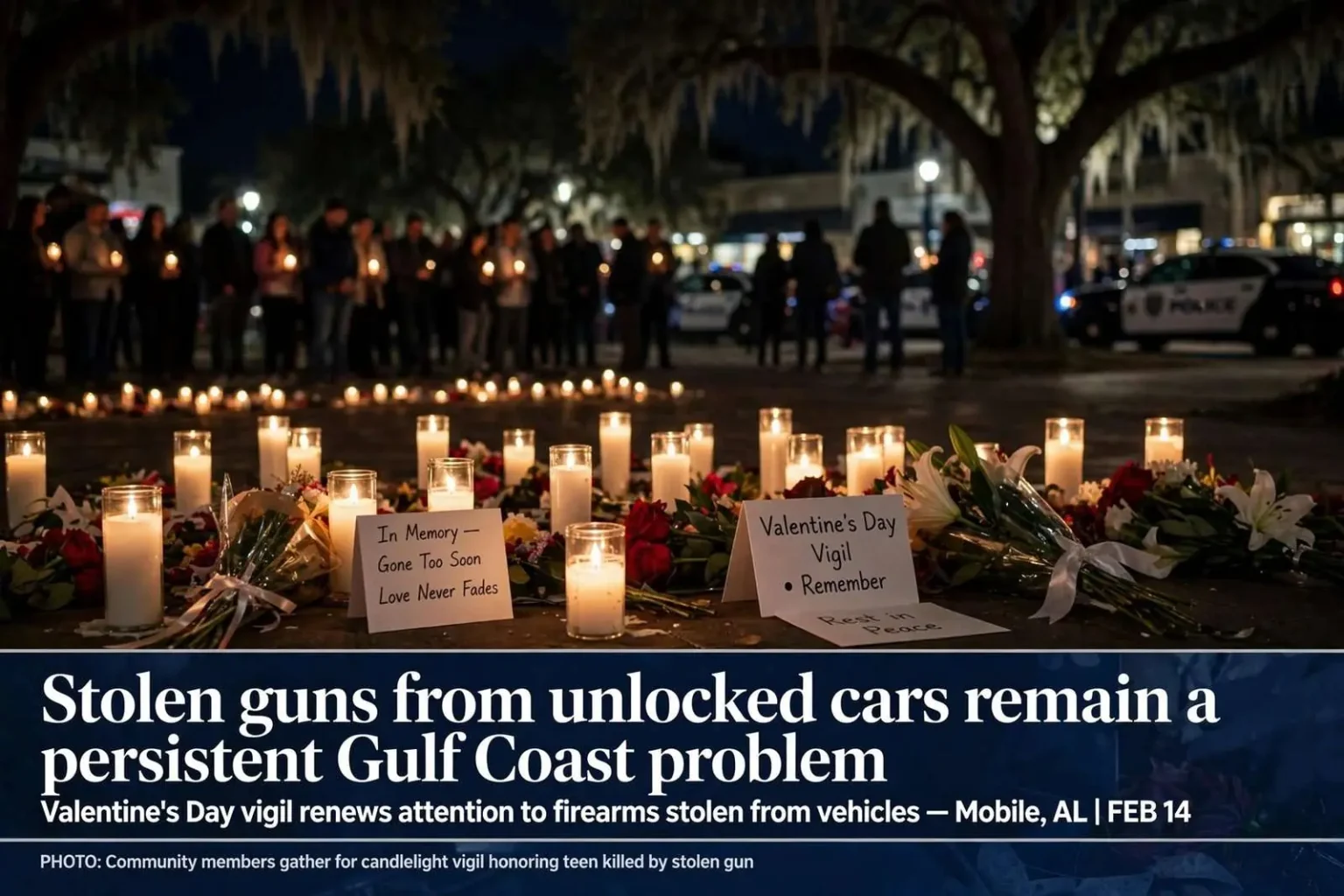
A Valentine’s Day vigil for a teen killed by a stolen gun renewed attention on a stubborn problem across the Gulf Coast: firearms taken from vehicles that were left unlocked. The vigil, held on a holiday built around love and loss, drew families and community members mourning a young life ended by a weapon that should never have been in a thief’s hands — and it put a public face on a pattern that police chiefs and sheriffs from Mobile to Pensacola have been warning about for years.
Mobile Public Safety Director James Barber said the vast majority of guns stolen from cars — about 80 percent — come from unlocked vehicles, and only about half of owners have recorded serial numbers, making it hard to track how many are taken. The two statistics together describe a problem that is equal parts preventable and invisible. A locked door defeats most opportunistic auto burglars, who move down streets trying handles in the dark and rarely force entry. And without a serial number on record, an owner who loses a gun often cannot even say with certainty when it disappeared, let alone help investigators trace where it went.
Last year in Mobile, nearly 1,200 guns were stolen from vehicles. The number is staggering in a city Mobile’s size — an average of more than three guns every single day leaving the backs of trucks, center consoles and glove compartments and entering the underground market. Each of those firearms is a potential carjacking weapon, a potential robbery gun, or a potential backdrop to exactly the kind of tragedy the Valentine’s Day vigil marked. Police have long argued that the auto burglary problem and the gun violence problem are not separate issues but the same issue at different stages.
How a Stolen Gun Becomes a Murder Case
In July, Mobile police arrested 19-year-old Marco Perez and two teenagers accused of breaking into dozens of vehicles. The case was a textbook illustration of the pattern: a small crew, a series of neighborhoods hit in the night, and a haul that included firearms lifted from cars whose owners never heard a thing. Auto burglary sprees of this kind are rarely about the guns alone — electronics, cash and loose change go into the same bags — but the firearms are what turn a property crime into a public safety crisis.
Perez was later named in a federal indictment for gun trafficking. The federal case signaled that prosecutors view the movement of stolen firearms as more than a series of local break-ins: when guns taken from vehicles begin flowing to other hands — sold on the street, traded for drugs, carried by people legally barred from owning them — the offense rises to the level of federal gun trafficking statutes that carry far stiffer penalties than state burglary charges alone.
Then came the case that removed any remaining doubt about the stakes. In January 2019, Perez was charged with capital murder in the shooting death of Mobile Police Officer Sean Tuder with a stolen gun traced back to an owner who had not reported it missing. The detail stunned even veteran officers. The weapon used against a 30-year-old police officer had been stolen from a vehicle, and the theft had gone unreported — meaning the gun circulated on the street for weeks with no alert attached to its serial number and no owner actively looking for it.
Tuder’s death reverberated across the Gulf Coast law enforcement community. The officer had been with the Mobile Police Department’s tactical and street-level units, working the kind of crime suppression detail that takes stolen guns off the street, when he was shot in the line of duty. Officers from across the region joined the funeral procession, and the investigation into where the weapon came from became its own grim lesson in how a single unlocked truck door can ripple outward into a homicide case.
Police immediately seized on the reporting gap. Owners who discover a gun missing and fail to file a report leave investigators blind: the serial number never enters the system, no flag is attached, and a weapon used in a crime weeks later cannot be quickly connected to its origin. Barber and other department leaders have repeatedly urged anyone who loses a firearm to report it immediately, framing the report not as an admission of carelessness but as a basic step that gives police a starting point.
The Problem Spans the Region
The problem spans the region, and the numbers bear that out beyond Mobile County. Daphne police say car break-ins there often target guns specifically, a pattern the Eastern Shore department has tracked as burglars cross the bay knowing that Baldwin County’s residential streets — like neighborhoods everywhere on the Gulf Coast — contain vehicles with firearms left inside. A handgun tossed under a seat after a trip to the range, a shotgun left in a truck bed overnight, a pistol in a purse on the back floorboard: each is a theft waiting for the right passerby.
Last year Escambia County, Florida, reported nearly 250 stolen guns, mostly from unlocked cars. The Pensacola-area county’s numbers mirror Mobile’s in miniature, and deputies there have run the same public education campaign — lock the car, record the serial number, report the theft immediately — with the same frustrating limits. Baldwin County sees dozens taken each year, smaller in raw count only because the population is smaller; the per-capita pattern is the same, and Baldwin County deputies and municipal police departments from Fairhope to Gulf Shores handle the same kinds of cases.
What unites the agencies is the conclusion they keep arriving at: the supply of stolen guns begins with unlocked doors. Investigators describe the typical Gulf Coast auto burglar as an opportunist, often a teenager, working a neighborhood street by street and pulling handles until one opens. Forced glass breaks attract attention and take time; an unlocked door takes seconds. Every firearm removed from the supply of unsecured guns, police argue, is one less gun available to the street — and one less potential case file like the ones Mobile has become grimly familiar with.
Law enforcement agencies across the two states have pressed the message through every channel they have: social media posts after each burglary spree, neighborhood association meetings, public service announcements, and the direct appeals officers make on doorsteps when canvassing a street that was hit overnight. The advice never changes — take the gun out of the car when you park, lock the vehicle, record the serial number and store it somewhere safe, and call the police the moment a firearm is missing.
The serial number habit deserves particular emphasis, because it is the cheapest fix of all. A serial number written down at purchase, kept with a receipt or stored in a phone note, turns a stolen-gun report from a vague complaint into a traceable record. When that gun surfaces in a traffic stop, a pawn shop check or a homicide investigation, the number connects the weapon to its lawful owner — and sometimes to the thief. Roughly half of Gulf Coast gun owners have taken that step, according to the figures Barber cited, leaving the other half with no way to prove what they lost or help police find it.
Community advocates add a harder truth: the guns stolen from cars do not stay stolen property crimes for long. A firearm lifted from a midtown Mobile truck can appear within weeks in a robbery across town, a shooting in Prichard, or a case across state lines. The underground market in stolen guns thrives on volume, and volume is what the region’s unsecured vehicles provide. Reducing the supply requires no new law, no new program and no new technology — only the habit of a locked door and a gun stored where a thief cannot reach it.
Barber’s plea at the center of the discussion was as plain as public safety advice gets. “The simplest and most obvious way to do that, lock your vehicle,” Barber said. The simplicity is the point, and also the frustration. The region’s police departments cannot lock a single car door from outside it; that step belongs to the roughly 1,200 gun owners a year in Mobile alone whose decisions determine whether a firearm stays where they left it or becomes someone else’s weapon.
The Valentine’s Day vigil, meanwhile, did what vigils do: it put a name and a face on a statistic. The teenagers and families holding candles were not thinking about serial numbers or clearance rates. They were mourning a young person killed with a gun that began its journey in someone’s unsecured vehicle — the human end of a chain that starts with a car door left unlocked on an ordinary night. Police hope the vigil’s message travels as far as the grief it marked: the next stolen gun prevented is a tragedy that never has to be mourned at all.