ATF Releases Surveillance Video Seeking Suspect in Mobile Firebombing
Federal investigators released surveillance footage of a truck linked to a February firebombing near a Mobile home, seeking help identifying a suspect.
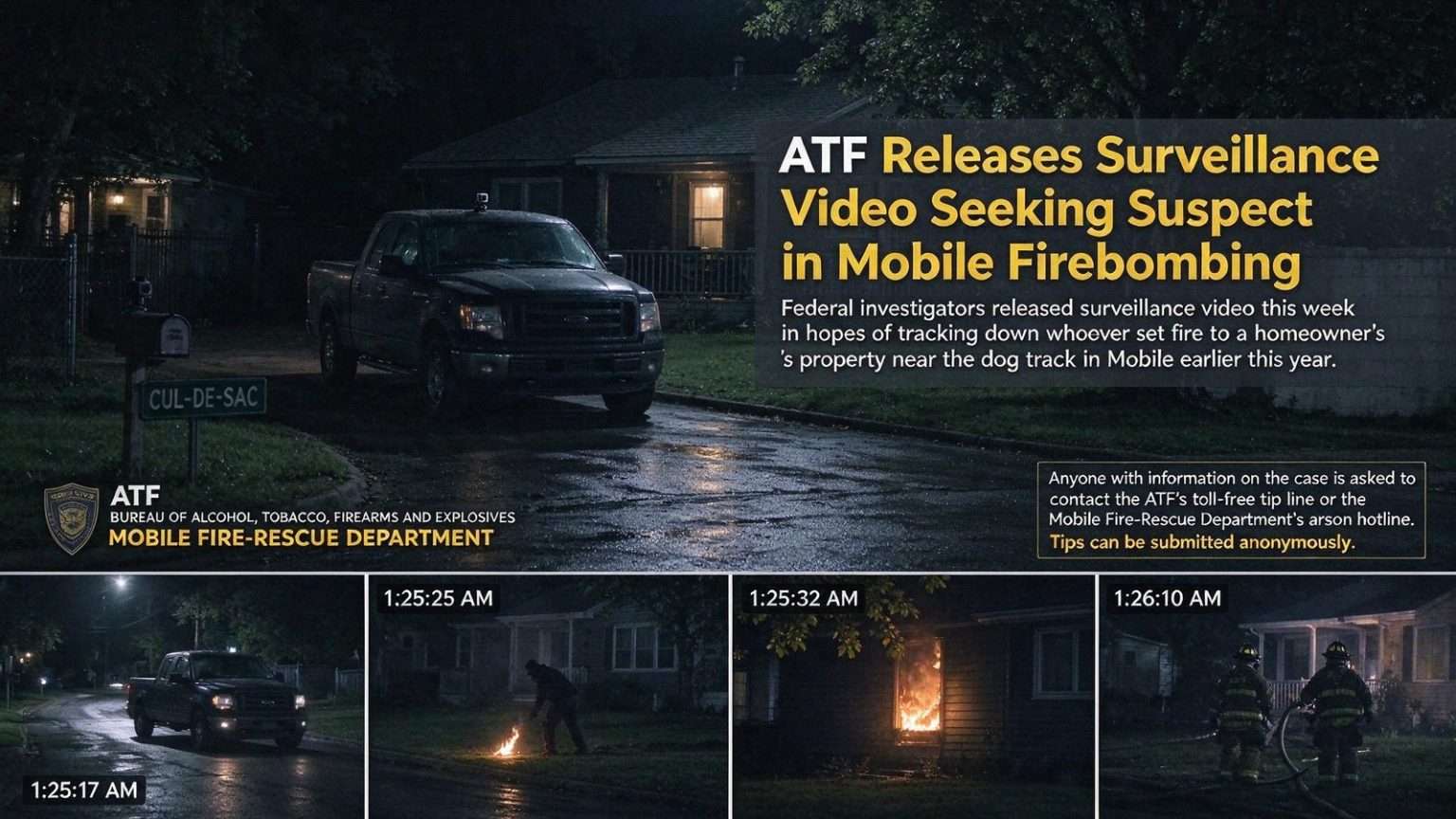
Federal investigators released surveillance video this week in hopes of tracking down whoever set fire to a homeowner’s property near the dog track in Mobile earlier this year, in an attack officials are treating as a deliberate firebombing rather than an accident.
The incident happened around 1:25 a.m. on Feb. 15 outside a home off Old Pascagoula Road, according to a special agent with the Bureau of Alcohol, Tobacco, Firearms and Explosives who is leading the investigation. The road stretches west from the city’s western edge through a mix of rural parcels, small subdivisions and commercial strips, passing near the Mobile Greyhound Park track that gives the area its most familiar landmark. Investigators believe someone deliberately ignited a fire using an accelerant, based on lab analysis of a glass bottle and wick recovered at the scene — the classic components of a makeshift firebomb, designed to shatter and spread burning liquid on impact.
What the Video Shows
The footage shows a dark-colored, extended-cab pickup truck driving slowly through a cul-de-sac before a small figure appears near the home, seemingly lighting something on fire before quickly fleeing the area. The fire burned only briefly before the homeowner spotted the flames and called the Mobile Fire-Rescue Department, likely preventing more serious damage.
“It’s fortunate the owner saw this,” the ATF agent said, noting the blaze could easily have spread to the house itself or to neighboring homes had it gone unnoticed longer. Fires set against exterior walls or under eaves can work their way into attics and wall cavities within minutes, and in a neighborhood where houses sit close to the property line, a single firebomb can threaten several families at once. That the attack happened in the dead of night — and that anyone was awake to see it — investigators count among the case’s few breaks.
Investigators say the sparse population of the surrounding area at that hour makes the truck in the video a key lead in identifying who was involved. Old Pascagoula Road and its side streets see little traffic in the early morning hours, meaning almost any vehicle moving through a residential cul-de-sac at that time would have a reason to be there — and, investigators hope, a driver or passenger someone in the area can recognize.
A Mobile Fire-Rescue Department spokesman confirmed that authorities believe the truck seen in the surveillance footage belonged to the suspect. Mobile Fire-Rescue, the city’s combined fire and emergency medical service, maintains a dedicated arson investigation unit that works fires alongside ATF agents when the circumstances warrant federal involvement.
Why Firebombings Are Different
Agents said cases like this one are relatively rare and tend to differ from typical arson investigations. Firebombings, the ATF agent explained, are usually symbolic acts aimed at a specific target rather than random vandalism, which means investigators must also consider whether the intended target was the actual victim or whether the attack was a case of mistaken identity.
Mistaken-target cases are among the most difficult to solve, investigators say, because the trail that matters — the motive — leads to an entirely different person than the victim. A house near a well-known business, or a vehicle previously parked at the address, can leave a family targeted for reasons they never know. That possibility is one reason agents have declined to speculate publicly about a motive while the review continues.
Federal involvement in a residential fire might seem unusual, but it follows a standard pattern. When a fire shows signs of an explosive or incendiary device, ATF brings laboratory resources, national case databases and bomb-and-arson expertise that local departments rarely maintain on their own. The bureau’s fire research laboratory and its registry of device profiles let investigators compare the construction of a recovered firebomb against devices used in other cases across the region — a technique that has linked seemingly unrelated attacks in the past.
The timing of the release also matters strategically. Publicizing surveillance footage weeks or months after an incident can shake loose memories that have had time to settle: someone who heard a truck that night, saw a similar vehicle parked somewhere unusual, or noticed a neighbor burning clothing or containers afterward. Agents said releasing the video now reflects their judgment that the case needed a public push to generate the tips that lab work alone has not yet produced.
That distinction shapes the whole investigation. An ordinary arson case tends to follow the money — insurance disputes, failing businesses, personal debts. A firebombing, by contrast, often signals a message: retaliation for something, intimidation of a household, or an escalation in a personal dispute. ATF agents trained in fire and explosives work backward from that logic, mapping the victim’s connections, checking whether similar incidents have occurred nearby, and testing whether the chosen weapon and timing suggest someone with or without experience.
Investigators also comb the digital trail that follows almost every modern crime. The area around Old Pascagoula Road sits within range of traffic cameras, business surveillance systems and the cell-site records that courts can order providers to preserve. Subpoenas go out to utilities, to the companies that service nearby commercial properties, and to ride services and delivery drivers who worked the corridor that night. Each document narrows the window: who was on the road at 1:25 a.m., which vehicles turned into the subdivision, how long the truck idled in the cul-de-sac before the figure got out.
The bottle and wick recovered at the scene undergo forensic analysis that can reveal trace evidence — residue of the accelerant, fingerprints, DNA — while the surveillance video is being reviewed frame by frame for additional clues about the vehicle and the figure who got out of it. Agents have not said whether the truck was captured well enough to identify a make, model or tag.
Accelerant analysis is a science of its own. Gas chromatography can distinguish gasoline from diesel, lamp oil or alcohol-based accelerants, and sometimes identifies additives that trace to a specific grade or brand — details that mean little to the public but can matter enormously in court. Evidence technicians bag and seal every fragment from the scene, because defense attorneys in arson cases routinely challenge collection and chain-of-custody procedures, and a single documentation gap can unravel a prosecution years later.
How the Public Can Help
Investigators are asking anyone who recognizes the vehicle, or who has other information about the incident, to come forward. Anyone with information on the case is asked to contact the ATF’s toll-free tip line or the Mobile Fire-Rescue Department’s arson hotline. Investigators say tips can be submitted anonymously and any information, however small, could help identify who was behind the attack.
Anonymous tips have closed many arson cases across the Gulf Coast over the years, and agents stress that people often hold pieces of a puzzle without realizing it: a pickup truck that does not belong in the neighborhood, a acquaintance who came home late that night, a grudge mentioned in passing weeks earlier. Reward programs for arson tips have operated in Mobile County in the past, and tipsters using the hotlines can remain anonymous under programs that allow rewards to be paid without revealing a caller’s identity.
For the homeowner, the episode has been unsettling in a way officials say is common for firebombing targets: the fire was small, the damage recoverable, but the knowledge that someone targeted the house remains. Fire investigators coordinate with local police in such cases to keep extra attention on the neighborhood while the case develops, and agents urged the family’s neighbors to report anything unusual.
Residents of the area say the stretch of Old Pascagoula Road near the track has changed gradually over the years, as older homesteads give way to new construction and commuters discover the corridor as an alternate route into the city. But the side streets off the main road remain dark and quiet after midnight, which is precisely what investigators say made the truck’s slow pass through the cul-de-sac stand out. In a neighborhood where almost everyone’s comings and goings are noticed, the vehicle itself may be the strongest clue the case will get.
The investigation remains open, and authorities have not identified a suspect or a possible motive publicly as they continue reviewing evidence gathered from the scene and analyzing the surveillance footage frame by frame for additional clues.
ATF’s New Orleans Field Division, which covers Alabama and the Gulf Coast, supports local departments across south Alabama on fire and explosives cases, and agents said the Mobile-area partnership with Mobile Fire-Rescue’s arson unit is one of the reasons the case advanced quickly from a late-night fire call to a federal investigation with lab work and video analysis underway within days.