Sixteen Candidates Vie for Open Mobile County District Court Seat
Sixteen attorneys have submitted their names for consideration to fill the Mobile County District Court judge seat vacated by Judge Jay York.
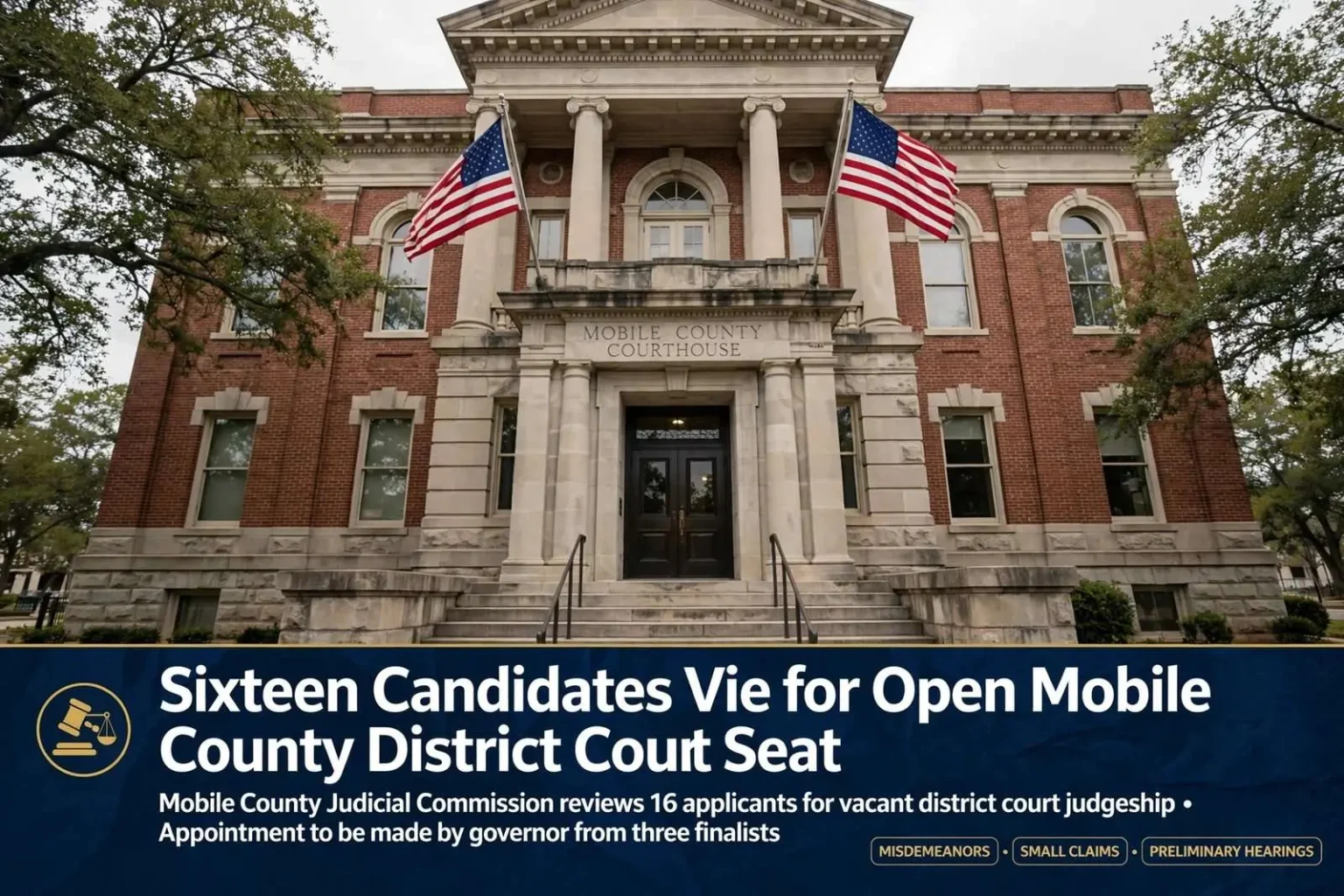
A crowded field of sixteen candidates has emerged to fill a vacant Mobile County District Court judgeship, setting up a competitive selection process before the seat is filled later this year. The opening was created when Judge Jay York moved up to the Mobile County Circuit Court, taking the seat vacated by former Circuit Judge Joseph “Rusty” Johnston. Johnston went on medical leave earlier in the year and retired roughly two months later, triggering the chain of judicial appointments now working through the county’s selection process.
The Mobile County Judicial Commission is reviewing applications from sixteen local attorneys who submitted their names for consideration. The list includes a mix of private practitioners and attorneys with government experience, reflecting the range of legal backgrounds vying for a seat that handles a high volume of misdemeanor criminal cases, small claims and other district-level matters central to everyday life in Mobile County.
The vacancy is the product of a domino effect that began at the top of the county’s trial bench. Johnston, a veteran circuit judge, stepped away from his duties on medical leave earlier in the year, and his retirement roughly two months later left a permanent opening on the circuit court. York’s promotion from the district bench to fill that circuit seat then set off the current vacancy, and each step in the chain has followed the same appointment framework that Alabama uses whenever a trial judgeship opens between elections.
How Alabama Fills a Judicial Vacancy
Under Alabama’s judicial appointment process, the commission does not select the replacement directly. Instead, members are tasked with narrowing the list down to three finalists, whose names will then be forwarded to the governor’s office for a final decision. The structure is designed to put a professional screening layer between the full field of applicants and the governor, who makes the ultimate pick without a statewide campaign or special election in the interim.
At the time, that authority rested with then-Governor Robert Bentley. The governor’s office typically conducts its own review of the three finalists before announcing an appointment, and the person chosen takes the bench for the balance of the unexpired term rather than starting a fresh one.
Before finalizing its recommendations, the commission opened a public comment period, inviting residents to weigh in on the candidates through mid-July. Officials noted that submitted comments would remain confidential, though the commission said it would not consider anonymous input, a policy designed to keep the process transparent while still protecting those willing to speak candidly about candidates they may know professionally or personally.
Mobile County residents interested in the outcome of the selection were encouraged to submit comments by mail ahead of the noon deadline in mid-July. The confidentiality pledge means that letters criticizing or endorsing a candidate will not become part of any public record, but the no-anonymous-comments rule is intended to prevent unsubstantiated claims from influencing the vetting.
What the District Court Bench Handles
District Court judges in Mobile County handle a substantial share of the county’s day-to-day legal business, presiding over misdemeanor prosecutions, traffic cases, preliminary hearings for felony matters and civil disputes involving smaller dollar amounts. In practical terms, the district courtroom is where most Mobile County residents encounter the court system, whether as a defendant, a plaintiff in a small claims matter, a witness or a juror.
The Mobile County District Court operates as the entry point of the county’s trial judiciary, and its docket volume dwarfs that of the circuit court. Misdemeanor prosecutions alone account for thousands of filings each year, and every felony charge in the county passes through a district courtroom for a preliminary hearing before it can proceed to a grand jury. The judge who fills this seat will inherit that full caseload immediately upon taking the oath of office.
Small claims and civil matters in district court involve disputes below the circuit court’s jurisdictional threshold, giving individuals, landlords, contractors and small businesses a forum that is faster and less formal than a circuit trial. Traffic dockets, meanwhile, touch more residents than any other part of the courthouse, making the quality and temperament of district judges a matter of routine public consequence rather than occasional interest.
The position is often a stepping stone to higher judicial office, as illustrated by York’s own move from the district bench to the circuit court. Lawyers across Mobile County have historically viewed a district judgeship as both a public service and a proving ground, and the sixteen applicants now under review include attorneys for whom the seat could mark the beginning of a long judicial career.
Inside the Judicial Commission’s Work
The judicial commission includes a mix of appointed and elected members responsible for vetting nominees before matters ever reach the governor’s desk. The commission’s makeup reflects a longstanding Alabama effort to blend bar association input, lay representation and elected oversight in the screening of judicial applicants, rather than leaving the choice entirely to political channels.
In a field of sixteen, the commission’s narrowing task is substantial. Members review each applicant’s legal experience, disciplinary history where applicable, community standing and courtroom readiness, and the public comment period supplements that file with input from people who have dealt with the candidates as clients, opposing counsel or fellow lawyers.
Screening at this scale is not routine even in a county as large as Mobile. When vacancies arise with only a handful of applicants, commissions can move quickly through interviews and deliberations; a sixteen-candidate field means more interviews, more comment letters to review and a longer path to a three-name list. That competitive dynamic gives the governor’s office a deeper pool than it often receives, with finalists likely to represent distinctly different career paths through Mobile’s legal community.
What Happens Next for the Seat
The eventual appointee will serve until the next general election, when Mobile County voters will have the opportunity to weigh in directly on who holds the seat going forward. That timeline means the appointed judge will spend the intervening period building a record on the bench while prospective challengers decide whether to qualify for the race.
For the sixteen applicants, the months ahead carry obvious stakes. Only three names will go to the governor, and only one person will take the oath. For Mobile County residents, the practical effect is simpler: the courtroom where misdemeanors, traffic cases, preliminary hearings and small claims are resolved will soon have a new judge, chosen through a process that has already drawn more public engagement than most judicial vacancies in the county attract.
The commission’s next public step will be the transmission of its three finalists to the governor’s office, and the appointment that follows will close out a chain of personnel changes that began with a circuit judge’s medical leave. Until then, the district court docket continues under the county’s remaining district judges, with the incoming juror expected to assume a full slate of cases the day the appointment is announced.
Legal observers note that Alabama’s appointment framework has shaped the composition of trial benches across the state for decades. Because judicial terms in Alabama run six years and elections fall on a staggered schedule, vacancies from retirement, promotion or resignation are common, and the commission-to-governor pipeline is the standard mechanism for keeping courtrooms staffed in between. Mobile County, with one of the largest trial court systems in the state, has seen the process play out repeatedly on both its circuit and district benches.
The appointee who emerges from this field will join a district court that also serves as a feeder of institutional knowledge for the circuit bench. Judges who begin at the district level become familiar with the county’s law enforcement agencies, prosecutors, defense bar and clerk’s office, relationships that carry over if they later seek or receive promotion to the circuit court. York’s own trajectory is the most recent local example, and several of the sixteen applicants are likely aware that the seat they are seeking has become a proven route upward.
The public comment window also gives the process a civic dimension that pure political appointment would lack. By soliciting letters from residents before the finalist list is drawn, the commission obtains information that resumes and interviews do not always surface, such as how candidates treat litigants, whether they honor commitments to clients and how they conduct themselves in the community. The confidentiality rule encourages candor from those sources, while the ban on anonymous submissions keeps the record accountable.
For now, all attention in the courthouse turns to the commission’s deliberations. When the three finalists are announced, the governor’s office will take center stage, and Mobile County will learn which of sixteen attorneys will hold one of the busiest benches in south Alabama until voters have the final word.