Mobile City Council Votes to Strip Confederate-Era Flags From City Seal
Mobile's city council voted to remove all flags but the American flag from the city seal, ending years of debate over Confederate symbolism downtown.
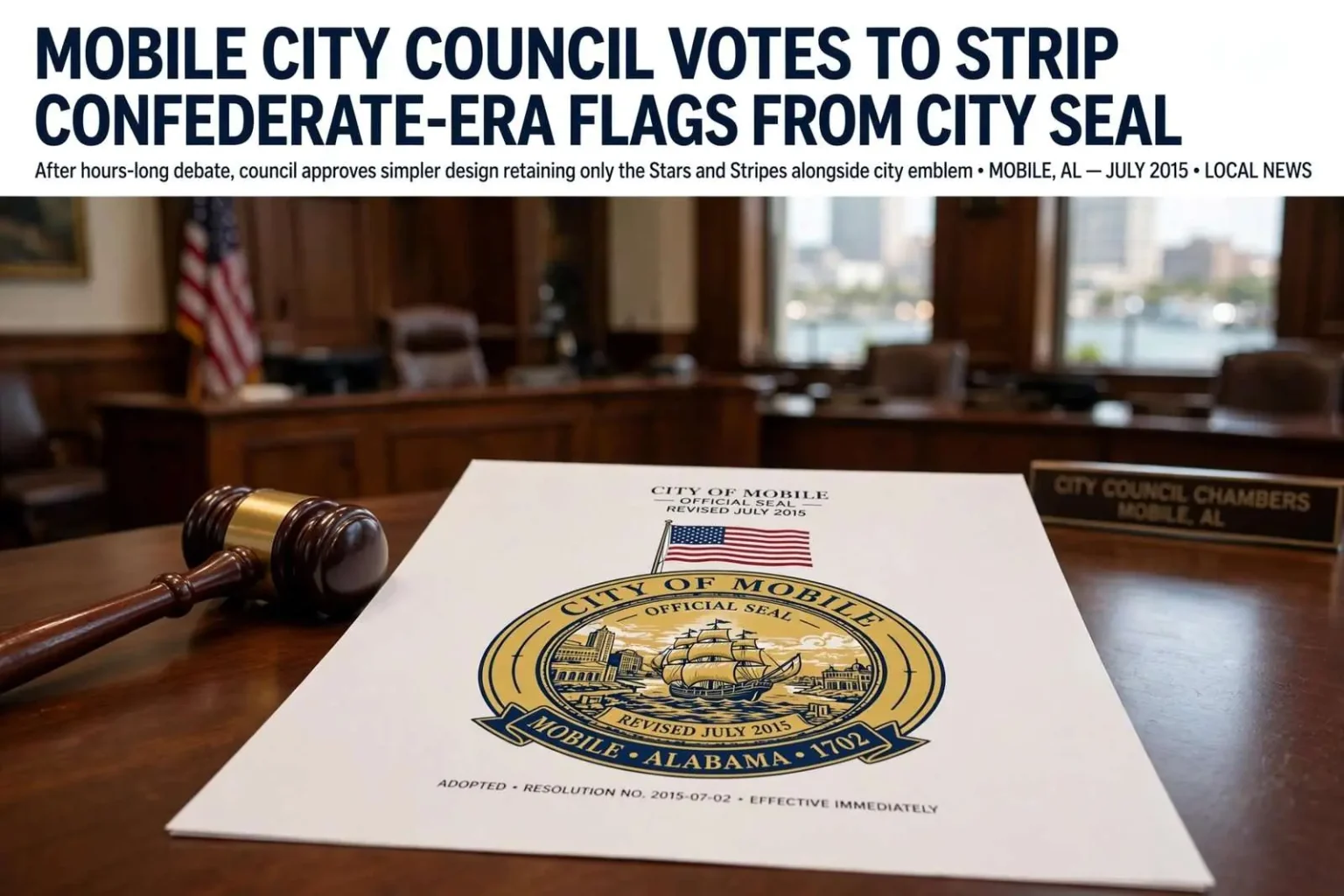
After an emotional, hours-long debate, the Mobile City Council voted to strip nearly every flag from the city’s official seal, leaving only the Stars and Stripes alongside the city emblem. The decision capped a discussion that stretched late into the evening and drew speakers on both sides of an issue that has divided communities across the South for generations. Council members said the vote reflected both the historical weight of the seal and the changing attitudes of the city it represents.
The vote came amid renewed national attention on Confederate imagery following the killing of nine churchgoers in Charleston, South Carolina, weeks earlier. That attack set off a nationwide reexamination of flags, monuments and other symbols tied to the Confederacy, and Mobile was hardly immune to the conversation. Across Alabama and the wider Gulf Coast, officials faced renewed questions about emblems that had stood, largely unexamined, for decades.
Mobile’s seal had long featured a series of historical flags representing the various nations and governments that once claimed authority over the city, including a Confederate national flag. The design traced Mobile’s unusual history as one of the Gulf Coast’s oldest cities, a place governed over the centuries by colonial powers, the United States and the Confederacy. Supporters of the original design had argued the flags simply told that layered story in chronological order.
Three council members originally proposed a middle path: swapping the third national Confederate flag for Alabama’s state flag, which would have preserved the number of flags on the seal while removing the most contested image. That compromise won support from some members who wanted to keep the historical framing intact. But a majority of the council opted instead to remove every flag except the American one, going further than the original proposal and leaving the seal with a simpler design.
Before the final vote, an amendment offered by one councilwoman would have replaced the disputed flag with an earlier Confederate design, an attempt to satisfy critics who considered the third national flag especially charged. The amendment failed by a 2-5 vote, signaling early in the evening that a majority of the council was prepared to move well beyond symbolic substitution. From there, attention shifted to whether any flags at all would remain.
A seal layered with colonial history
Mobile’s multilayered past explains why the seal looked the way it did. Founded by the French in the early eighteenth century and later passed between Britain, Spain and the United States before briefly falling under Confederate control during the Civil War, the city changed sovereigns more often than almost any other in Alabama. The flags on the seal were meant to mark each of those transitions, a visual timeline of rule that stretched across more than two centuries.
That historical richness is part of what made the debate so difficult. Council members who favored keeping the flags argued that Mobile’s colonial and Civil War-era past is a genuine part of the city’s identity, and that removing it from official imagery risked pretending that history never happened. Others countered that a city seal is not a museum exhibit but a contemporary statement, and that governments choose, every day, which parts of their history to display on letterheads, patrol cars and public buildings.
Voices for reconciliation
Public comment before the vote leaned toward reconciliation. A local pastor described the Confederate flag as “a symbol of divisiveness” and urged the council toward unity, a sentiment that drew visible agreement from much of the chamber. Speakers described the seal as something every resident of Mobile carries with them, whether on a water bill or a city-issued document, and argued that no resident should feel excluded by an official emblem.
Other council members pointed to the historical weight of the seal, arguing the flags reflected Mobile’s complicated colonial and Civil War-era past rather than an endorsement of any particular ideology. They warned that stripping the flags would invite criticism that the city was erasing history. The exchange, at times, grew pointed, with members speaking past one another about what the seal means to different generations of Mobilians.
Not the first reckoning
This was not Mobile’s first reckoning with the seal. A decade earlier, the city removed the Confederate battle flag from the design following public protests, leaving the third national flag of the Confederacy in its place. At the time, that change was presented as a compromise: the battle flag, with its most charged modern associations, would go, while the older national banner would remain as a purely historical marker.
One council member who served during that 2005 debate recalled how contentious the process had been then, saying she was inclined to preserve the historical elements even as she ultimately abstained from Tuesday’s vote. Her recollection underscored how long the question has shadowed the council, surfacing roughly once a decade as national attitudes shift. The abstention reflected the position of members who found merit in both arguments and chose not to tip the outcome.
The 2005 episode and Tuesday’s vote bookend a gradual evolution in how the city handles its most contested imagery. What was considered a decisive step ten years ago now reads, to many residents, as an incomplete one, and the council’s latest decision effectively closes the chapter that the earlier compromise left open.
The 1961 question
Another council member offered a different historical account, noting that Mobile’s city commission first added the Confederate flag to the seal in 1961, during the era of resistance to federal school desegregation orders. He argued the addition at that time was a political statement tied to the civil rights movement rather than simple historical commemoration. Under that reading, the flag’s presence on the seal was not a centuries-old inheritance but a mid-century insertion with a pointed message.
The distinction mattered to the debate, because it reframed what preserving history would actually mean. If the flag arrived in 1961, its defenders were defending a choice made a century after the events the seal otherwise commemorates. The councilman’s account was part of a broader argument that official symbols deserve scrutiny not only for what they depict but for when and why they were adopted.
Part of a larger shift
The decision makes Mobile the latest Alabama city to reconsider Confederate-linked symbols in official use, following similar debates unfolding across the South that summer. Communities across the region were reexamining flags on public property, and Alabama municipalities faced their own questions about seals, monuments and markers. Mobile, as one of the state’s oldest and most historically self-aware cities, carried particular weight in that conversation.
City officials said the updated seal would be phased in on municipal materials and signage in the months following the vote. Existing supplies will be used up and replaced gradually, a process that spreads the cost of the change across multiple budget cycles and avoids a sudden, expensive switchover. Residents should expect to see the new design appear on stationery, vehicles and public buildings over time rather than all at once.
What the new seal will look like
With only the Stars and Stripes remaining alongside the city emblem, the revised design is considerably simpler than the version it replaces. City officials have described the updated seal as retaining the emblem’s core imagery while dropping the row of historical banners that framed it. The American flag, as the one banner shared by all residents regardless of how they view the region’s past, was the natural choice for the lone survivor.
The simplification also spares future councils a recurring argument. Where the old design required constant defense of each individual flag, and in 2005 and again this year a renegotiation of which flags belonged, the new one reduces the seal to elements that have not been publicly contested. Officials in other cities watching Mobile’s experience may take note of that practical advantage.
What it means for the Gulf Coast
The council’s decision reflects a broader shift in how South Alabama communities have approached historical Confederate symbolism in official government contexts, balancing calls for reconciliation against arguments about preserving local history. The region’s governments are custodians of an unusually deep historical record, and each has had to decide for itself where commemoration ends and endorsement begins. Mobile’s vote will likely be cited in neighboring debates, both as an example and as a precedent.
For residents, the change is largely symbolic but not abstract. A city seal appears on everyday documents, from utility notices to court paperwork, and emblems shape how a city presents itself to visitors and investors. Supporters of the vote argued that a seal stripped of contested imagery projects a more welcoming Mobile; critics countered that the city had lost a teaching tool that connected the present to a complicated past.
What remains clear is that the question, debated in 2005 and settled for now this week, has followed the natural arc of such disputes: from protest, to compromise, to a more permanent resolution. Whether other South Alabama municipalities follow Mobile’s lead remains to be seen, but the council has established where the state’s oldest major city now stands. The updated seal will begin appearing on official materials in the months ahead, closing one of the longest-running symbol debates in Mobile’s recent history.