Daphne Intersection Closes for Weeks as Roundabout Project Nears Finish
A busy Daphne intersection shut down completely as crews entered the final phase of a $1.7 million roundabout project expected to last up to six weeks.
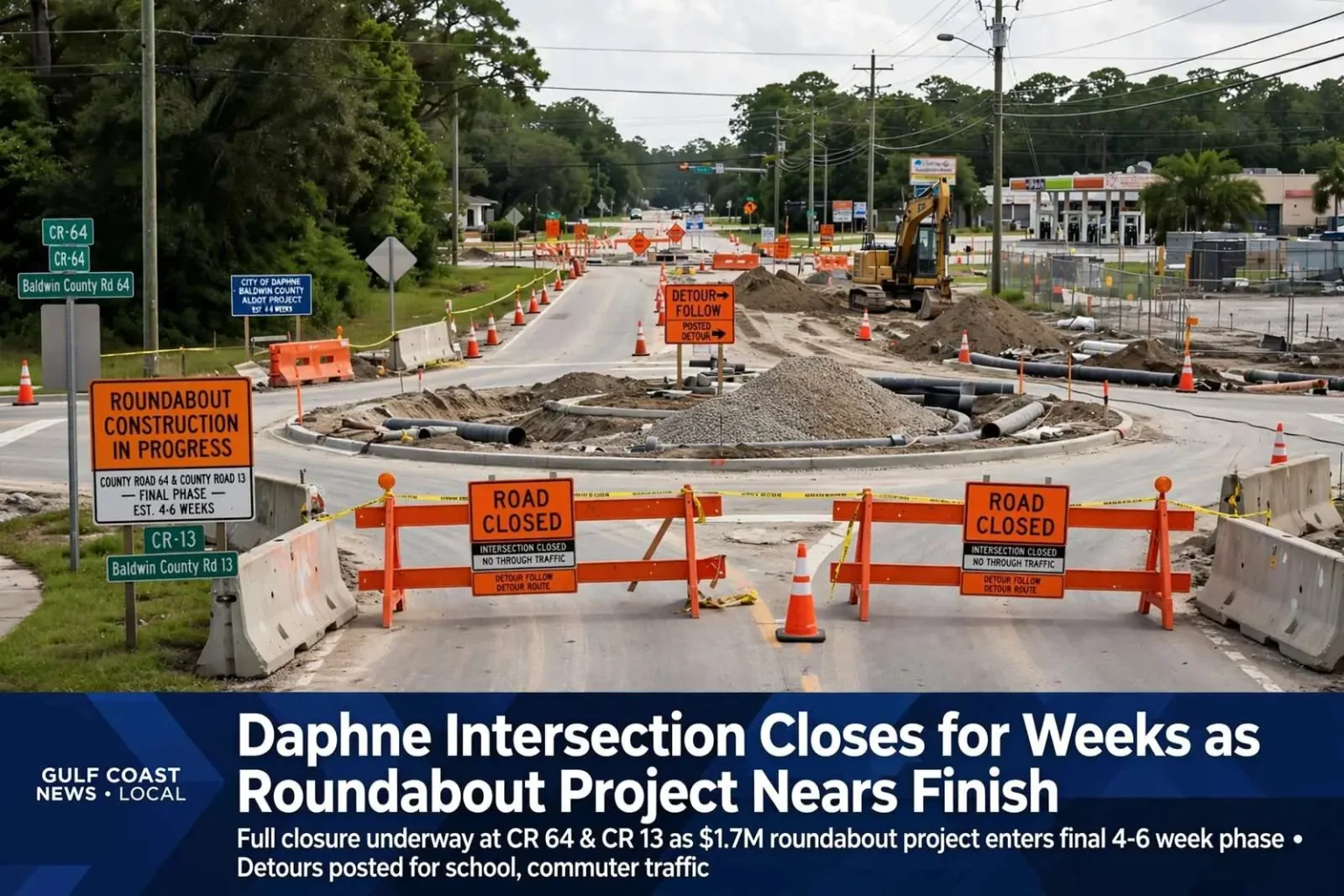
A heavily traveled Daphne intersection was closed in all directions this week as construction crews moved into the final phase of a $1.7 million roundabout project connecting Baldwin County roads 64 and 13. The full closure — a disruptive step for one of the growing city’s busiest crossroads — marks the endgame of a project that has reshaped how thousands of daily commuters, school buses and shoppers move through the heart of Daphne’s road network.
The closure began in the morning, with the work expected to continue for four to six weeks. City officials say some motorists initially ignored posted detour signs, causing backups near the site before traffic adjusted to the new routes. Officials urged drivers to plan ahead, study the detour map before setting out and resist the instinct to thread through surrounding neighborhoods, where cut-through traffic during construction creates its own hazards and delays.
The project is a joint effort between the city of Daphne, the Baldwin County Commission and the Alabama Department of Transportation. A Mobile-based contractor was awarded the $1.17 million low-bid contract for the work last November, and construction on the roundabout itself has been underway since March. Splitting responsibility among the three governments reflects how the intersection actually functions: county roads meeting within Daphne’s city limits, with state highways carrying the overflow traffic that the roundabout is designed to relieve.
This marks the first time the entire intersection has been shut down completely. Until now, crews had kept traffic moving through the work zone under flagging operations and partial lane closures, an approach that kept the corridor functioning but stretched the schedule. Taking the intersection fully offline for the final phase lets contractors pour the central island, finish the circular roadway and complete the associated drainage and striping work in weeks rather than months, trading short-term pain for an earlier reopening.
Detour routes vary depending on direction of travel. Motorists heading west who need to continue north have a relatively short detour available through nearby residential streets. The bigger disruption falls on drivers moving east toward Alabama 181, who face a longer detour looping north before connecting back to the main corridor; that route is reversed for traffic headed the opposite direction. Drivers approaching from the south have another alternate route available to reach Alabama 181.
City officials say they are aiming to have the new traffic circle finished before the start of the school year. Three schools sit along or near county road 13, adding urgency to completing the work before buses and parents are back on the road in large numbers. The morning and afternoon school runs already strain the corridor on ordinary days; adding a construction zone to that mix in August would have complicated arrivals, dismissals and the after-school activity traffic that follows them.
Why a Roundabout
Roundabouts have become an increasingly common tool for easing congestion at busy intersections along Baldwin County’s fast-growing corridors, offering continuous traffic flow without the delays of traditional signal lights. Instead of stopping every approach for a red light, a roundabout yields traffic in a slow, one-way circulation that keeps vehicles moving during gaps — typically moving more cars per hour than a signal at the same intersection, without the long queues that build at peak times on roads like 64 and 13.
Safety is the other argument. Federal highway studies have consistently found that converting a two-way-stop or signalized intersection to a modern roundabout dramatically reduces fatal and injury crashes, because the geometry strips out the high-speed, right-angle collisions that make signal intersections dangerous. Vehicle speeds through a roundabout are low, conflict points are reduced, and the most common crashes become fender-bender sideswipes rather than T-bone impacts. For a fast-growing county where more traffic arrives every year, those numbers have made roundabouts an easy sell to engineers, even where drivers initially grumble about learning a new pattern.
Daphne’s growth has made the 64/13 corridor a case study in that dynamic. The city’s population has climbed steadily for decades as Eastern Shore commuters, drawn by Daphne’s schools and its position across Mobile Bay from the region’s job center, filled in subdivisions along the county roads. Each new roof adds trips to the same intersections, and each added trip compounds the delays that once made a simple crossing of 64 and 13 an exercise in patience during rush hours and school change times.
Local officials have pointed to the project as part of a broader push to modernize infrastructure in the Daphne area as population growth continues to strain existing roads. Across Baldwin County, governments have been layering roundabouts, turn lanes and widened corridors onto a road grid that was laid out for a much smaller population, and the pace of that work has become one of the most discussed subjects in local politics from Daphne to Foley. Growth pays for some of it through impact and sales tax revenue, but the county’s transportation needs have consistently outpaced its transportation dollars.
The $1.7 million price tag for the roundabout project reflects that balancing act between modest public budgets and escalating construction costs. The low-bid contract structure that brought the work in at $1.17 million leaves the remainder for contingencies, inspection and associated work — a cushion that joint projects between multiple governments have learned to build in after years of fuel-price swings and material shortages.
For the next several weeks, though, the arithmetic that matters most to Daphne drivers is simpler: the intersection is closed, the detours are mapped, and the reopening is scheduled for the weeks before classes resume. City officials say crews will work to hold the four-to-six-week window, and residents who can shift trips, carpool or use the alternate routes will spare themselves the worst of the disruption.
Drivers are being urged to follow posted detour signage and allow extra time for trips through the area until the intersection reopens. When the barriers come down, the corridor’s daily routine will change: no signal cycle to wait out, no left-turn queue across traffic, just a slow circle that keeps cars moving through one of Daphne’s busiest crossings. Whether the improvement feels worth the six-week detour, drivers will begin judging for themselves on the first morning it opens.
The timing of the full closure also reflects lessons learned from earlier phases of the work. During the spring and early summer, flaggers and lane shifts kept the intersection partially open but produced recurring delays at peak hours, and crews could only advance the work in fragments between rush periods. Contractors on joint municipal projects often reach a point where a short, complete closure is faster and cheaper than months of piecemeal work, and engineers concluded that the final pours and paving could only be done properly with the intersection emptied.
City staff have been updating residents through the city’s website and social media channels as the closure progressed, publishing the detour map and responding to the most common complaints. The first days of any full closure are typically the roughest, as commuters who missed the announcements discover the barriers on their way to work; after that, traffic engineers say, driver behavior settles into new patterns within a week or two. The early backups near the site, officials said, were concentrated among drivers who disregarded the posted routes rather than among those following them.
The roundabout is also the latest chapter in Baldwin County’s long courtship with the traffic circle as a design solution. Several roundabouts have already been built across the county in recent years, at intersections where growth outstripped the original two-lane crossings, and officials report that drivers’ early resistance tends to fade once the pattern becomes routine. Studies of converted intersections have found that average delays drop sharply, and the county’s engineers have pointed to the local results when defending the approach to skeptical residents.
The project’s partners each brought different pieces to the table: the city contributed local matching dollars and coordination with businesses and schools along the corridor, the county commission carried the road improvement through its capital program, and the state transportation department reviewed the design and permitting because of the junction’s tie-in to the state route network. Multi-government projects of this kind require intergovernmental agreements that spell out cost splits and maintenance responsibilities once the work is done — paperwork that can take nearly as long as the construction itself, but that has become standard practice as Baldwin’s municipalities and the county pool resources for growth-driven roadwork.
Businesses near the intersection have been watching the closure with particular attention. Gas stations, restaurants and shops that depend on pass-by traffic typically see sales dip during full closures, even when access to their parking lots remains open. City officials encouraged residents to keep patronizing the corridor’s businesses during construction, noting that the detour routes deliberately keep drivers within reach of the affected storefronts. For the owners, four to six weeks of disruption is the price of a corridor that should move more customers past their doors once the circle opens.
When the project is complete, maintenance of the roundabout will fall to the governments according to the boundaries that cross at the intersection, and the county will add the circle to its resurfacing and mowing cycles like any other piece of the road grid. The first school year with the roundabout in service will be the real test: hundreds of buses and parent drivers learning a new pattern at the same time, on a corridor that serves three schools. Officials are betting that a week of orientation — and the promise of no more left-turn waits across two lanes of morning traffic — will win over even the skeptics.