Mobile Council Committee Backs Nearly $500,000 in Hank Aaron Stadium Upgrades
A Mobile City Council committee recommended shifting surplus park funds toward urgent upgrades at Hank Aaron Stadium despite lingering lease concerns.
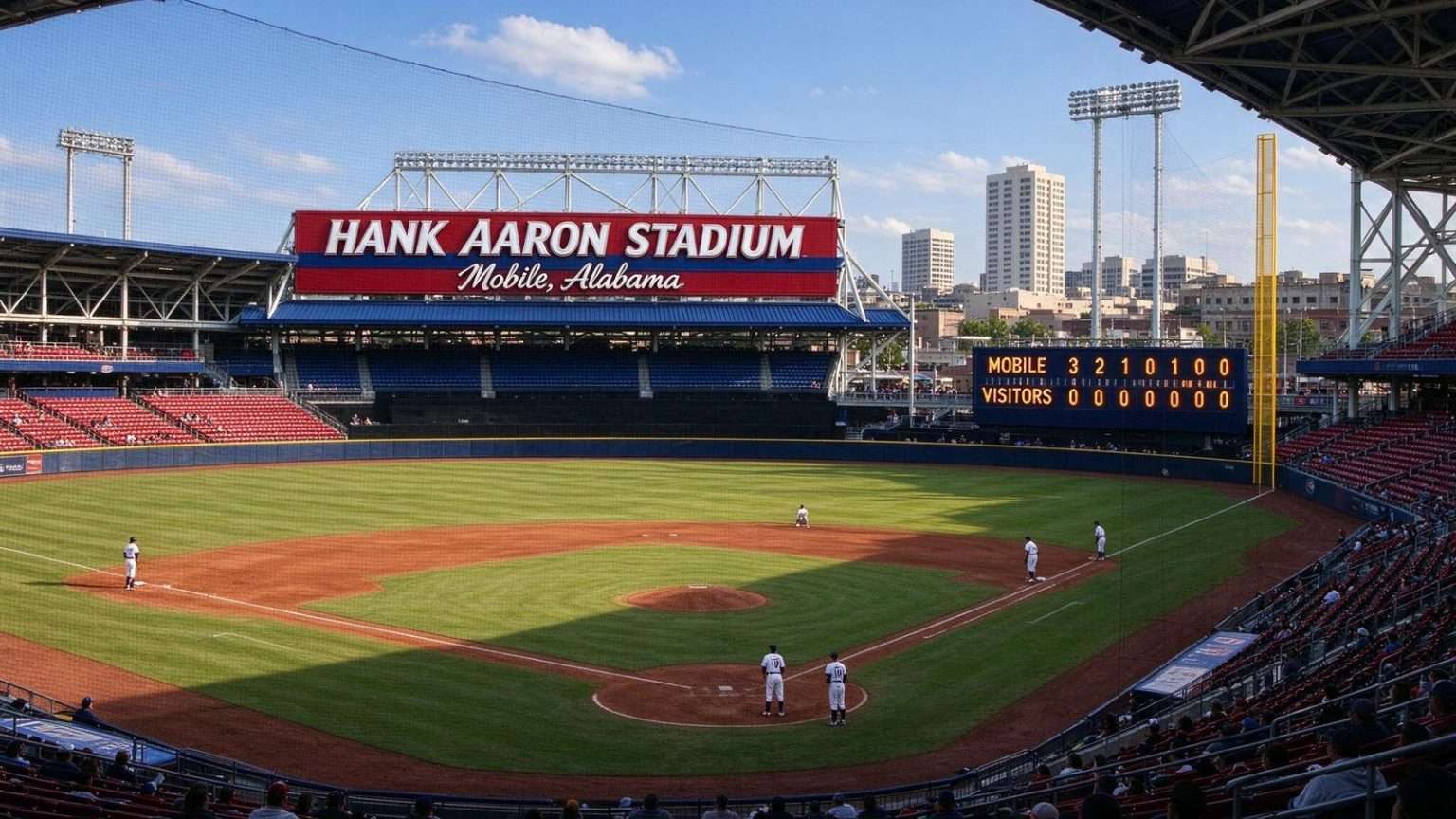
A Mobile City Council committee voted this week to recommend moving forward with nearly $500,000 in upgrades to Hank Aaron Stadium, even as at least one council member raised pointed questions about the wisdom of funding improvements for a tenant with a history of falling behind on payments to the city. The debate touched on lease obligations, the condition of the city’s parks system, and what signal Mobile sends when it spends on a facility whose operator owes it money.
The council’s finance committee approved a resolution requesting that surplus funds from the city’s parks budget be redirected to cover immediate stadium upgrades, including lighting changes requested by Minor League Baseball. Two committee members voted in favor of the recommendation, while a third abstained, citing unresolved questions about who bears financial responsibility for the improvements under the terms of the stadium’s existing lease agreement.
The abstaining council member pushed back repeatedly during the discussion, noting that the stadium’s tenant, a professional baseball team that plays in the Southern League, is currently behind on payments owed to the city under a lease that was already renegotiated once in recent years after the team fell behind. She argued that funding upgrades for a facility with ongoing payment issues sends the wrong signal when so many other city facilities also need capital improvements.
Separate issues, or not?
Supporters of the funding request countered that the stadium upgrades and the team’s outstanding debt are technically separate issues, and that completing the requested improvements is necessary for the city to remain in compliance with its contractual obligations to the team regardless of the payment dispute. That framing — that the city’s maintenance duties and the tenant’s payment record sit on different sides of the ledger — carried the committee vote, but it did not settle the underlying tension.
A staff member representing the mayor’s office acknowledged that, aside from the city’s newest parks, most municipal recreational facilities have significant unmet capital needs, and said the administration is developing a broader plan to identify and prioritize deficiencies across the parks system. The acknowledgment gave the abstaining member’s argument some force: the money being redirected to the stadium is coming from a parks budget that serves facilities with their own backlogs of deferred maintenance.
The funding request stemmed from a letter sent by Minor League Baseball officials last summer specifying lighting and facility standards the stadium would need to meet. Across the country, Minor League Baseball has tightened its requirements for member clubs’ ballparks, and cities that own stadiums have found themselves facing upgrade demands — clubhouse sizes, lighting, field dimensions, player amenities — that can run into the millions of dollars over time.
Why the league standards matter
The letter from Minor League Baseball is the proximate cause of the spending debate, but it reflects a league-wide phenomenon. In recent years the governing body of minor league baseball has raised the bar for the facilities its teams play in, establishing requirements that cover everything from the quality of field lighting to the space available for players, trainers and equipment. Teams that play in aging municipal stadiums have had to choose between pushing their landlords for upgrades and, in some cases, relocating.
Hank Aaron Stadium, named for the Mobile native who holds a place among the greatest players in baseball history, has served as the home of Southern League baseball in the city for decades. The stadium is one of Mobile’s signature recreational facilities, but it is also a decades-old ballpark, and ballparks of that age require continual investment to meet modern professional standards — the kind of investment that only makes sense when a professional tenant is committed to playing there under a long-term lease.
The lighting changes requested by the league are a reminder of how technical these standards can be. Modern stadium lighting requirements govern not just brightness but uniformity across the playing field, which affects broadcast quality, player safety and the fan experience. Replacing or upgrading a lighting system at a baseball stadium is a six-figure project on its own, which is why the league’s letter translated directly into the roughly half-million-dollar request before the committee.
The lease dispute underneath
The heart of the committee’s disagreement was not whether the stadium needs the upgrades — it was whether the city should spend on the facility while the tenant owes the city money. The abstaining member’s position rested on a simple question of fairness and precedent: a lease renegotiated once already after the team fell behind has now slipped again, and committing parks surplus funds to the tenant’s workplace while the payments remain outstanding is, in her view, exactly the wrong message to send about how Mobile manages its assets.
The majority’s position, that compliance with the lease’s facility obligations is legally separate from the tenant’s payment record, is the more cautious reading of the contract. If the lease requires the city to maintain the stadium to professional standards, failing to do so could expose the city to claims by the team regardless of how much the team owes. Municipal attorneys typically advise that a government’s own contractual duties cannot simply be suspended because the other party is in arrears — the remedy for the arrears is enforcement, not withholding performance.
That leaves the city with parallel tracks: pursuing the payments the team owes under the renegotiated lease, and funding the improvements the league requires. The committee’s recommendation moves the second track forward; what happens on the first remains the open question that colored the entire discussion.
The parks budget trade-off
The source of the money — surplus in the parks budget — framed the debate as much as the destination did. Redirecting surplus from one department’s budget to a single facility’s needs means those dollars are not available for other parks purposes, and Mobile’s recreation inventory is large and varied: neighborhood parks, community centers, ball fields, playgrounds and waterfront amenities scattered across the city’s districts.
The administration’s acknowledgment that most facilities outside the newest parks have significant unmet capital needs was an unusually candid summary of the situation facing the city. The broader plan to identify and prioritize deficiencies is intended to give the council a systematic view of those needs, but until that plan is complete, individual funding decisions like this one are being made without a comprehensive map of what else the money could address.
Council members weigh these trade-offs with their districts in mind. A half-million dollars invested in a downtown stadium serves the whole city in one sense — professional baseball is a civic amenity — but the same sum spread across neighborhood facilities would touch more residents directly. That tension is inherent in capital budgeting, and it is why the committee’s vote, though 2-1 in favor with the recommendation, produced more discussion than the dollar figure alone would suggest.
What happens next
The committee’s recommendation moves to the full City Council, which will decide whether to adopt the resolution and redirect the funds. The full council is not bound by committee action, and the abstaining member’s questions — about lease responsibility, about the outstanding payments, about the wisdom of the priority — can be renewed there before any vote.
Meanwhile, the underlying facts remain what they were: a tenant behind on its lease payments, a league requiring facility upgrades, a stadium that carries the name of Mobile’s most famous baseball son, and a parks system with needs of its own. How the council resolves the recommendation will say something about how Mobile balances contractual obligation against fiscal caution — and about which of the city’s many facility needs it treats as most pressing when the money is finite.
Hank Aaron Stadium’s place in Mobile
The stadium occupies a special position in Mobile’s civic identity. The city produced an extraordinary collection of baseball talent — Aaron himself, Willie McCovey, Satchel Paige, Billy Williams, Ozzie Smith among them — and the ballpark named for Aaron stands as a monument to that history as much as a venue for the games played there. When a facility carries that kind of meaning, decisions about its upkeep are never purely financial, and council members weighing the vote know that a rundown stadium bearing Aaron’s name would be a civic embarrassment as well as a league compliance problem.
Professional baseball also brings measurable activity to the area around the ballpark on game nights: ticket sales, concessions, staff jobs and foot traffic that spill into nearby businesses during the season. Losing a Southern League franchise would cost the city more than the lease payments it is chasing, which is part of why keeping the facility compliant with league standards is treated as an investment in the tenant relationship as well as in the building.
At the same time, the episode illustrates the inherent risk of municipal stadium ownership. Cities across the country that own ballparks have found themselves in Mobile’s position — the team falls short financially, the league raises facility requirements, and the public owner is asked to fund improvements for a private enterprise that owes it money. The arrangement can still be worthwhile, but it depends on the lease being enforced and the tenant remaining viable, questions that the council’s discussion suggested are both open.
The compliance clock
League facility standards tend to come with deadlines, and the letter received last summer set the improvements in motion rather than leaving them optional. Lighting upgrades in particular have become more urgent league-wide as minor league stadiums modernize, and a club playing in a facility that falls out of compliance can face pressure from the league — up to and including relocation discussions — which is the scenario Mobile’s supporters of the funding wanted to avoid.
The finance committee’s recommendation, if adopted by the full council, would put the roughly $500,000 to work on the improvements the league specified, drawn from parks budget surplus. The administration’s broader facilities plan, still in development, will eventually provide the systematic prioritization the abstaining member asked for, but the stadium decision will have been made before that plan arrives — which was precisely her point about process as much as policy.
For Mobile residents, the practical questions to watch as the recommendation moves forward are three: whether the council adopts the funding, whether the city pursues collection of the team’s outstanding lease payments in parallel, and whether the administration’s parks plan, when it surfaces, restores confidence that the city’s other facilities are not being left behind. The committee vote has set those questions in motion; the full council will provide the first answers.