Alabama Hip Hop Week Opens With Mobile Food and Clothing Drive
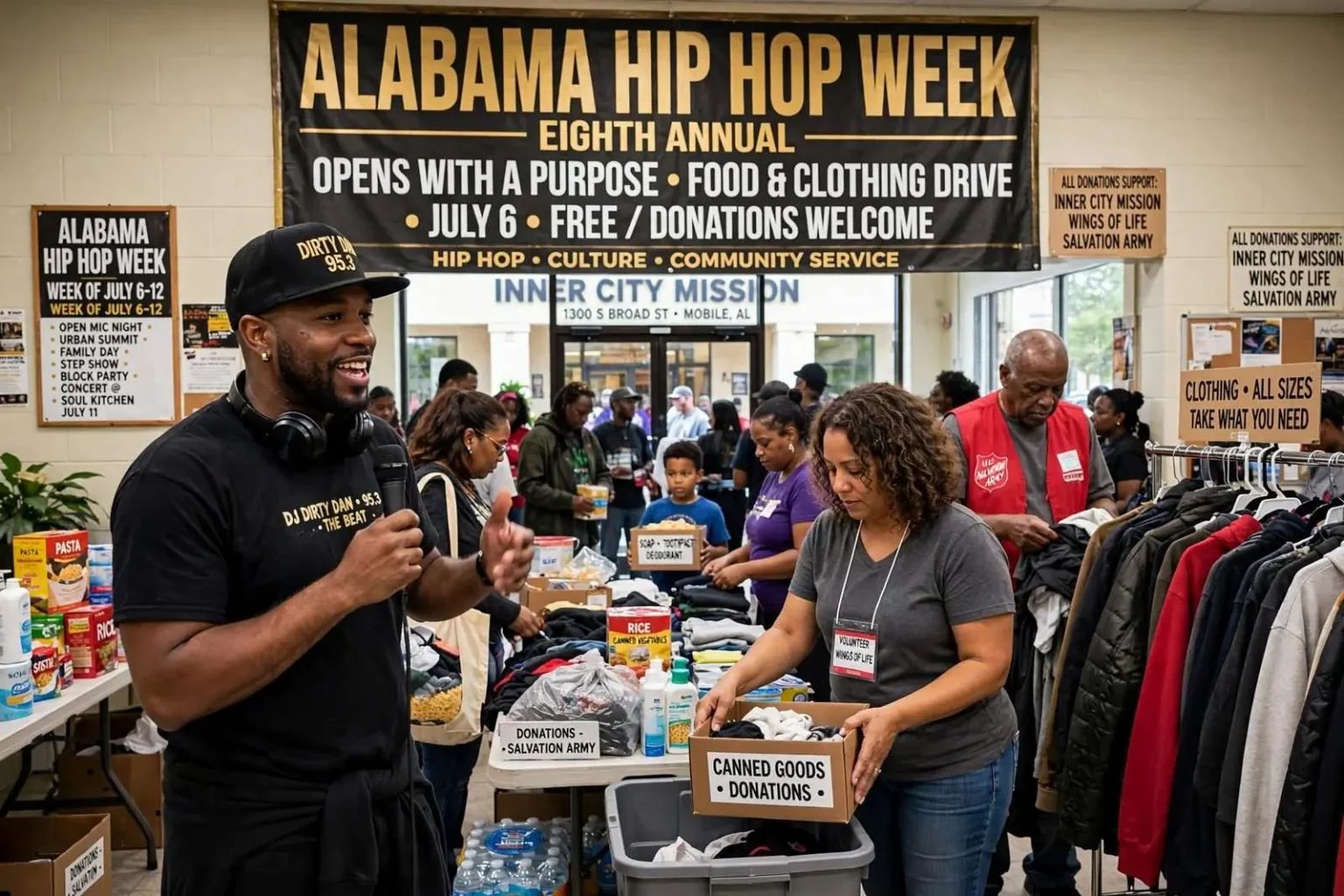
The eighth annual Alabama Hip Hop Week began in Mobile with a food and clothing drive drawing roughly 200 people to Inner City Mission on South Broad Street.
Hip Hop Week Opens With a Purpose
Mobile kicked off the eighth annual Alabama Hip Hop Week on Monday with a community food and clothing drive that drew an estimated 200 people to Inner City Mission on South Broad Street, organizers said. The week-long celebration, which ran from July 6 through July 12, was put together by local radio personality Kalenski Adams, widely known around Mobile by his on-air name, DJ Dirty Dan. The drive filled the mission’s lobby with donated goods in the opening hours of a week that has become one of the Gulf Coast’s most distinctive combinations of culture and charity. Organizers said the turnout exceeded what they had expected for a Monday evening event.
Adams said the group wanted to try something different this year after focusing on a community clean-up in 2014. “Last year we did the community clean-up and we wanted to mix it up this year and help other organizations in the community,” Adams said. The shift from labor drives to donation drives reflected conversations the organizers had after last year’s event, where participants suggested that the week should address the immediate needs of Mobile’s homeless and low-income residents. The change also broadened the range of community groups that could take part, since a drive welcomes volunteers of every age and ability level.
Any food and clothing collected during Monday’s drive that wasn’t distributed on-site was set to go to Inner City Mission, Wings of Life and the Salvation Army, all of which serve homeless and low-income residents in the Mobile area. The three organizations represent different layers of the city’s safety net: a mission offering shelter and meals, a ministry serving families in transition, and the Salvation Army’s long-running social services operation. All three operate on tight budgets and rely on donation drives to stock food pantries and clothing closets throughout the year. Directing the week’s first event toward them set the tone for everything that followed.
South Broad Street itself carries meaning for the event. The corridor through the neighborhood known as Maysville has long been one of Mobile’s historic Black business districts, and hosting the drive at Inner City Mission placed the week’s opening squarely in the community whose young people much of the programming aims to reach. Organizers have deliberately spread Alabama Hip Hop Week’s events across neighborhoods rather than concentrating them downtown, a choice that has shaped the event’s identity as a citywide affair.
A Week of Programming Across the City
Beyond the charitable kickoff, the week filled out with a mix of community and entertainment programming spread across several Mobile neighborhoods. An open mic night gave local musicians a stage, while a midweek urban summit and family day combined youth programming with networking opportunities for artists and small business owners. The summit sessions covered the practical side of a creative career, from recording and promotion to connecting with local business owners who hire and collaborate with artists. Family day activities kept younger children included, a deliberate choice by organizers who want the week to read as a community event rather than a club circuit.
A youth dance and step show in Trinity Gardens gave younger residents a chance to perform, and a mixer downtown brought together industry figures for a more professional-networking-focused evening. Trinity Gardens, the neighborhood north of downtown where the step show took place, has long been a hub for the kind of precision stepping traditions that run through Gulf Coast youth culture. Step teams draw their members from school and church programs across the city, and a public showcase gives the crews an audience beyond their home congregations. The downtown mixer, held the same stretch of days, served the older cohort of producers, promoters and venue operators who keep the scene running.
The week’s public-facing events culminated in a Friday evening art walk through downtown Mobile and a Saturday family day at Texas Street Park, followed that night by a concert at Soul Kitchen Music Hall featuring a lineup of regional hip-hop artists and a tribute set honoring two performers with strong local followings who had died in recent years. The tribute segment drew some of the week’s most emotional moments, with veteran artists paying respects to peers whose careers ended early. Soul Kitchen, the music hall on Dauphin Street’s entertainment strip, has hosted the showcase repeatedly and provides a professional stage for acts that usually play smaller rooms. The pairing of a family-friendly afternoon in the park with a full concert lineup the same evening captured the week’s dual identity in a single day.
The week wrapped up Sunday with a block party along Dauphin Street in downtown Mobile. The closing event closed off the traffic and turned the street over to DJs, vendors and families for the kind of open-air celebration that Dauphin Street has hosted during festivals for generations. Organizers have used the block party format to end the week on a note that invites newcomers, since a street festival asks nothing of its audience but attendance.
Nearly a Decade of Culture and Service
Organizers have used the week for nearly a decade to blend music programming with service projects, giving the event a dual identity as both a cultural celebration and a vehicle for supporting local nonprofits that assist Mobile’s homeless population. That balance did not happen by accident. Adams and his team built the week around the idea that hip hop culture, at its best, is organized around mutual aid as much as artistry, and each year’s schedule has paired performances with a service component aimed at the city’s neediest residents. The formula has kept the event welcome in venues and neighborhoods that might resist a pure entertainment festival.
The event’s staying power reflects a broader push among Mobile-area musicians and promoters to use entertainment programming as a platform for charitable giving, pairing concerts and open mics with tangible support for organizations like Inner City Mission that operate on limited budgets and rely heavily on donation drives to stock food pantries and clothing closets throughout the year. Summer is a hard season for the agencies that feed Mobile’s homeless population, since demand rises as school-year programs close and donations slow. A drive that arrives in early July, in the middle of that gap, lands at the moment the shelves are thinnest.
City officials have not weighed in publicly on the event, but its consistent annual return suggests it has built a loyal following among Mobile’s music community and downtown venue operators who host its various stops throughout the week. Eight years is a long run for a locally organized festival operating without major institutional backing, and the survival of the week owes much to the venue owners and volunteers who absorb its costs. What began as a radio personality’s project has become a fixture of the city’s summer calendar, one that ends each year the way it began: with the community asked to give something back.
Why the Drive Mattered So Much
The scale of the need behind Monday’s drive is easy to miss in a city known for its festivals and waterfront renewal. Mobile’s homeless population includes families with children, veterans and older residents living on fixed incomes, and the agencies that serve them run on donations and grants that arrive unevenly through the year. Inner City Mission, anchored on South Broad Street, provides shelter, meals and a pathway toward stable housing for men, women and families, while Wings of Life and the Salvation Army cover overlapping ground with their own programs. None of the three can afford to turn away donations of food and clothing, and none could have generated a crowd of 200 donors on their own on a Monday night in July.
The drive also served as a hands-on introduction for people who had heard of Alabama Hip Hop Week but never participated. Families who came to drop off a bag of groceries stayed to volunteer, and organizers used the occasion to hand out the week’s full schedule, ensuring that the crowds who showed up for charity also showed up for the concerts, the summit and the block party. That crossover was the point. Adams has argued for years that the culture and the community work are the same project, and the Monday turnout gave him the strongest evidence yet that Mobile’s hip hop audience agrees.
A Week With Deep Local Roots
The designation as Alabama Hip Hop Week, rather than simply a Mobile event, reflects the ambition of its organizers. The week has drawn participants from Baldwin County and communities across the lower Alabama Gulf Coast, and its showcase lineup has always mixed Mobile acts with artists from Pensacola, Biloxi and beyond. The name stakes a claim for the state’s second city as the center of Alabama hip hop culture, a claim Mobile’s scene has backed with a deep bench of DJs, producers and promoters. For local artists, the week functions as an annual homecoming, a moment when the city’s scattered venues and crews share stages and audiences.
The July timing also gives the week the summer season largely to itself. Mobile’s festival calendar peaks during Mardi Gras in winter and thins out through the humid months, and a mid-July week fills a gap for local musicians whose regular bookings slow down with the season. Venue operators on Dauphin Street have come to count on the week’s traffic, and the Saturday concert at Soul Kitchen has become a dependable showcase for acts angling for larger bookings. The block party finale, meanwhile, gives neighborhoods east of downtown a reason to come into the city core and see what the scene has built.
By the time the last Sunday night block party wrapped along Dauphin Street, the week had once again lived up to its double billing: a celebration of music and a working charity drive, each carrying the other. The food and clothing left after Monday’s distribution was delivered to the three partner agencies, the week’s concerts paid performers who rarely get paid showcases, and the eighth annual edition closed with organizers already talking about how to mark the ninth. For the residents who donated, performed or simply showed up, the week demonstrated the formula its organizers have preached for nearly a decade, that culture and community service are strongest when they arrive together.