American Lotus in Full Bloom Across the Mobile-Tensaw Delta
Golden American lotus flowers are carpeting stretches of the Mobile-Tensaw Delta this summer, drawing paddlers to one of the region's showiest natural scenes.
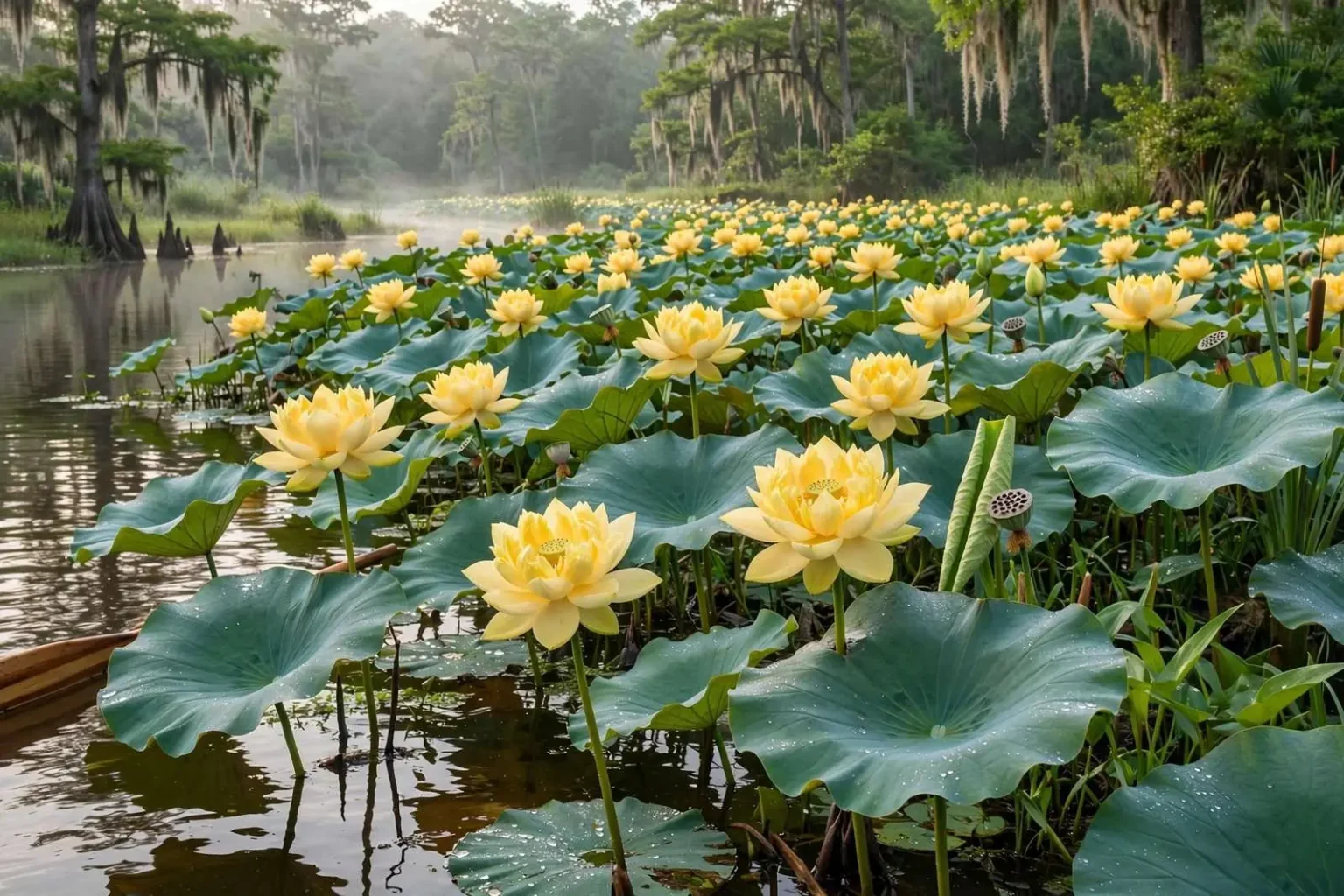
Along the banks of the Tensaw River, a quarter-mile stretch of shoreline has erupted into a carpet of gigantic golden blooms, as the American lotus reaches its brief but spectacular summer peak across the Mobile-Tensaw Delta. For a few weeks each summer, the most dramatic botanical show in south Alabama plays out in the middle of the state’s largest wetland, where paddlers drifting the river’s quiet channels find the banks transformed by flowers that look borrowed from the tropics.
The flowers, roughly the size of salad plates, rise a full foot above broad, water-repellent pads that themselves stand nearly two feet above the water’s surface on sturdy stalks. The architecture of the plant is what makes the display so striking from a canoe or kayak: rather than floating flat on the surface like the familiar water lily, the American lotus lifts its blooms and its saucer-sized leaves into the air on rigid stems, creating a waist-high thicket of green and gold along the waterline that sways with the river’s current.
The plant is found in shallow ponds and slow-moving rivers throughout the South, from Florida to Texas, but the Delta’s dense stands have long drawn naturalists and paddlers alike. The Mobile-Tensaw Delta — the vast wetland where the Alabama River’s forks spread into a maze of bayous, rivers and bottomland forest at the head of Mobile Bay — offers exactly the combination the lotus demands: shallow, slow, nutrient-rich water with soft bottoms where the plant’s sprawling root systems can anchor and spread.
The flower has deep historical roots in the region. Eighteenth-century naturalist William Bartram described encountering the blooms during his travels through the Delta, writing admiringly of flowers that opened “double as a rose” and stretched seven or eight inches across in a “lively lemon color.” Bartram’s accounts of his journeys through the Southeast in the 1770s remain one of the earliest written portraits of the region’s natural wealth, and the lotus stands he recorded along these rivers are still producing the same spectacle more than two centuries later.
The American lotus is a botanical cousin of the lotus species found in Asia and Africa, distinguished mainly by its yellow rather than pink petals. The resemblance is close enough that paddlers who know the lotus of Asian art and temple ponds will recognize the form immediately — the great cupped blooms, the distinctive seed pods, the shield-shaped leaves — even as the color marks it unmistakably as a native of American waters.
Planted on Purpose
According to naturalist and author Fred Nation, the lotus likely didn’t arrive in the Delta by accident. He said prehistoric Indigenous communities in the Southeast are believed to have deliberately planted and spread the lotus, along with species like Chickasaw plum, yaupon and Osage orange, across the region. The idea reframes the Delta’s lotus beds as something more than wild scenery: they may be living remnants of ancient food landscapes, cultivated by peoples who understood the plant’s value centuries before the first naturalist described it in English.
Nearly every part of the plant is edible, from the flower and stem down to the starchy, banana-shaped root buried deep in the mud. That root — the lotus root familiar from Asian cuisine — is the prize, and it explains both the ancient cultivation and the plant’s enduring pull on foragers. The young leaves and seeds are edible as well, but the root carries the calories, and harvesting it has always meant work: the roots run deep in the sediment, well below where a casual wader can reach.
Harvesters traditionally locate the roots by feel, wading through thick, dark sediment while sharing the water with snakes and alligators. It is, by any honest description, an uncomfortable harvest. The Delta’s water is opaque, its bottom shifts underfoot, and its summer residents include species that demand a forager’s full attention. Those who have harvested Delta lotus roots describe the work as an exercise in patience — feeling along the buried rhizomes inch by inch, cutting them free, and hauling them up through a foot or more of mud.
Locally, at least one Fairhope restaurant has been known to feature lotus root on its menu when it’s in season, a small culinary echo of the plant’s ancient role in the region’s diet. The appearance of a native Delta root on an Eastern Shore menu is a reminder that the region’s edible landscape extends well beyond its famous seafood — into the swamps and rivers where Indigenous communities ate from the water centuries before the first restaurant opened on the bay.
An Ecological Engine
Beyond its culinary uses, the lotus plays a meaningful ecological role. Nation noted that the broad, shading leaves shelter fish, frogs and alligators, while the plant’s characteristic funnel-shaped seed pods — often seen dried and used in floral arrangements — hold seeds that feed waterfowl and other wildlife. The dense stands function as habitat in the fullest sense: shade for the small creatures hiding from herons, ambush cover for the predators hunting them, and a nursery of insects and seeds feeding the food web from the bottom up.
The plant’s summer dominance is also temporary. After the bloom fades and the pods mature, the stands begin to brown and break down, and by fall the shoreline thickets that shaded the riverbanks in July have largely collapsed back into the water, leaving the seed pods to rattle on their stalks and the roots to wait out the winter in the mud. The brief season is part of what makes the peak bloom an event that draws paddlers to plan around it rather than something the Delta simply offers on demand.
For visitors hoping to see the bloom, the Delta’s paddle trails offer the surest access. The waterways around the Tensaw, Blakeley and Apalachee rivers thread through some of the densest lotus habitat, and outfitters and paddling groups along the Delta consistently rank the lotus bloom among the summer’s signature sights. Early morning is the best window — the flowers open with the sun, the heat has not yet built, and the wildlife that shelters among the stands is at its most active.
The Delta itself deserves equal billing with the flower. Covering hundreds of thousands of acres at the confluence of the Alabama and Tombigbee river systems, the Mobile-Tensaw Delta ranks among the largest wetland ecosystems in the United States and has been called the Amazon of Alabama for its density of species — from black bear and alligator to more than 300 kinds of birds. Its lotus beds are one feature of a landscape that sustains the fisheries of Mobile Bay, filters the water flowing into the Gulf and anchors one of the most productive ecosystems in North America.
That abundance is why botanists and naturalists keep returning to the lotus story. A plant that is edible from flower to root, that shelters an entire community of wildlife, that was carried and planted by ancient peoples across the Southeast, and that still produces a two-week spectacle capable of drawing paddlers off the highways — few native plants gather so many threads of the region’s natural and human history into a single bloom.
Nation, a longtime chronicler of the Delta’s plants and their uses, has made the Indigenous-cultivation argument in his writings on the region: that the Southeast’s landscape encountered by the first European explorers was not untouched wilderness but a managed, gardened world, its useful species spread deliberately along the waterways. The lotus stands of the Mobile-Tensaw fit that account — dense, productive, and concentrated exactly where a community harvesting them would want them to be.
Whether the quarter-mile display now visible along the Tensaw represents a good year for the plant is hard to say without long-term monitoring, but locals who paddle the river regularly describe the bloom as one of the highlights of the paddling calendar, worth rearranging a summer schedule to catch. The peak passes quickly, and the window to see the Delta at its most golden is measured in weeks, not months.
For now, the shoreline stands are at their height, the seed pods are still green, and the paddlers are finding their way to the banks where Bartram once marveled at flowers opening “double as a rose.” The Delta’s great summer show is underway — rooted, as it may well have been for a thousand years, in mud planted on purpose.
The lotus season also intersects with one of the Delta’s less welcome dynamics. Dense native stands like these can be crowded out by invasive aquatic vegetation, and the health of the lotus beds is often cited by paddlers and naturalists as a barometer of the Delta’s condition. Native plants that anchor shorelines and feed wildlife are the first losers when herbicide treatment, development or saltwater intrusion reshapes the system, which makes each year’s bloom worth more than a photograph — it is a reading on how the wetland is holding up.
For photographers, the morning bloom offers the most reliable light. The flowers track the sun through the day, opening fully by mid-morning and closing toward evening, and the low-angle light of early hours turns the acres of standing pads into layered gold-and-green geometry. The quarter-mile stretch on the Tensaw has become a known destination among area photographers for exactly that reason, arriving by canoe before the tour boats and finding the banks already lit.
The plant’s usefulness did not end with the arrival of markets and restaurants, either. Gardeners across the Gulf Coast have long experimented with native lotus in ornamental ponds, where the plant’s dramatic blooms and standing foliage make it a centerpiece in anything larger than a tub. Care is the catch — in a generous earthen pond, the lotus spreads with the vigor of the plant it is, sending rhizomes across the bottom until it owns the water. It is a plant that remembers being cultivated for food, and it behaves accordingly.
All of which returns to the core fact of the summer bloom: it is fleeting, it is ancient, and it is almost entirely accessible. No fees, no tickets, no schedule — just a river, a paddle craft and a stretch of shoreline where one of the largest native flowers in North America is doing what it has done since long before Bartram put pen to paper. The pods will rattle dry by September, the banks will quiet down, and the Delta will keep the memory in its mud until next July.