Mobile SWAT Standoff Ends in Arrest After Domestic Violence Shooting
Mobile police arrested a man after a domestic violence shooting and armed standoff at an apartment complex on Old Shell Road early Sunday morning.
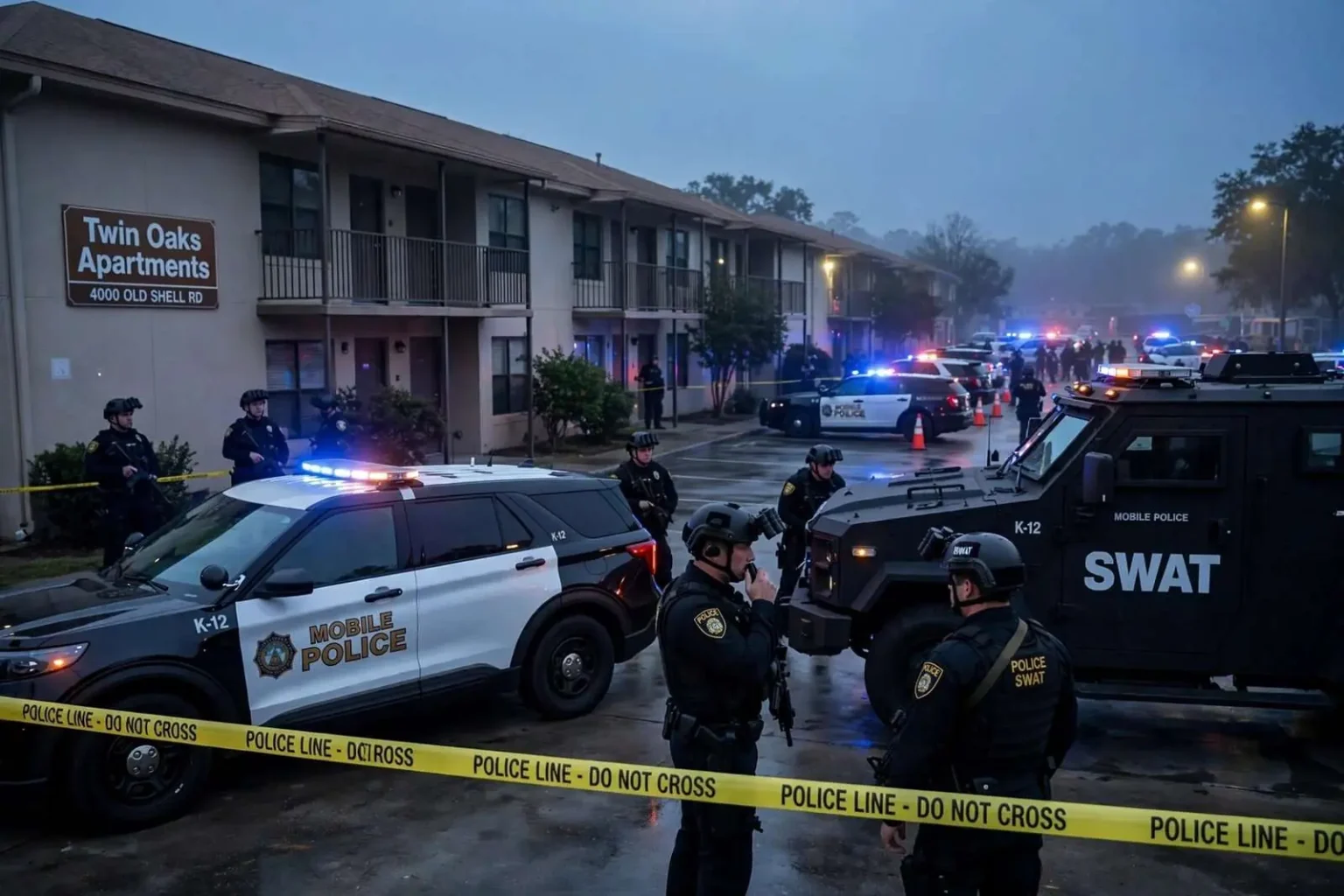
A domestic violence call in west Mobile turned into a tense standoff early Sunday morning after officers found a woman suffering from multiple gunshot wounds outside her apartment, according to Mobile police. The incident on Old Shell Road brought patrol officers, SWAT operators and hostage negotiators to an apartment complex before dawn, and it ended with a barricaded suspect in custody and a 25-year-old woman fighting to recover.
Officers responded to the Twin Oaks Apartments on Old Shell Road just before 6 a.m. after receiving a report of domestic violence, a police spokesman said. When they arrived, they located a 25-year-old woman outside the apartment with multiple gunshot wounds. The woman told officers her boyfriend, 31, had shot her several times before barricading himself inside the apartment.
She was transported to a local hospital, where she was listed in stable condition. Her survival — after being shot multiple times at close range — was the incident’s one piece of good news. Medics rushed her from the scene while officers established a perimeter around the complex, uncertain whether the man inside still had the weapon that had just been fired.
With an armed suspect refusing to come out, Mobile police called in the department’s SWAT team along with hostage negotiators to manage the standoff. After a tense but relatively brief confrontation, the suspect surrendered and was taken into custody without further incident or injury to responding officers. The surrender closed out an early morning that could have ended far worse for the woman, the neighborhood and the officers surrounding the building.
Police charged him with Domestic Violence First Degree, the most serious domestic violence classification under Alabama law, reserved for cases involving serious physical injury or the use of a deadly weapon. The charge carries significant prison exposure, and prosecutors treat it as a marker of cases where a victim came within minutes of being killed.
Why SWAT and Negotiators Respond
SWAT and negotiator call-outs like this one are typically reserved for standoffs where officers believe a barricaded suspect poses an ongoing threat to themselves, hostages or the surrounding neighborhood. The calculus in a domestic shooting is unforgiving: a man who has already fired multiple rounds at a partner, and who still may be armed, behind an apartment door with unknown conditions inside, is exactly the scenario patrol commanders do not want to resolve by force alone.
Negotiators work first. Their role is to open a line of communication with the barricaded suspect, slow the situation down, and talk the person out without another shot fired. Every hour a standoff continues safely is an hour in which the legal outcome can shift from a shooting scene to an arrest — and in this case, the tactic worked. The suspect came out and surrendered, and no one else was hurt.
The Scene on Old Shell Road
Old Shell Road is a busy commercial and residential corridor running through Mobile, and the apartment complex where the shooting occurred sits among other residential properties in the area. Police temporarily secured the surrounding streets while negotiators worked to bring the standoff to a peaceful resolution, rerouting early-morning traffic and holding a perimeter that kept residents away from the apartment building while the situation developed.
Neighbors in the complex woke to police vehicles, barricade tape and the sight of officers in tactical gear taking positions around the building. In apartment communities, a standoff is a neighborhood event: residents cannot leave, others cannot return, and everyone waits for word that the person inside is in custody. By Sunday morning, that word came — the suspect surrendered, was handcuffed, and was driven from the scene to booking.
The secured perimeter also protected the crime scene. The apartment where the shooting began, the parking areas where the wounded woman was found, and the shell casings and physical evidence left behind all had to be preserved for investigators, who began documenting the scene as soon as the surrender made it safe to do so.
Domestic Violence First Degree Under Alabama Law
The charge the boyfriend faces — Domestic Violence First Degree — is reserved under Alabama law for the most serious domestic violence cases: those in which the offender causes serious physical injury to a family or household member, or uses a deadly weapon in the assault. A conviction carries a determinate prison sentence measured in years, and the classification exists precisely to distinguish shootings and beatings that nearly kill from lesser assaults.
Alabama’s domestic violence statutes are organized by degree, with the first-degree charge carrying the heaviest penalties. Prosecutors in Mobile County have made domestic violence cases a priority, reflecting both the volume of such calls — among the most frequent serious calls police answer — and the danger they pose to victims, children and responding officers. Domestic violence calls are statistically among the most dangerous calls law enforcement responds to, for everyone involved.
The woman’s multiple gunshot wounds will be central to the prosecution’s case, alongside her account to officers at the scene, physical evidence from the apartment, and any statements the suspect made during the standoff. His surrender and arrest without further violence preserved the evidence investigators need to present the case in court.
The Broader Pattern of Domestic Violence Calls
The incident adds to a string of domestic violence calls that have drawn a heavy police response in the Mobile area, underscoring the resources departments dedicate to de-escalating situations where firearms are involved. Advocates and police alike describe a pattern that repeats across the region: escalating abuse, a weapon introduced, and a moment of crisis that arrives without warning — often late at night or in the early hours, inside homes and apartments where no one outside can see what is happening.
Domestic violence advocates in the Mobile area have long emphasized that the hours and days after a shooting or violent episode are the most dangerous for a victim, and that safety planning — a place to go, people to call, documentation of injuries — can be lifesaving. Local shelters and crisis lines operate around the clock to receive victims who leave situations like the one on Old Shell Road, and advocates encourage anyone in danger to reach out before a situation reaches the point a police standoff becomes necessary.
For police, the lesson of Sunday morning’s outcome is the value of patience. A barricaded suspect who has just shot someone is at the highest risk point of the entire relationship — the moment when a person who believes he has nothing to lose may turn a weapon on officers, or on himself. Negotiators talking a suspect out, however slow it feels to the neighborhood waiting behind the tape, is the outcome that saves the most lives on the scene.
What Happens Next
The suspect remains in custody facing the first-degree domestic violence charge, and his case now moves into the Mobile County court system, where an initial appearance and bond determination will follow. Prosecutors will build the case from the victim’s statement, her medical treatment records, the physical evidence at the apartment and the account of the standoff that ended in his surrender.
The woman, listed in stable condition at the hospital, faces a recovery measured in surgeries and rehabilitation — the physical legacy of being shot multiple times at close range by a partner. Advocates note that victims of serious domestic violence often need support well beyond the criminal case: housing, counseling and protection orders to keep the person who shot them away as the court process unfolds.
For the Twin Oaks Apartments community, the morning’s events leave the residue that every shooting leaves in a residential complex — questions about what was heard through the walls, and relief that it ended the way it did. A woman survived. A suspect is in custody without another shot fired. And a neighborhood that woke to barricade tape went to bed knowing how much worse an early Sunday morning on Old Shell Road could have been.
The timeline of the standoff itself — from the 911 call just before 6 a.m. to the surrender — illustrates how the department sequences such responses. Patrol officers arrive first, locate the victim, and establish whether the suspect is still inside and armed. The perimeter goes up immediately, because an apartment complex has multiple exits, balconies and sightlines that must be covered. Only then do SWAT operators and negotiators take over the direct engagement, while supervisors keep the scene from becoming chaotic.
Each of those layers has a purpose. The perimeter keeps the suspect from fleeing into the neighborhood and keeps bystanders from wandering into danger. The negotiators give the suspect a path out that does not end in gunfire. The SWAT posture provides the backstop — the capability to enter by force if talks fail, which exists so that it usually doesn’t have to be used.
Mobile police have not released additional details about the relationship between the suspect and the victim beyond confirming they were boyfriend and girlfriend, nor have they detailed the weapon involved. Those specifics will emerge through the court process, where charging documents and testimony will lay out the sequence of the assault. What the department confirmed publicly is the essential outline: a woman shot multiple times, a suspect barricaded with a weapon, a negotiation, and an arrest.
Residents with information about the case, or about the events inside the apartment before police arrived, can contact Mobile police investigators. In domestic violence prosecutions, details that neighbors observe — arguments heard, injuries seen, prior incidents — often corroborate the pattern of abuse that prosecutors present alongside the evidence of the final assault.