Downtown Mobile Rolls Out Early St. Patrick’s Day Parade
The Exchange Club of Mobile's St. Patrick's Day parade brought green-clad crowds to downtown Mobile ahead of the holiday itself.
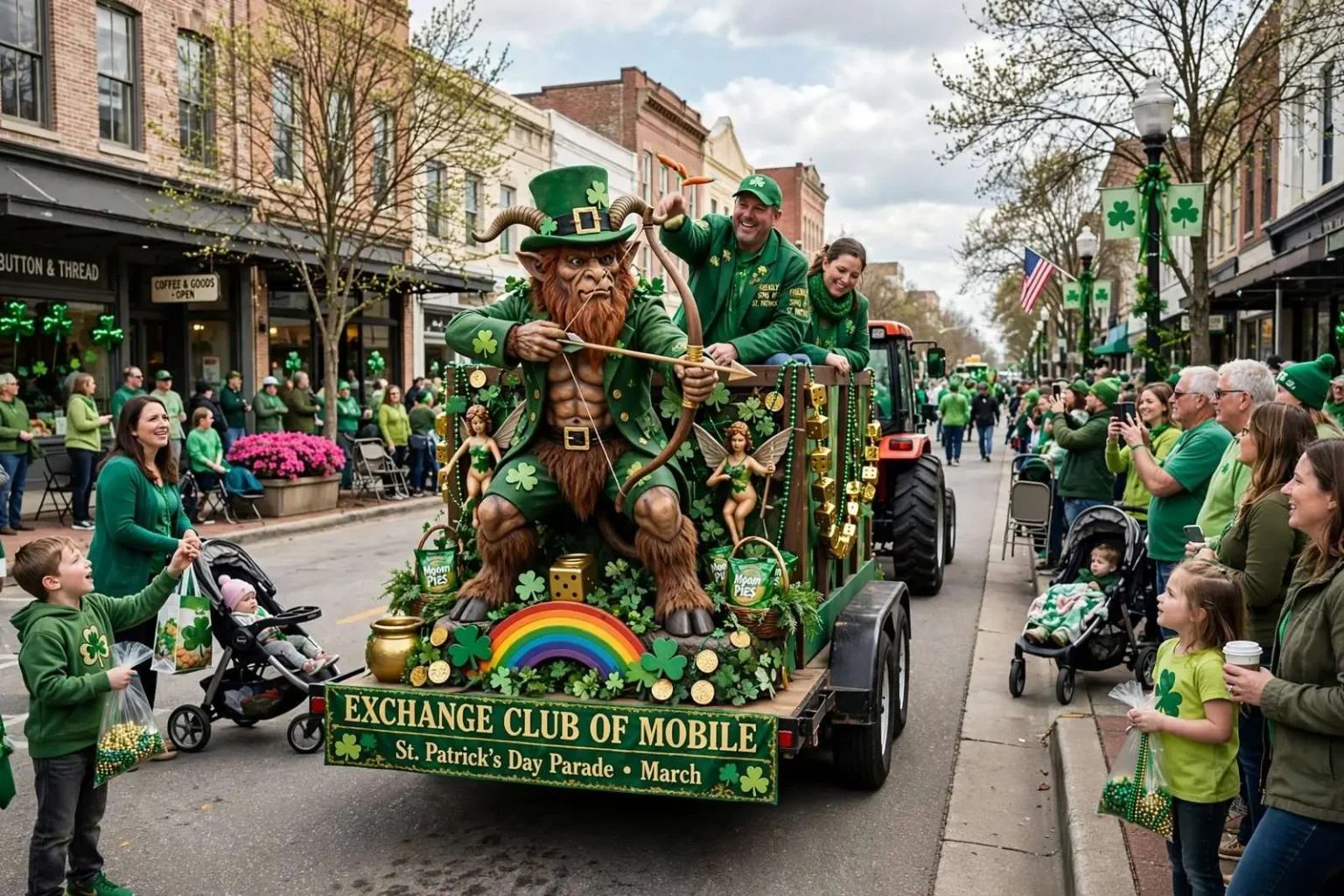
Just weeks after the last Mardi Gras float rolled through downtown, Mobile’s parade season kept going Saturday afternoon as the Exchange Club of Mobile staged its annual St. Patrick’s Day procession through the heart of the city. Crowds began claiming spots along the route well before the first units moved at around 2 p.m., and unlike the barricaded corridors of Carnival, many spectators simply stood curbside to catch a glimpse of the floats and riders. The open setup gave the afternoon an easygoing, neighborhood feel that regular attendees have come to expect from the early spring event, which has quietly become a fixture on the city’s crowded parade calendar.
Weather cooperated after days of rain had soaked the Gulf Coast. Temperatures held in the low-to-mid 70s under partly cloudy skies for much of the afternoon, giving spectators a comfortable window to watch the procession pass without the heat that can make March afternoons along the coast feel like summer. The dry stretch was welcome news for organizers and float riders alike, since wet weather in the days leading up to a parade can leave routes slick and cut into crowd sizes. By mid-afternoon, sidewalks along the downtown portion of the route were lined with families, strollers and folding chairs.
Even though the actual holiday was still a few days away on the calendar, green was everywhere. Parade-goers turned out in every imaginable shade, from emerald and forest green to chartreuse, olive, lime and classic shamrock, embracing the spirit of the holiday well ahead of schedule. Nearby shops did steady business with visitors picking up last-minute beads and green accessories, and it was common to see entire families coordinated in matching shirts for the occasion. For children at the curb, the green-drenched spectacle served as a colorful preview of a holiday they would celebrate again before the week was out.
The willingness of so many residents to turn out for a holiday that had not technically arrived says something about Mobile’s appetite for parades. In a city that has staged Carnival celebrations since the early 18th century and bills itself as the home of the nation’s original Mardi Gras, a procession is less an event than a habit. The St. Patrick’s Day parade slots neatly into a spring calendar that also includes a growing list of neighborhood and themed processions, extending a season that in most American cities ends abruptly on Ash Wednesday.
Irish Folklore Rolls Through Downtown
The floats leaned into Irish folklore and playful costuming. One of the most talked-about entries featured a half-leprechaun, half-minotaur figure standing at the front of the float with a bow and arrow, flanked by smaller mythical characters tucked among leafy greenery. The hybrid creature drew double-takes and phone cameras along the route, with spectators debating whether it was a leprechaun gone wrong or a minotaur celebrating the wrong holiday. Other units carried shamrocks, rainbows and pots of gold, standard iconography for a parade that borrows its themes from Irish tradition rather than Carnival.
The craftsmanship on display reflected Mobile’s long institutional memory for float building. Generations of local builders have plied the trade here, supplying Carnival societies and civic groups with rolling scenery, and civic parades like this one benefit from the same pool of talent, tractors and trailers. Riders on many units wore costumes matching their float themes, and the pace of the procession — slower and more conversational than a typical Mardi Gras run — gave float riders time to interact with the crowd rather than simply throwing and moving on.
Riders from the Friendly Sons of St. Patrick’s kept things light as well. One rider surprised the crowd by tossing carrots instead of the usual beads, drawing laughter from children who scrambled for the vegetables anyway and from parents who appreciated the novelty. The Friendly Sons, a fraternal organization with deep roots in Irish-American communities across the country, have long been a staple of St. Patrick’s season on the Gulf Coast, and their riders brought the kind of good-natured showmanship that keeps families coming back to the route year after year.
Throws were plentiful throughout the route, with strings of gold dice beads and green shamrock beads drawing enthusiastic cheers from the curbside crowds. Riders also handed out the parade staple of Moon Pies alongside a green taffy treat, keeping the crowd well supplied without the frenzy sometimes seen during Mardi Gras season. The Moon Pie, a snack cake that became Mobile’s signature throw decades ago, remains the currency of local parades, and the green-tinted treats handed out Saturday fit the holiday theme perfectly. Children left the route with bags heavy with beads, and plenty of adults went home with their own hauls.
The mood along the route was noticeably calmer than during the Carnival season that had wrapped up just weeks earlier. Parents stood with small children close to the float line, an arrangement few would attempt during the city’s biggest Mardi Gras processions, and riders took time to pose for photographs and hand throws directly to the youngest spectators. For families who find the downtown Mardi Gras crowds overwhelming, the St. Patrick’s Day parade has become the comfortable alternative — all of the spectacle with a fraction of the crush.
The Exchange Club’s Long Parade Tradition
The parade has become something of a tradition for the Exchange Club of Mobile, giving the community a reason to gather downtown again just weeks after Mardi Gras festivities wrapped up. Exchange Clubs across the country are civic service organizations whose local chapters raise money for community causes, with a national focus on child abuse prevention efforts, and the Mobile club has used its parade both as a signature event and as a visible way to connect with the public. The annual procession ties a festive afternoon directly to the organization’s year-round service mission in the Mobile community.
Civic club parades occupy an important place in Mobile’s procession calendar alongside the mystic societies that dominate Carnival. Organizations such as the Exchange Club can stage a parade with volunteer labor, member-built units and community sponsors, keeping costs manageable while still delivering a full procession. The model has kept mid-sized parades viable in an era when the logistics of a downtown event — police escorts, street closures, cleanup crews — grow more complicated every year, and it has preserved a place on the calendar for processions that would not otherwise exist.
Organizers and longtime attendees say the event continues to draw steady crowds year after year, even with the official St. Patrick’s Day holiday still days off on the calendar. That consistency has made the parade a reliable early-March anchor for downtown businesses, whose restaurants and shops see a lift on parade afternoons as processions bring foot traffic that ordinary weekends do not. The event’s family-friendly crowd tends to arrive early, linger after the last float passes and spread spending across an entire afternoon rather than a single evening.
A Lower-Key Follow-Up to Carnival
For a city known nationally for its Carnival celebrations, the early St. Patrick’s Day parade offers a lower-key, family-friendly follow-up that keeps the parade season going a little longer each spring. Mobile’s Mardi Gras, which traces its local roots to 1703 and now spans weeks of processions before Lent, draws large crowds to downtown streets each winter and anchors the region’s tourism calendar. An event like Saturday’s procession operates on a far different scale, but it serves a similar civic purpose: giving the community a shared ritual, a reason to gather downtown and a spectacle that belongs to everyone.
The timing also works in the parade’s favor. By mid-March, the frenetic pace of Carnival is a memory, school spring breaks are approaching, and the first warm weekends of the year draw residents outdoors. A Saturday afternoon parade with mild temperatures and a manageable crowd size hits a sweet spot for families with young children and for older residents who have stepped back from the Mardi Gras crush. The result is an event that fills a niche no other procession on the calendar quite occupies, straddling the line between holiday celebration and community festival.
A Sign of Spring on the Gulf Coast
For many downtown Mobile residents and visitors, the early procession has become as much a marker of the changing season as the flowering azaleas that typically bloom around the same time each March. Mobile’s embrace of the azalea runs deep — the city has long been known as the Azalea City, and the flowering shrubs that line its streets and parks hit their peak color as the parade calendar moves past Carnival and toward spring. Locals tend to measure the season by both: when the azaleas open and the Exchange Club’s floats roll, winter is officially over on the Gulf Coast.
The parade also reinforces downtown Mobile’s pull as an entertainment destination. Investment in the city center over recent decades — new residential units, restored storefronts and a steady stream of festivals and public events — has given processions like Saturday’s a denser residential audience than they enjoyed a generation ago. Residents who live within walking distance of the route treat the parade as a neighborhood occasion, carrying chairs and strollers to the curb on foot rather than driving in and circling for parking.
With another St. Patrick’s Day procession in the books, Mobile’s parade season rolls on toward the events of late spring and summer, and the Exchange Club of Mobile can count another year of steady crowds, full bags of throws and green-clad families along its route. For a city that never really stops parading, the early celebration of an Irish holiday has earned a permanent place on the calendar — a little greener, a little quieter and a few weeks ahead of everyone else.