Mobile Cracks Down on Peddler’s Licenses at LoDa ArtWalk
Mobile officials began random peddler's license checks at LoDa ArtWalk, enforcing a long-ignored rule as the downtown arts event grew in popularity.
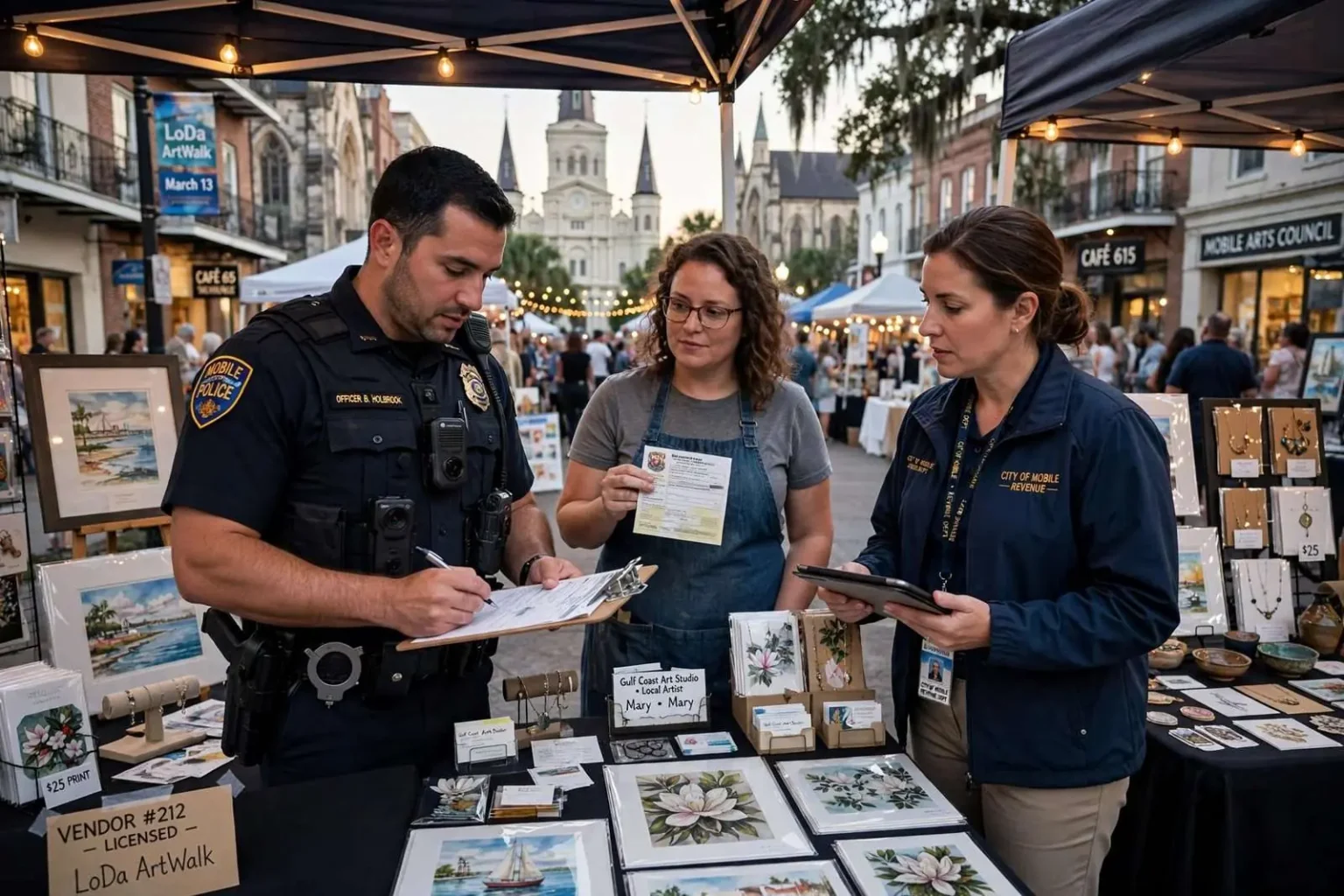
Vendors setting up at Mobile’s popular LoDa ArtWalk faced a new layer of scrutiny this month as city officials began actively enforcing peddler’s license requirements that had gone largely unenforced since the monthly arts event began. City revenue officials and Mobile Police Department officers conducted random compliance checks during the March 13 ArtWalk, moving through the crowds of Cathedral Square and the surrounding blocks to confirm that vendors had registered with the city before setting up their tables.
The checks marked a turning point for an event that has operated for years on informal tradition. LoDa ArtWalk, a monthly showcase of local artists concentrated around Cathedral Square, is jointly presented by the Mobile Arts Council and the city’s special events department, and the event’s growth into a downtown institution is precisely what brought the licensing question to a head.
While peddler’s licenses have technically been required of vendors since the event started, city spokesman George Talbot confirmed that the renewed enforcement effort followed months of negotiations between city officials and the arts council. Those discussions weighed how to protect the open, spontaneous character that made ArtWalk popular while bringing order to an event that had outgrown the rules it was born under.
Mobile Mayor Sandy Stimpson said the crackdown grew out of ArtWalk’s own success. “This community event is experiencing the best problem you could have: overwhelming participation,” Stimpson said in a prepared statement. “Due to increased popularity, the city of Mobile and the Mobile Arts Council have decided on best practices that preserve the artistic integrity of the event while addressing issues that have risen due to increased participation.”
Downtown Businesses Back the Push
The push for enforcement has support from downtown business owners who compete with ArtWalk vendors for foot traffic and sales. Carol Hunter, a spokeswoman for the Downtown Mobile Alliance, said brick-and-mortar gallery and shop owners have long felt the licensing gap gave unlicensed vendors an unfair advantage.
“The brick and mortar folks pay the sales taxes and business licenses and all of that,” Hunter said. “They always felt it was a little bit of an unfair advantage for folks to set up in public (right-of-ways) and conduct business.”
The grievance Hunter described is a familiar one in historic commercial districts across the country, where monthly market events draw crowds that overflow from the sidewalk into the shops. Downtown Mobile’s galleries and retailers stay open late for ArtWalk specifically to capture the event’s crowds, and owners who make that investment have argued that vendors selling the same goods from folding tables, without a license or rent, undercut the very businesses the event was created to support.
The alliance’s support gave the city political cover for an enforcement effort that could easily have been read as hostility toward the arts. With the Downtown Mobile Alliance and the Mobile Arts Council both at the table, the licensing push was framed from the start as a partnership between the city’s business and artistic communities rather than a crackdown imposed on one by the other.
City officials first signaled their intent to enforce the licensing rule back in October 2014, giving vendors months of advance notice before checks actually began. The lengthy runway was intentional, allowing regular vendors to obtain their licenses and giving the arts council time to communicate the change through the channels artists actually use, before the first police officer asked a single vendor for paperwork.
How the Compliance Checks Worked
Talbot said the deadline to register with the Mobile Arts Council to reserve a display space had already passed by the time enforcement started, though he noted the city retained some flexibility for artists who wanted to participate on short notice. That flexibility matters to the character of the event, which has always included artists who show up month to month without a long-term plan, and the negotiated structure was designed to accommodate them without abandoning the requirement outright.
The random nature of the checks was itself a strategic choice. Announcing exact checkpoints or a fixed inspection route would have let unlicensed vendors simply position themselves elsewhere, while random verification spread through the event keeps the requirement consistent for everyone. Revenue department staff handled the licensing questions, with police officers present for compliance and safety.
It remained unclear at the time exactly what penalties vendors might face if found without a valid peddler’s license during a compliance check, though the presence of both revenue department staff and police officers signaled the city intended to treat the requirement seriously going forward rather than as a rule enforced only on paper. Officials declined to detail enforcement consequences in advance, leaving first-time violators to expect warnings rather than fines, at least initially.
For the vendors, the change alters the economics of selling at ArtWalk. A peddler’s license carries a fee and a registration process, modest costs for an established seller but real ones for a hobbyist or a student, and some artists have weighed whether the event’s exposure justifies the added step. The arts council’s registration system, tied to display space reservations, gives compliant vendors an organized place in the event rather than a first-come scramble for sidewalk.
An Event That Outgrew Its Origins
LoDa ArtWalk has grown into one of downtown Mobile’s signature recurring events, drawing artists, musicians, and food vendors to the historic Lower Dauphin Street district each month and helping anchor the area’s broader downtown revitalization efforts over the past decade.
The Lower Dauphin district, with its mix of restored commercial buildings, galleries, restaurants and bars, has become the center of downtown Mobile’s cultural life, and ArtWalk is the monthly engine that fills its streets. On ArtWalk evenings, crowds move between Cathedral Square and the surrounding blocks in numbers few other downtown events match, bringing with them the late-night commerce that made the district’s revitalization viable.
That success is exactly what created the licensing problem. An event that fills a historic district with thousands of visitors creates real questions for a city: crowds that spill into the street, vendors occupying public right-of-ways, food service in pedestrian areas, and commerce conducted on sidewalks without any record of who is selling what. Cities that host recurring street events typically reach a point where informal generosity must give way to structure, and Mobile reached it with ArtWalk.
The peddler’s license itself is an old instrument of municipal commerce, the city’s way of registering who sells in public space, collecting the associated fees and holding vendors to basic standards. In a city where downtown development has been a civic priority, applying that instrument to ArtWalk is less a novelty than the normal machinery of city management finally catching up to the event’s scale.
For the artists, the city’s approach came with a trade-off worth naming. The requirement adds a step between making work and selling it, but it also moves ArtWalk toward the legitimacy of a curated market, where registered vendors compete on quality rather than tables, and where the event’s reputation becomes an asset every licensed seller shares. Cities that have formalized their market events in similar ways have generally seen vendor quality and sales rise together.
The collaboration between the Mobile Arts Council, the special events department, the Downtown Mobile Alliance and the revenue department has become a case study in how the city now manages its signature events. Each organization brings a different constituency, working artists, downtown businesses, event visitors and the city treasury, and the months of negotiation before enforcement produced a structure intended to balance all of them.
What happens after the first round of checks will show whether the balance holds. If vendors register in growing numbers and the event keeps its open, welcoming character, the March 13 enforcement will be remembered as the moment ArtWalk grew up. If the checks squeeze out the spontaneous artists who gave the event its character, city officials may find themselves revisiting the compromise. For now, the message to vendors is clear: the city’s most popular monthly event now comes with its rules attached.
The View From the Vendor Tables
Among the vendors themselves, reaction to the enforcement has tracked the distance between selling styles. Artists who had always treated ArtWalk as a professional venue, carrying business cards, taking custom orders and returning month after month to the same corner, largely welcomed a rule that raises the bar for the tables beside them. Casual sellers, meanwhile, faced a decision about whether the monthly event was worth formalizing for.
The compliance checks also gave the event’s regulars something they had quietly wanted for years: a predictable field. Vendors described the pre-enforcement ArtWalk as a free-for-all in which the same premium spots were claimed by whichever cart or table arrived first, and in which the variety of goods ranged from original painting to merchandise with no connection to local art at all. Registration through the arts council puts a structure under that chaos.
The food vendors at ArtWalk occupy their own category in the licensing landscape, since selling prepared food in public requires health permits layered on top of business registration. The city’s enforcement has concentrated on peddler’s licenses first, but vendors and officials alike treat the March checks as the beginning of a broader normalization of how the event’s commerce works.
Police presence at ArtWalk serves double duty, enforcing licensing compliance while also managing the crowd safety issues that come with filling a historic district’s narrow sidewalks on a Friday evening. Officers assigned to the event have long handled traffic, disturbances and lost children, and the licensing checks added a low-friction task to an evening the department already staffs.
For the customers who make ArtWalk a monthly habit, little changes visibly. The event’s bands, gallery openings and street scenes remain exactly what drew the crowds originally, and the licensing requirement operates behind the scenes, visible mainly in tidier vendor rows and a somewhat more consistent standard for what is being sold. The city’s wager is that the only people who notice the difference will be the ones who needed to.