Bienville Square Hosts Mobile’s First Food Truck Friday
Downtown Mobile launched its first Food Truck Friday at Bienville Square, bringing together six local food vendors and a holiday food drive.
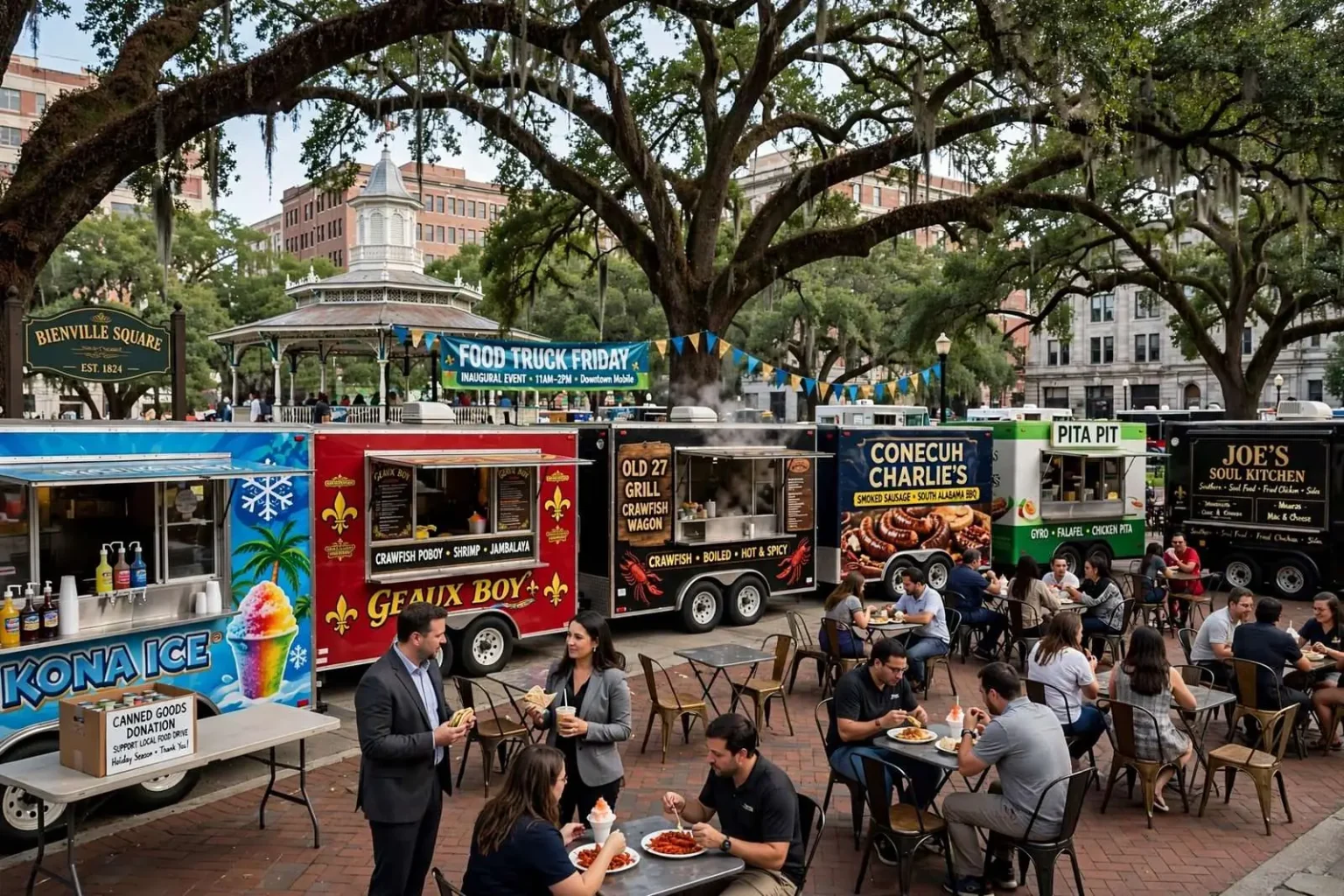
Downtown Mobile welcomed its first Food Truck Friday event at Bienville Square, bringing together a lineup of local mobile food vendors for a midday gathering meant to become a recurring tradition in the heart of the city. The debut installment transformed the historic park into an open-air food court for a few hours, with workers from nearby office towers, government buildings and courthouses filtering out of their workplaces to sample everything from crawfish to shaved ice without ever getting back in their cars.
Mayor Sandy Stimpson’s office confirmed that at least six food trucks set up in the square from 11 a.m. to 2 p.m. for the inaugural event. The lineup included Geaux Boy, Kona Ice, Conecuh Charlie’s, the Old 27 Grill Crawfish Wagon, Pita Pit and Joe’s Soul Kitchen, giving attendees a range that stretched from Louisiana-style comfort food and south Alabama smoked sausage to Caribbean ice treats, pita wraps and traditional Southern plates. The mix of established operators and local favorites was deliberate, offering something approachable for cautious first-timers and something distinctive for adventurous eaters.
The city supplied café-style tables and chairs so visitors could sit and enjoy their meals in the park rather than eating on the go. That small logistical touch mattered more than it might appear. Food truck gatherings live or die on whether people feel comfortable lingering, and shaded seating in a green square is precisely what turns a lunch run into a social occasion. Throughout the midday window, attendees occupied the seating clusters under the park’s mature oaks, turning the square into something closer to a neighborhood festival than a quick turnaround lunch stop.
Stimpson said the food truck concept itself wasn’t new to Mobile, noting that individual trucks had already been operating around the Port City for some time. Vendors had appeared at private events, breweries, office parks and community celebrations across the area, building loyal followings one stop at a time. What his office hoped to accomplish with the new event was giving vendors a reason to congregate in one central location on a regular basis, making it easier for downtown workers and visitors to sample multiple options in a single outing. Aggregation, in the city’s view, benefits everyone involved: diners get variety without driving across town, and vendors get access to a guaranteed crowd instead of betting on a location alone.
A downtown park with deep roots
Bienville Square was a fitting stage for the experiment. The park sits in the core of Mobile’s central business district, bounded by Dauphin, St. Francis, Royal and North Conception streets, and has served as a gathering spot since the nineteenth century. It is named for Jean-Baptiste Le Moyne, Sieur de Bienville, the French colonial founder of Mobile, and the square has long hosted everything from political rallies and holiday observances to lunchtime concerts. Its bandstand, fountains and sprawling live oaks make it one of the most recognizable green spaces on the Gulf Coast, and its location within walking distance of thousands of downtown employees made it the natural choice for a weekday lunch-hour event.
City officials framed Food Truck Friday as more than a lunch option. Events like this one are part of a broader effort to keep activity flowing in downtown Mobile during weekday hours, when office workers are already present but often leave the area the moment their shifts end. A regular, predictable gathering gives people a reason to stay, to walk a block or two, and to see the city center as a destination rather than a place they merely pass through. Business owners along the surrounding streets also stand to benefit from the added foot traffic, since a crowd drawn for lunch frequently becomes a crowd that shops or runs errands before heading back to work.
Looking toward Cooper Riverside Park
The mayor mentioned interest in eventually expanding the concept to Cooper Riverside Park, particularly during the spring and fall months when outdoor gatherings tend to draw larger crowds. The riverfront park, which fronts the Mobile River along Water Street, offers views of passing ships, open lawn space and a different backdrop than the shaded square in the heart of the business district. Cooler-season events there could pair the food truck format with the waterfront setting that distinguishes Mobile from many inland cities, and officials see the seasonal timing as a way to work with, rather than against, the Gulf Coast climate. For now, though, the focus remained on establishing a consistent presence at Bienville Square as the inaugural location. Organizers understand that a recurring event earns its audience through repetition: workers need to know it will be there each week before they build it into their routines, and vendors need a dependable date before they commit their inventory and staff.
Lessons from Huntsville’s playbook
Mobile wasn’t the first Alabama city to experiment with a recurring food truck rally. Downtown Huntsville Inc. had already built a successful monthly gathering that launched earlier in the year, eventually adding craft beer, live music and street dancing to the format. What began as a straightforward lunch event evolved into an evening social fixture, with the extras turning a meal stop into a night out. By the time Huntsville’s organizers wrapped their 2014 season, the event had drawn an estimated 20,000 total patrons over its seven-month run, offering a model of what sustained community interest could look like for a similar effort in Mobile.
The Huntsville experience carried two practical lessons. First, attendance grew when the event stopped being solely about food and became entertainment; music and dancing gave attendees a reason to arrive early and stay late, which in turn increased food and beverage sales for the vendors. Second, consistency mattered more than size. A monthly rhythm let residents plan around the event, and the steady cadence helped organizers refine logistics — parking, seating, vendor placement — without the pressure of a weekly turnaround. Mobile’s Friday schedule takes the opposite approach, betting that a weekly lunch format near the largest concentration of downtown employers will generate its own gravity, even without evening programming.
A holiday-season charitable angle
City officials also used the debut event to tie in a charitable component fitting the holiday season, encouraging attendees to bring canned goods and other donations to the square. The drive gave the gathering a purpose beyond lunch, connecting the downtown community with neighbors who face food insecurity, a need that typically grows during the holiday months. Collection points at a public event lower the barrier to giving: attendees who planned to come for a sandwich could drop a can or two on the way in, and the accumulated contributions add up quickly when a steady stream of people passes through over three hours. Combining celebration with service has become a common pattern for civic events across Alabama, and embedding it in the first outing signaled that Food Truck Friday was intended to be a community institution rather than a novelty.
For the vendors themselves, the event represented a low-risk way to reach a new customer base. Operating a food truck means constant decisions about where to park, and a lunch spent circling office parks can be a lunch spent guessing. A city-sanctioned gathering in a well-known square removes that uncertainty for the day, and the shared publicity from the mayor’s office brings in diners who might never have tracked down an individual truck on social media. Operators like Conecuh Charlie’s, which trades on the south Alabama sausage tradition of Conecuh County, and Joe’s Soul Kitchen, a fixture of the local Southern cooking scene, arrived with established reputations that the format helps carry to a wider audience, while newer entrants get to piggyback on the collective draw.
What it means for downtown Mobile
The launch comes as downtown Mobile continues to build on years of public and private investment in its core. The area around Bienville Square includes courthouses, law offices, banks, restaurants and the surrounding entertainment districts along Dauphin Street, and civic leaders have long sought ways to knit those pieces together into a cohesive daytime experience. A recurring food truck event is an inexpensive intervention by city standards — the main contributions are coordination, the loaned tables and chairs, and the use of public space — yet it touches several goals at once: supporting small business, energizing public parks, and giving residents a positive, family-friendly reason to come downtown.
The format also fits the rhythms of Gulf Coast life. With mild weather much of the year, outdoor midday gatherings are practical in a way they are not in colder regions, and the city’s interest in a spring and fall expansion to the riverfront reflects that advantage. Residents who work downtown can expect the event to grow or shrink with the seasons, and the city has left itself room to adjust the schedule, the lineup and the location based on what the first months of turnouts show.
Organizers and vendors alike will be watching attendance in the coming weeks to see whether the debut crowd becomes a habit. If the early response holds, Food Truck Friday could join the roster of signature downtown Mobile gatherings that residents mark on their calendars — and, as the Huntsville example suggests, could eventually layer in music and other attractions as the audience matures. For now, the city’s message to downtown workers is simple: on Friday, lunch is in the square.