University of South Alabama Orange Beach
Byrne Presses NOAA Official Over Red Snapper Count in Congressional Hearing
U.S. Rep. Bradley Byrne pressed a NOAA official over red snapper stock counts, arguing Gulf states should take over management of the fishery.
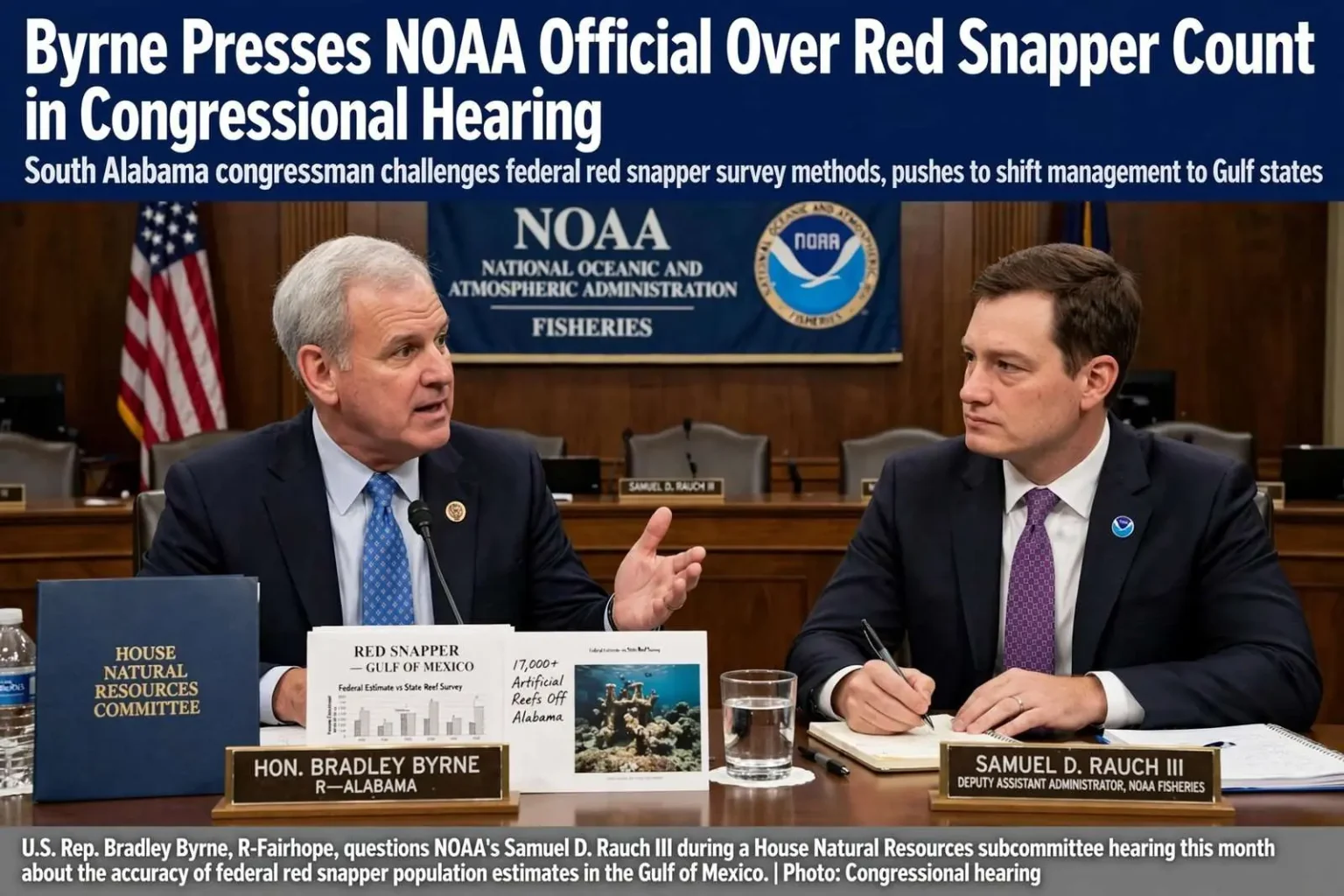
U.S. Rep. Bradley Byrne, R-Fairhope, sharply questioned a federal fisheries official during a congressional subcommittee hearing this month, challenging the accuracy of the government’s red snapper population estimates in the Gulf of Mexico and renewing his push to shift management authority to the Gulf states. The hearing gave the south Alabama congressman a national platform for an argument the Gulf Coast has been making for years: that federal scientists do not count the fish where the fish actually live.
Byrne pressed Samuel D. Rauch III, a deputy assistant administrator with the National Oceanic and Atmospheric Administration’s fisheries division, on why federal survey methods exclude Alabama’s extensive network of artificial reefs when estimating how many red snapper live in the Gulf. Alabama has built roughly 17,000 artificial reefs off its coast, and Orange Beach has long been recognized for its concentration of charter fishing boats built around the species.
The reef system is no accident. Through decades of state programs, Alabama has deployed everything from old ships and bridge spans to purpose-built concrete pyramids on the sandy Gulf floor, creating habitat where almost none existed naturally. The result is one of the most productive recreational fishing grounds in the country, and red snapper — a reef-dwelling species — congregate on that structure in numbers that anglers say the federal models simply do not see.
“You have $900 million and you can’t give us any better count of the fish stock than what you’ve given us today?” Byrne asked during the exchange, referencing NOAA’s overall budget. The question framed the grievance in dollars: a federal agency with a nine-figure budget, in the view of Alabama’s delegation, cannot accurately count the single fish species that anchors the coastal economy of his district.
The federal answer
Rauch responded that the trawl gear federal researchers rely on cannot be used safely around reef structures, and said the agency is working to fold state-collected data into its assessments. He noted NOAA Fisheries manages stocks nationwide, not just in the Gulf, and defended the agency’s overall accuracy. The explanation captures the technical heart of the dispute: federal surveys were designed around trawlable, relatively featureless bottom, and Alabama’s reef seascape is neither.
That methodological mismatch has consequences. If surveys sample natural bottom but skip the reefs where snapper concentrate, the resulting population estimate can miss a large share of the fish. Anglers and state biologists have argued for years that the federal numbers undercount the stock off Alabama, and that the error translates directly into shorter federal seasons, because quotas are set from the estimates.
Byrne countered that a University of South Alabama researcher, working with a fraction of NOAA’s budget, has used underwater camera technology to count red snapper directly on the reefs where they congregate — an approach he said the federal agency should have adopted already. Camera surveys sidestep the trawl problem entirely by observing fish on structure without touching it, and their results have consistently suggested more snapper on Alabama’s reefs than federal assessments assume.
Nine days on the water
Also testifying was Chris Blankenship, director of the Alabama Marine Resources Division, who told the subcommittee that private anglers and charter captains along the Alabama coast had only nine days of legal access to red snapper fishing this year despite the reef system’s productivity. Blankenship said his agency’s own data showed Alabama fishermen landed about 418,000 pounds of red snapper this season, compared with a federal estimate far higher than what the docks actually saw.
The gap between state data and federal estimates is the practical engine of the entire debate. Alabama has invested in its own data collection, including dockside sampling and electronic reporting, and state officials argue those numbers describe reality better than extrapolations built from survey methods that skip the reefs. When the two disagree, the shorter season falls on the fishermen.
Blankenship went further than the numbers, telling lawmakers the current federal system amounts to a “failure” for coastal fishing communities. From the state’s perspective, the argument is straightforward: a family that plans a summer fishing trip around a season that opens for nine days, sometimes with little notice, is not being managed — it is being squeezed, and the charter industry that depends on predictable access suffers the most.
The hearing centered on legislation before the House Natural Resources Committee that would transfer more red snapper management authority to the Gulf States Marine Fisheries Commission, an interstate body that includes Alabama alongside four other Gulf states. The idea is to move day-to-day snapper management from federal councils to the states, each of which already runs its own data programs and, in state waters, its own seasons.
Byrne has separately sponsored a measure to loosen federal fishing quotas as part of a broader reauthorization of the Magnuson-Stevens Fishery Conservation and Management Act, which has cleared committee and could reach the full House early next year. The Magnuson-Stevens Act is the foundational law of American fisheries management, and its periodic reauthorization is the vehicle through which Gulf Coast lawmakers have repeatedly tried to recalibrate how recreational catch limits are set and enforced.
What the states want
State control advocates point to a structural imbalance they see in the current system. Recreational anglers are regulated through estimates and quotas set federally, while the seasons grow shorter each time the data suggests the catch exceeded the target. The states, meanwhile, have demonstrated in state waters — and in pilot programs — that they can monitor landings with modern reporting tools in near real time, something the federal system has been slow to adopt.
Federal officials at the hearing said the administration has not yet taken a formal position on shifting management to the states, though they maintained current regulations have helped rebuild the red snapper population over time. That point is not in serious scientific dispute: the stock has recovered substantially from the overfished condition of past decades. The fight is over who owns the rebound — and who gets to set the rules for enjoying it.
The Gulf of Mexico Fishery Management Council, the regional body that currently advises NOAA on snapper quotas, has struggled for years to reconcile commercial and recreational demands on the same stock. Charter captains argue the recreational sector’s allocation does not reflect its economic footprint. Any shift toward the states would redraw that balance, which is why the proposal has allies and opponents far beyond Alabama.
Economic stakes on the coast
For charter operators and recreational anglers along the Alabama coast, the debate carries direct economic stakes tied to how many days each season they are legally allowed on the water. Orange Beach built one of the largest charter fleets in the Gulf around reef fishing, and red snapper is the headline species that fills those boats from June through the heart of the summer season.
A nine-day season ripples through that economy. Lodging, bait, fuel, tackle shops, restaurants and marinas all share in charter-boat revenue, and customers who cannot book a trip inside a compressed window simply do not come. Captains have described turning away business they could not legally serve, in the middle of the season that pays for their year.
For the delegation, the hearing was part of a sustained campaign. Alabama’s senators and Gulf Coast House members have pressed NOAA in successive years over season lengths and survey methods, and the state has periodically set its own longer seasons in federal waters in defiance of federal rules, forcing negotiations. The legislation now before the committee represents the legislative branch of that same push.
Whether the bill reaches the full House and survives the Senate remains uncertain, and the administration’s neutrality leaves the outcome to Congress. What the hearing made clear is that the dispute is no longer only about fish. It is about whether the management of a rebuilt, multimillion-dollar fishery will stay with a federal system that Alabama’s lawmakers consider blind to their reefs — or move to the states that built them.
Scientific questions sit underneath the politics. Federal stock assessments draw on surveys, biological sampling and modeling to estimate how many fish can be caught without harming the population, and the rebuilding plan that produced today’s larger stock also produced today’s shorter seasons, as managers tightened quotas to force compliance. Anglers who lived through the closures of the last decade often describe the outcome as perverse: the better the fishery gets, the shorter the season becomes.
Camera-based surveys of the kind cited in the hearing are part of the fix Alabama has pushed. Pairing underwater video on reef structures with the state’s dockside sampling and angler reporting would give managers a picture of the fishery that matches how it is actually fished — around structure, from private boats and party vessels, in a concentrated corridor off one state’s coast.
The hearing closed with the same unresolved tension that has defined the issue for years: a federal agency defending its science, a state director calling the system a failure, and a congressman asking why a rebuilt fishery still leaves his constituents nine days on the water. The legislation before the committee will test whether Congress settles that argument — or leaves it to another season of short openings and long hearings.