Mobile Cuts Overnight, Sunday Hours for 311 Citizen Hotline to Save $75,000
Mobile has cut overnight and Sunday hours for its 311 citizen hotline, a move city officials say will save about $75,000 a year.
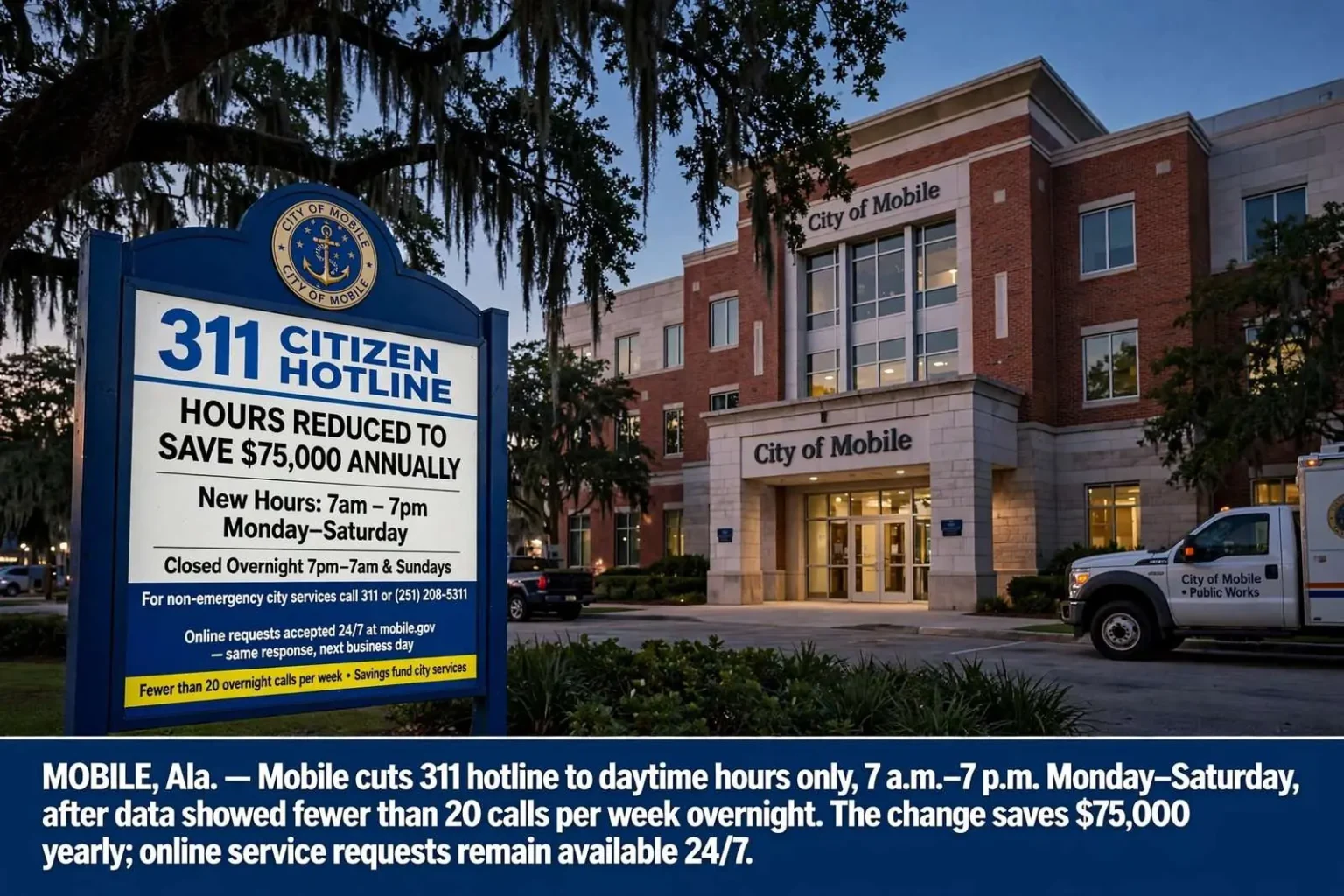
MOBILE, Ala. — The City of Mobile has scaled back the hours of its non-emergency 311 citizen hotline, moving from round-the-clock availability to a set schedule of 7 a.m. to 7 p.m., Monday through Saturday. Mayor Sandy Stimpson’s office announced the change, saying the new hours are expected to save the city about $75,000 a year without cutting any services residents actually rely on regularly.
Stimpson spokesman George Talbot said the hotline typically fielded between 10,000 and 11,000 calls a month, but fewer than 20 calls per week came in during the overnight hours between 7 p.m. and 7 a.m. that are now being eliminated from the schedule. The numbers made the decision a matter of arithmetic: staffing a 24-hour call center to answer a handful of late-night calls each week cost far more than the volume justified.
City officials say residents with requests that come up outside the new hours can still submit them through the City of Mobile’s website, which accepts service requests at any hour even when the phone lines are closed. Online submissions enter the same tracking system as phone calls, meaning a pothole report or missed trash pickup logged at midnight waits for morning staff rather than disappearing.
Any true emergencies should continue to be reported to 911 rather than the 311 line, which is designed for informational requests, service complaints and general questions about city departments rather than urgent safety issues. Officials stress the distinction because the two lines answer different needs: 311 is a convenience and information service, while 911 dispatches police, fire and medical response around the clock.
What 311 Handles
The 311 system is intended to route citizen service requests electronically to the appropriate city department, give residents a neutral channel for suggestions about city services, track the progress of service requests, answer general questions about city organizations, and help residents access city services efficiently. For many residents it is the front door to city government — the number to call for a broken streetlight, an abandoned vehicle or a question about garbage collection without knowing which department owns the problem.
That routing function is the core of the system’s value. A caller does not need to know whether a drainage issue belongs to public works, engineering or another department; the 311 staff or online form captures the request and sends it to the right office, with a tracking number residents can use to follow up.
Utility Emergencies Are Handled Separately
City officials emphasized that utility emergencies should still be reported directly to the relevant utility rather than through 311. Water and sewer emergencies outside normal business hours can be reported at (251) 694-3100, electrical emergencies at 1-800-245-2244, and gas emergencies at (251) 476-2720 or (251) 476-8052.
The distinction matters most at night, when the 311 lines are now dark. A water main break, a gas odor or a downed electrical line requires the utility’s own emergency crews, not a morning callback from city staff, and Mobile officials have directed residents to keep those numbers handy for after-hours problems. Utilities maintain 24-hour emergency dispatch independent of city hall, and their response does not change with the 311 schedule.
The Dialing Workaround Some Callers Need
Officials also noted that not every wireless or landline carrier can connect directly to Mobile’s 311 call center by dialing 311. Residents whose carriers don’t support the short code can instead call (251) 208-5311 to reach the same service. Short codes like 311 depend on carrier routing agreements, and callers who reach a dead end dialing three digits should save the ten-digit number as a permanent alternative.
The schedule change took effect immediately following the announcement, as the city continued looking for efficiencies that trim costs without touching the services residents use most. The $75,000 in projected annual savings comes entirely from the overnight staffing window, which served the smallest slice of the hotline’s monthly call volume.
Saturday hours remain part of the new schedule, a detail that preserves access for residents who work weekdays and handle city business on weekends. The service window now runs 84 hours a week, down from 168, with all of the reduction concentrated in the overnight period where the data showed the least demand.
Part Of A Broader Efficiency Push
The Stimpson administration has framed the hotline change as part of a broader effort to run city government on data about how residents actually use services. Call volume records showed a service staffed for every hour of the week was only needed for a fraction of them, and the administration chose to redirect the savings rather than spread the cost across the budget.
Mobile’s 311 system is part of a national model that has spread to hundreds of cities since Baltimore launched the first 311 line in the 1990s. The idea is consistent everywhere: give residents one memorable number for non-emergency city business, keep 911 free to handle true emergencies, and build a data trail of service requests that helps departments spot recurring problems — from pothole clusters to streetlight outages — and allocate crews accordingly.
The online request channel has grown in importance across the country as more residents skip the phone entirely, photographing problems and logging them through city websites. Mobile’s decision to keep the web system accepting requests around the clock reflects that shift; a resident reporting a downed limb or a clogged storm drain at 11 p.m. can file the request the same way they would at noon.
What Residents Should Know Going Forward
For everyday purposes, the guidance is simple. Call 311 — or (251) 208-5311 if your carrier does not connect to the short code — between 7 a.m. and 7 p.m. Monday through Saturday for city service requests, suggestions and general questions. Use the city website at any hour for the same requests. Call 911 for emergencies. Call the utility numbers directly for water, sewer, electrical and gas problems, day or night.
City officials say the change preserves the hotline’s essential role while eliminating the expense of staffing for calls that almost never came. The 10,000 to 11,000 monthly calls the line handles will now all arrive inside the new window, where staff can answer them, route them and track them to completion as before.
The overnight call data tells the story behind the change. Fewer than 20 calls a week between 7 p.m. and 7 a.m. means roughly 1,000 late-night calls a year against more than 120,000 calls annually overall — a fraction of a percent of the workload, spread across hours when most city departments the hotline routes to are closed anyway. A late-night caller reporting a streetlight outage was, in practice, leaving a message that the next morning’s staff would process.
Staffing for those hours is where the cost concentrates. A 24-hour call center requires overnight shifts, which typically command premium pay and require more staff per shift to cover safety and turnover. Eliminating the overnight window is the single largest staffing saving available without touching daytime and Saturday service levels, which is why the projected $75,000 annual savings maps so cleanly onto the schedule change.
The city’s utility partners operate on a different model entirely. Water, sewer, electrical and gas systems are monitored continuously because failures in those networks can threaten property and safety within minutes, not business days. That is why the emergency numbers for each utility remain 24-hour services even as the city’s information line goes dark at night — the two systems answer different kinds of urgency.
Residents who have saved the 311 short code as their default contact for city business may also want to save the backup number, (251) 208-5311, alongside it. Carrier support for short codes varies across wireless providers and can change with plan updates, and the ten-digit line guarantees access to the same call center from any phone.
The hotline’s role in city operations extends beyond individual complaints. Every tracked service request becomes a data point the city can map, and the accumulated pattern helps departments schedule work, justify equipment purchases and identify infrastructure that fails repeatedly. A neighborhood that logs repeated drainage complaints, for example, produces the record that prioritizes a capital repair over another patch.
The suggestion channel works the same way in reverse. Residents who call with ideas about city services — a new crossing guard location, a streetlight that should exist, a park improvement — have a single entry point that passes the idea to the department that can act on it, rather than a complaint line that would misroute it.
For new residents, the number is also an introduction to how Mobile city government is organized. Callers asking which department handles a question end up with an answer and, often, a direct contact, which is the kind of navigation help that city websites alone cannot always provide. Keeping that function staffed across a six-day window preserves the human front door to city hall even as the hours narrow.
The change arrives as cities across the country reevaluate their 311 operations in light of online channels that never close. Mobile’s approach — trim phone hours to match demand, keep the web intake open continuously, and protect the emergency pathways — mirrors the pattern other mid-sized cities have adopted, and the $75,000 in annual savings represents the measured cost of staffing for calls the data showed were not happening.