Mobile Museum Honors the Storied Career of Maj. Gen. J. Gary Cooper
A special exhibit at Mobile's National African-American Archives and Museum traced the military, business and diplomatic accomplishments of Maj. Gen. J. Gary Cooper.
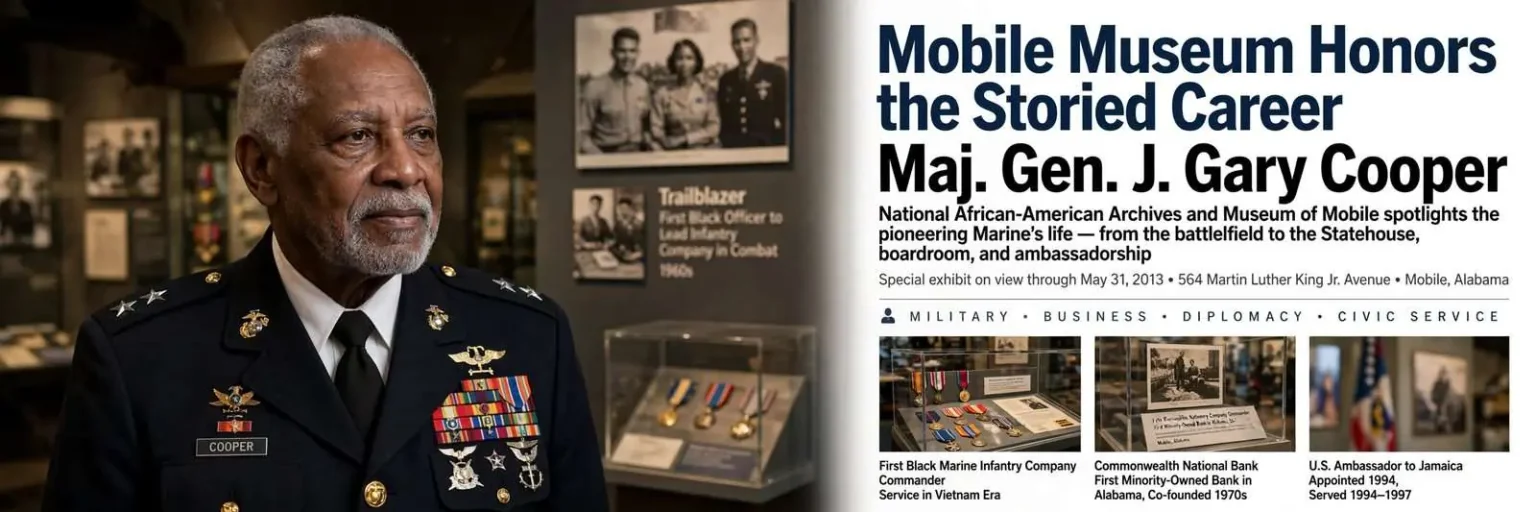
Through the end of May 2013, the National African-American Archives and Museum of Mobile devoted a special exhibit to one of the city’s most distinguished sons, Maj. Gen. J. Gary Cooper. Titled “A Historical Look at the Life and Legacy of Major General J. Gary Cooper, USMC (Ret.),” the display gathered the highlights of a career that spanned the military, business and diplomacy. For residents of the Mobile area, it was a chance to see how a single life, rooted in one Gulf Coast port city, eventually reached every level of American public life.
The museum, located at 564 Martin Luther King Jr. Avenue in Mobile, has long served as a repository for the stories of African-Americans who shaped the Gulf Coast, from the families of the Africatown community to the civil rights figures of the twentieth century. Its galleries on this occasion traced Cooper’s path in rough chronological order, pairing photographs, documents and career mementos with the broader history of the institutions he entered and helped change. Visitors moved from his Mobile roots through his Marine Corps years and onward to the bank boardrooms, state offices and embassies that followed.
A trailblazer in the Marine Corps
Cooper’s military service formed the heart of the exhibit. He became the first black officer in the Marine Corps to lead an infantry company into combat, a distinction that placed him among the pioneers of an integrated American military. His decorations and career milestones, chronicled in the museum’s galleries, testified to a life of service that continued long after his years in uniform.
The milestone carried weight well beyond one officer’s file. For most of its early history the Marine Corps excluded African-Americans altogether, and even after the corps began accepting black recruits during World War II, those men trained at a segregated facility and were steered largely into support roles rather than front-line combat command. An African-American officer leading an infantry company into combat therefore marked a genuine turning point, demonstrating what integration meant in practice: authority and battlefield leadership in the corps’ most traditional arm.
The armed forces as a whole had been moving in that direction since President Harry Truman ordered the desegregation of the American military in 1948, a process that played out over the following years across every service branch. Cooper’s career fell squarely within that generation of officers who integrated the ranks not in principle but in fact, commanding troops, earning decorations and rising through the structure at a time when the expectation of black officership was still being contested.
Exhibit panels placed his combat leadership alongside the citations and campaign recognition he accumulated over the course of his uniformed service. Curators used the sequence to make a point that ran through the whole display: the qualities required to lead Marines under fire — discipline, preparation and composure — were the same qualities that carried Cooper through the civilian posts that came later.
President George H. W. Bush later appointed Cooper to serve as Assistant Secretary of the Air Force for Manpower, Reserve Affairs, Installations and Environment, a civilian post that put him over personnel and installation matters for one of the nation’s largest military departments. In 2001 he received the National Veterans Award, an honor recognizing decades of advocacy on behalf of those who had served. The exhibit placed the appointment and the award side by side, underscoring how his commitment to the military outlasted his active-duty years by decades.
Business, banking and civic roots
Cooper’s reach extended well beyond the armed forces. A Mobile native, he was one of the founders of Commonwealth National Bank, the first minority-owned bank in Alabama, an institution created to widen access to credit in communities that mainstream lenders had historically underserved. He also helped lead his family’s Christian Benevolent Funeral Home, a business in operation since 1928 and one of the best-known family enterprises in Mobile’s African-American community.
Both institutions mattered to the neighborhoods around them. A community bank, in an era when minority borrowers often struggled to obtain loans on fair terms, gave families and small-business owners a lender that understood the local economy; a funeral home that has served families across generations occupies a different but equally central place in the civic life of a city. The exhibit presented the two as a single thread in Cooper’s story — service rendered not in uniform but through the institutions that sustain a community day to day.
Minority-owned banks have historically played a disproportionate role in communities where credit was scarce, and Alabama was no exception. Commonwealth National Bank’s founding in Mobile gave the city a financial institution with ownership rooted in the very neighborhoods it served, and Cooper’s role as a founder reflected the same instinct that shaped his other work: build the institution, then lead it.
From the Statehouse to the capital
Politics came next. Cooper served in the Alabama House of Representatives as one of the first African-Americans elected to that body since Reconstruction, joining a small cohort of lawmakers who re-entered the chamber more than a century after federal troops withdrew from the South. Their arrival in the post-civil rights era marked the return of black representation to a legislature that had operated for decades without a single African-American member.
Later, as commissioner of the Alabama Department of Human Resources, Cooper led the state agency responsible for child welfare, public assistance and social services. The department touches tens of thousands of Alabama families every year through foster care, food assistance and protective services, and its commissioner’s job involves managing one of state government’s largest and most closely scrutinized operations. It was, in other words, a post where administrative competence mattered as much as policy philosophy — a demand Cooper had already met in the military and in business.
His public service also carried him abroad. President Bill Clinton appointed Cooper to serve as United States Ambassador to Jamaica from 1994 through 1997, capping a resume that touched the local, statewide, national and international stages. In Kingston he represented American interests and oversaw embassy operations in one of the Caribbean’s most consequential nations, a country with deep ties to the United States through trade, tourism and migration.
The ambassadorship drew on both his diplomatic temperament and his long record in administration. Managing a United States embassy means coordinating political, economic and consular sections while maintaining relationships with the host government, and ambassadors from the ranks of public life — rather than career foreign service — bring with them the perspective of the communities they came from. Cooper’s appointment fit a long tradition of American envoys whose value lay in their breadth of experience, and it made him one of the few Alabamians of his generation to hold a posting of that rank.
By the time the exhibit opened in the spring of 2013, that full arc — Marines, the Pentagon, banking, the Statehouse, a state cabinet and an ambassadorship — had made Cooper a recurring presence in conversations about Alabama’s civil rights legacy and its aftermath. The museum’s answer to the question of how one life could contain so much was simply to lay it out, room by room, in the neighborhood where it began.
A community remembers
For visitors, the exhibit offered a chance to trace the arc of a single remarkable life against the broader history of the city and the nation. Curators arranged the galleries so that the military, civic and diplomatic chapters echoed one another, inviting viewers to consider how the barriers Cooper broke in one arena prepared him for the next. The effect was less a collection of achievements than a single continuous narrative of service.
Museum staff framed the display as an educational resource as much as a tribute. School groups from Mobile-area classrooms were among the expected visitors through the run’s close at the end of May 2013, and docents emphasized the lesson embedded in Cooper’s story: that institutions change when individuals arrive prepared for the moment they are given. For older visitors, the exhibit recalled familiar names and places from the city’s recent past; for younger ones, it introduced a figure many had never encountered in a standard Alabama history course.
The National African-American Archives and Museum has occupied a particular place in Mobile’s cultural landscape for decades, preserving records, photographs and oral histories that document the African-American experience on the Gulf Coast. Exhibits built around native sons and daughters of the city are a staple of its calendar, and the Cooper retrospective fit squarely within that mission — using one family’s and one man’s story to carry a much larger account of the community.
Visitors who came for the military material found the fullest version of it, but the museum made a deliberate effort to show the connective tissue between Cooper’s uniforms and his civilian roles. Display cases carried items from his years in Jamaica alongside materials from his time in Montgomery and Washington, making the point that his career was not a series of unrelated jobs but a single public life conducted at increasing scale.
A lasting legacy on the Gulf Coast
Cooper’s career continues to be cited across Alabama as an example of leadership across sectors. The firsts he collected — in the Marine Corps, in the Statehouse, in banking and in diplomacy — are frequently invoked in discussions of the state’s civil rights era and the generation of African-American Alabamians who moved from protest into the mainstream of public and commercial life. His path from the neighborhoods around Martin Luther King Jr. Avenue to the Pentagon and an overseas embassy embodies that transition as completely as any single biography in the state.
The Christian Benevolent Funeral Home remains in family hands, and Commonwealth National Bank’s place in Alabama history as the state’s first minority-owned bank is a fixed point in accounts of black enterprise in the Southeast. Each is regularly mentioned in profiles of Cooper, and each illustrates the same principle the exhibit pressed: that lasting community influence is built through institutions, not merely held through office.
The museum used the exhibit’s run to encourage visitors to contribute documents and photographs connected to Mobile’s African-American military and civic history, part of an ongoing effort to preserve materials that might otherwise be lost to time. Archivists at institutions like the Archives and Museum routinely note that the records of pioneering figures are often scattered among families, churches and veterans’ posts, and that exhibits of this kind are among the most effective ways to surface them.
For the duration of the spring 2013 run, the life of J. Gary Cooper served as both subject and lesson: proof, displayed blocks from where it began, of how far a Mobile native could go, and of how much of the journey was made in service to the city he left and the country he represented. The exhibit closed at the end of May 2013, but the record it documented — the combat command, the cabinet appointment, the ambassadorship, the bank and the family business — remains part of Mobile’s shared history.