Sealed Motions Surface in Ex-Auburn Star Nick Fairley’s Mobile DUI Case
Sealed motions were argued in Mobile County Circuit Court in the years-old DUI case against former Auburn football standout Nick Fairley of Mobile.
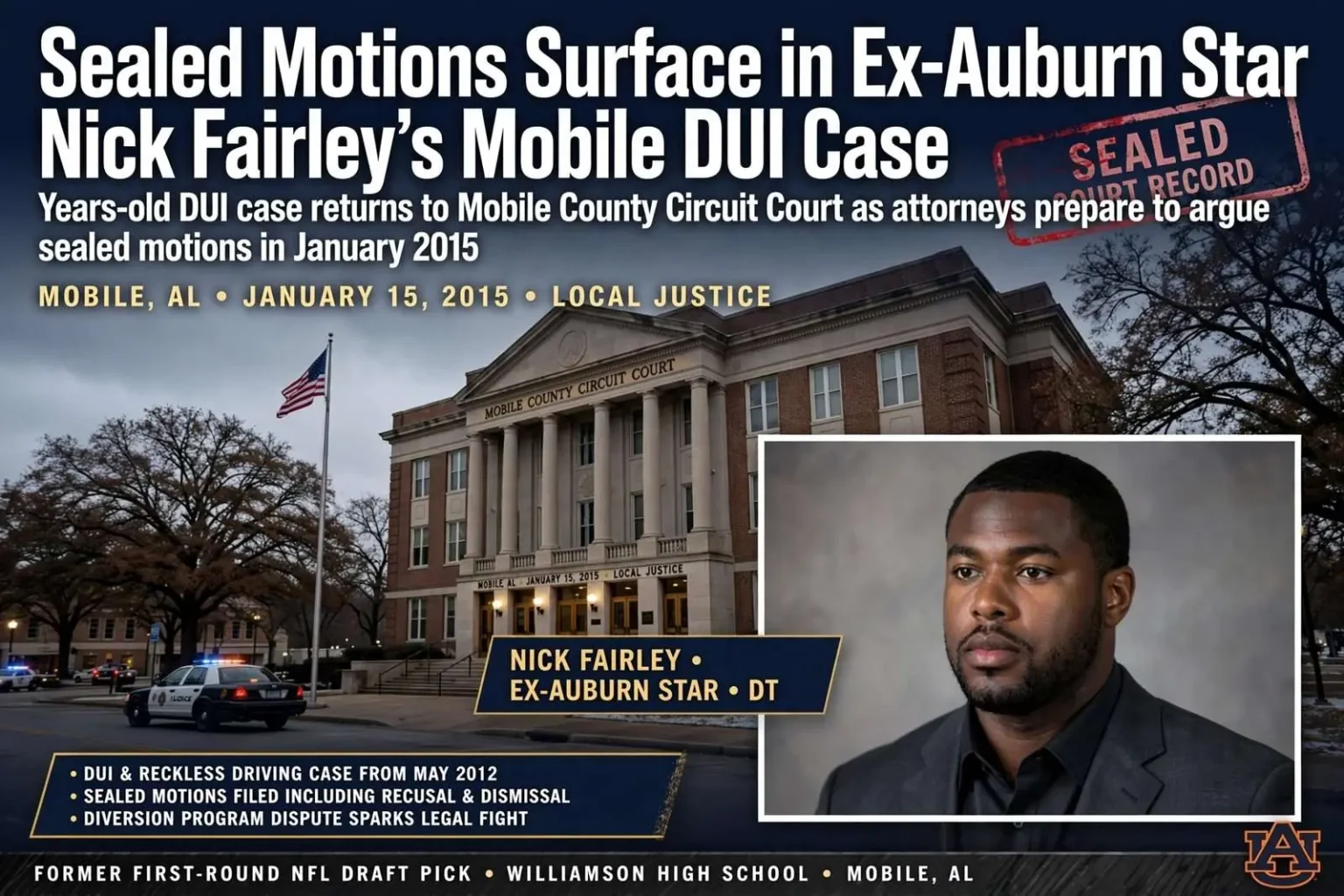
A years-old DUI case tied to a former Mobile-area football standout returned to Mobile County Circuit Court in mid-January 2015, as attorneys prepared to argue motions that had been filed under seal, keeping their specific contents hidden from public view. The sealed filings added a new layer to a case that has lingered in the local court system far longer than many residents might expect for charges that began with a traffic stop.
The case involves Nick Fairley, a Williamson High School graduate and former Auburn University defensive lineman who went on to be drafted into the NFL. Fairley was arrested in Mobile in May 2012 after an Alabama State Trooper clocked him traveling at speeds up to 100 mph along Interstate 10 near U.S. 90 in the Tillman’s Corner area, resulting in DUI and reckless driving charges. The stop took place on one of the busiest corridors in the Mobile area, where Interstate 10 carries commuters and commercial traffic between the city’s western neighborhoods and the Eastern Shore.
Fairley pleaded guilty to both charges later that year and received a six-month suspended jail sentence, a year of probation and a $600 fine. On its face, the disposition resembled the outcome in many DUI cases handled in Mobile County, where suspended sentences and supervised probation are common resolutions. But the case did not end there.
At sentencing, a dispute arose between the Mobile County District Attorney’s Office and Fairley’s defense team over whether prosecutors had agreed to let him enter a pretrial diversion program that could have kept the convictions off his record. Prosecutors argued Fairley was ineligible because of a separate marijuana possession charge from earlier in 2012, even though that charge was later dismissed. Program eligibility rules generally require a clean record, and Fairley was ultimately denied entry.
The disagreement turned on what had been communicated, and agreed to, before Fairley entered his pleas. Pretrial diversion programs in Alabama are designed to redirect certain defendants away from the traditional court track, allowing them to complete supervision, testing and other requirements in exchange for having charges dismissed and, in many cases, a record that does not reflect a conviction. Whether a particular defendant qualifies, however, rests largely with the district attorney’s office, and prosecutors have long maintained discretion to screen out applicants whose records raise concerns.
A rejected plea offer and a sealed court fight
Fairley appealed the ruling, hoping to still be admitted to the diversion program and have the case resolved without a permanent conviction. He rejected a plea offer from the District Attorney’s Office in December 2014. That decision set the stage for the January hearing before Mobile County Circuit Judge Sarah Stewart, where one of Fairley’s attorneys filed a motion to dismiss the case and a separate motion asking the judge to recuse herself, both sealed from public review. Fairley himself was not required to appear for the hearing.
Sealed filings are relatively unusual in Alabama trial courts, where motions and court records are presumptively open to the public. When a party asks a judge to keep a filing under seal, the court must weigh the request against the public’s interest in access to court proceedings. In practice, sealed motions in criminal cases often involve matters such as plea negotiations, attorney communications or information that could affect a defendant’s rights if disclosed prematurely. Whatever the reason in Fairley’s case, the sealing means the public arguments in the dispute, including the specific grounds for the dismissal request and the recusal motion, may never be fully visible on the public record.
A recusal motion asks the judge presiding over a case to step aside, typically on grounds that involve potential conflicts of interest or questions about impartiality. Under Alabama practice, such requests are directed to the judge herself in the first instance, and granting or denying them is part of the routine business of the circuit bench. A denied recusal motion can still shape a case, though, because it frames how the defense views every later ruling and can factor into any eventual appeal.
The motion to dismiss represents the more consequential of the two filings for Fairley. If granted, it would wipe out the DUI and reckless driving convictions entirely, ending a case that has shadowed the former football star for more than two and a half years. If denied, Fairley’s options within the trial court would narrow considerably, leaving the question of whether the diversion dispute was handled properly to be litigated further or resolved through a new agreement with prosecutors.
Local roots made the case high-profile
The case has drawn attention in the Mobile area in part because of Fairley’s local roots and football pedigree. After starring at Williamson High School and Auburn, where he helped lead the Tigers to a national championship, Fairley was a first-round NFL draft pick in 2011. His professional team later opted not to exercise a contract option, a decision unrelated to the Mobile legal proceedings but one that kept his name in the news at the same time his years-old DUI case was still winding through the local court system.
Fairley’s rise from Williamson High School to the top of college football is the kind of story Mobile sports fans follow closely. Williamson, a public high school in the city, has long produced athletes who went on to college and professional careers, and Fairley’s path to Auburn made his ascent one of the more notable in recent memory for the area. By the time of the 2012 arrest, he was among the most recognizable football figures ever to come out of Mobile, which meant his court appearances drew an intensity rarely applied to a routine DUI docket.
What diversion means in Alabama courts
The heart of the dispute is the question of whether Fairley was promised entry into pretrial diversion before he pleaded guilty. Alabama’s district attorneys operate diversion programs at the county level, and participation is generally framed as an agreement between the defendant and the prosecution rather than an entitlement. A typical DUI diversion track involves supervision, alcohol education, fines and compliance conditions over a set period, with successful completion leading to dismissal of the charges so that no conviction appears on the participant’s record.
Programs of this kind are generally aimed at defendants whose cases can be resolved without a lasting conviction, and they have become a common tool for handling first-offense DUI cases across the state. For participants, the difference between a diversion outcome and a straight conviction is significant: a conviction follows a person into job applications, licensing and background checks, while a dismissed charge through diversion largely does not. Because admission is a matter of prosecutorial discretion rather than a right, disputes over eligibility often hinge on whether an agreement was actually reached and what a defendant’s record showed at the time of the application.
That is what made the marijuana possession charge from earlier in 2012 central to the dispute. Prosecutors treated it as a disqualifying mark against eligibility even though the charge was later dismissed, while the defense maintained that Fairley should have been allowed to proceed. The argument illustrates a broader tension in Alabama’s diversion framework: eligibility rules generally require a clean record, but defendants and prosecutors can disagree sharply about whether a charge that ended in dismissal should count against an applicant at all.
A familiar stretch of Mobile roadway
The geography of the original arrest remains familiar to anyone who drives Mobile’s southern and western reaches. Tillman’s Corner is a dense commercial district in western Mobile where U.S. 90 meets the Interstate 10 corridor, and the nearby stretch of interstate carries some of the heaviest traffic volumes in the region, linking the city with Pascagoula to the west and the Eastern Shore to the east. Speed enforcement along that corridor is a regular assignment for the Alabama State Troopers, whose highway patrol division covers interstates and state routes across Mobile County and the rest of southwest Alabama.
Troopers in that division handle everything from routine stops to major crash investigations, and DUI arrests on the I-10 corridor are a recurring feature of enforcement there. Cases that begin with such stops normally move through Mobile County’s district and circuit courts on a predictable path of arraignments, plea negotiations and sentencing. Fairley’s case instead became tangled in the diversion dispute, extending a timeline that might otherwise have closed within months of the arrest.
A long road through the court system
The continued court wrangling illustrates how a single traffic stop in Tillman’s Corner nearly three years earlier could still generate legal motions and hearings, underscoring the sometimes lengthy path Mobile County cases take from arrest to final resolution. What began as a May 2012 arrest on Interstate 10 has since stretched through a guilty plea, a sentencing dispute, an appeal of the diversion ruling, a rejected plea offer in December 2014 and now sealed motions before a circuit judge, with no announced endpoint.
For Mobile County’s courts, the case is a reminder that high-profile defendants bring public scrutiny to procedures that play out quietly every day. Diversion eligibility disputes, recusal questions and sealed filings all occur in local courtrooms regularly, but rarely with an audience. Fairley’s case has pulled back the curtain on that process for many local residents, showing how much of the criminal justice system’s daily work happens outside public view, and how much can turn on agreements and interpretations that never make it into open court.
The sealed nature of the filings means any rulings may likewise be entered without public explanation, and neither the District Attorney’s Office nor Fairley’s attorneys have made the underlying arguments available for review. Until the judge rules on the motions, the case remains unresolved on the Mobile County docket, nearly three years after a state trooper’s radar reading near Tillman’s Corner set it in motion.