Mobile Police Investigate Armed Robbery of Woman’s Dog on MLK Avenue
Mobile Police are searching for two men who robbed a local woman of her dog at gunpoint on Martin Luther King Avenue in a startling January case.
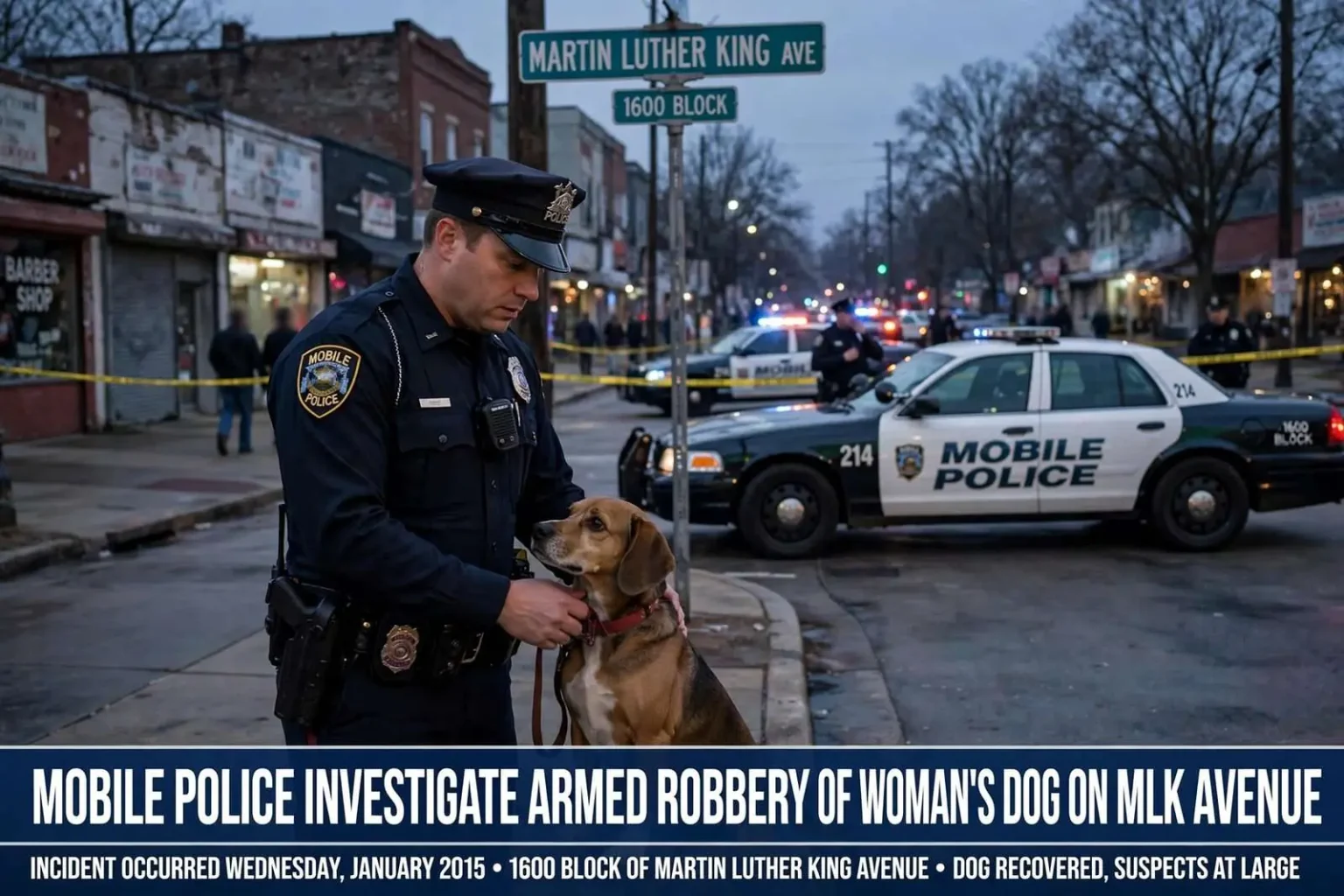
Mobile Police are investigating an armed robbery in which two men forced a woman to hand over her dog at gunpoint, an unusual case that unfolded on Martin Luther King Avenue in mid-January 2015.
According to Mobile Police Department reports, officers responded to the 1600 block of Martin Luther King Avenue around 5:13 p.m. on a Wednesday evening after a robbery call. The hour mattered: the street was still active with after-work traffic and pedestrians, which meant there were potential witnesses nearby when the confrontation took place.
The woman told responding officers that two men approached her, one of whom she recognized and one she did not know, and demanded her dog while displaying a firearm. Fearing for her safety, she complied and handed over the animal.
The detail that she recognized one of the suspects has been a thread running through the investigation. Robberies committed by someone the victim knows are typically worked differently from stranger attacks, with detectives looking closely at the victim’s acquaintances and any prior disputes that might explain the encounter.
Dog recovered quickly
Officers canvassed the surrounding neighborhood following the report and located the dog relatively quickly, though the two suspects had already fled the area and were not immediately apprehended. The search took officers through the blocks around MLK Avenue, checking with residents and asking whether anyone had seen the animal or the men who took it.
The dog was returned to its owner shortly after the search, bringing at least partial resolution to an otherwise frightening encounter. For the woman, the outcome was the best available under the circumstances — her pet was safe — but the armed confrontation itself remained an unresolved crime with two suspects at large.
Police have not released the breed or other identifying details about the animal, nor have descriptions of the suspects been made public as the investigation continues. Withholding those details while detectives work is standard practice, since premature descriptions can compromise identification procedures or tip off suspects.
Why pets become targets
Robberies involving pets, while less common than those targeting cash, electronics or vehicles, are not unheard of in urban Mobile neighborhoods, particularly when a dog carries resale value or is associated with breeding. Certain breeds command significant prices on the secondary market, and that value can attract thieves in any city.
Investigators have not said whether they believe the theft was motivated by the animal’s value or was connected to a personal dispute between the victim and the man she recognized among the suspects. The distinction matters for how the case is charged and worked: a robbery for profit is treated as a property-driven street crime, while a dispute-driven confrontation opens a separate line of inquiry into prior conflicts.
Either way, the use of a firearm elevates the case to armed robbery, one of the most serious felony charges in Alabama law, and one that police departments pursue aggressively regardless of what was taken. A gun displayed during a robbery changes the calculus entirely, because the threat is to a person’s life rather than merely their property.
The neighborhood context
Martin Luther King Avenue runs through one of Mobile’s oldest and most historically significant areas. The avenue and its surroundings — near Africatown and the city’s northside neighborhoods — have been the focus of years of community investment, revitalization efforts and public safety initiatives aimed at improving conditions for residents.
Armed robberies in the area draw close attention from both police and community organizations, which have worked to encourage cooperation between residents and investigators. Detectives know that cases on a busy corridor like MLK Avenue often are solved through the accounts of people who were nearby and saw something, which is why canvassing plays such a central role in the early hours after a report.
The mid-January timing also placed the incident during a period when daylight ends early, though the 5:13 p.m. report came at dusk when streets were still populated. Visibility, lighting and the presence of witnesses are all factors that shape what investigators can reconstruct from a street robbery.
The Police Department’s request
The Mobile Police Department continues to investigate the case and has asked anyone with information about the identities or whereabouts of the two suspects to come forward. Detectives have emphasized that even small details — a direction of travel, a partial description, a vehicle seen leaving the area — can be enough to move a case forward.
Tips can be provided directly to Mobile Police or anonymously through Mobile Area Crime Stoppers, which forwards information to investigators without collecting the tipster’s name and can pay rewards when a tip leads to an arrest. That channel matters in neighborhoods where residents may be reluctant to be seen cooperating with police.
In the meantime, the woman whose dog was taken at gunpoint has her pet back home. The suspects, however, remain unidentified publicly, and the case stands as an example of how quickly an ordinary errand can turn dangerous when someone on the street decides to use a weapon to take something — even something as unexpected as a family’s dog.
Armed robbery law in Alabama
Under Alabama law, robbery in the first degree — which covers robberies committed with a deadly weapon or causing serious physical injury — is a Class A felony, the same classification as murder. A conviction can carry a prison sentence of twenty years to life, which is why police and prosecutors treat cases involving the display of a firearm with such gravity, no matter the value of what was taken.
The charge does not depend on the thief succeeding in keeping the loot. What matters is the taking of property from a person by force or threat, and the weapon used in the process. In this case, the fact that the dog was recovered within hours does not soften the charge; the armed demand itself defines the crime.
That legal reality is worth understanding for residents who follow such cases: the quick return of the animal does not mean the matter is closed, and the investigation into the identities of the two men continues exactly as it would had they escaped with cash or jewelry.
Guidance for pet owners
Incidents like this one underscore a broader public safety concern for pet owners in the area: robberies that begin as property crimes can escalate quickly when a firearm is involved, and residents are encouraged to prioritize personal safety over any possession, including a beloved pet.
Police departments across the country give the same advice in armed robbery situations: comply with the demands, avoid arguing or chasing, note what can be safely observed — clothing, direction of flight, vehicle description — and call 911 immediately. Property can be recovered; a life cannot.
For dog owners specifically, common-sense precautions reduce risk. Walking with a companion, varying routes and times, staying in well-lit areas, and being alert to people loitering ahead all reduce the opportunity for an ambush. Pet-related thefts tend to be opportunistic, and thieves look for targets who are isolated and distracted.
Community members with questions about the case or information about the suspects are encouraged to contact the Mobile Police Department directly, or to use Crime Stoppers if they prefer to remain anonymous. Detectives have said the case remains open and active, and that any information about the men responsible — including from the man’s own acquaintances, who may know more than they have realized — could bring the investigation to a conclusion.
The episode remains one of the more unusual armed robberies investigated by the department that year, notable not only for what was taken but for how quickly officers working the blocks around Martin Luther King Avenue were able to bring the victim’s dog home.
How Mobile police work street robbery cases
When a robbery call comes in on a corridor like Martin Luther King Avenue, the first responding officers have a narrow window to gather perishable information: checking the area for the suspects before they leave on foot or by car, talking to anyone nearby, and securing a description that can be broadcast to patrol units. In this case, that fast response is what led to the dog being found, even though the men themselves got away.
After the initial response, the case passes to robbery detectives, who follow up on the victim’s statements, re-interview witnesses, and pull any available video from homes, businesses and traffic cameras along the avenue. Surveillance coverage in the area has expanded over the years, and footage from the window around 5:13 p.m. on the day of the robbery would be a central piece of evidence if it captured the encounter.
Because the victim recognized one of the two men, investigators also have a starting point that many stranger-robbery cases lack. Detectives can work from that thread — who the man is, who his associates are, whether there were prior interactions with the victim — to develop the identification needed for arrest warrants.
Robbery detectives in Mobile handle a heavy caseload, and cases with limited descriptions and no injuries can take time to resolve. What keeps them alive is information from the community: a name repeated by more than one person, a tip that matches the timeline, or a suspect connected to other robberies in the same area. Police have said all along that anyone who knows the men involved should come forward, and the case will remain open until that happens.
The department also uses cases like this one in its ongoing public safety messaging: that no item is worth a confrontation with an armed person, that witnesses should call in what they saw rather than assume it is unimportant, and that anonymous tips are a genuinely anonymous channel for neighbors who fear retaliation.