South Alabama Film Festival Rebrands as the Hurricane Film Festival
The South Alabama Film Festival has rebranded as the Hurricane Film Festival, with its 2015 event set for Sept. 25-27 in downtown Mobile.
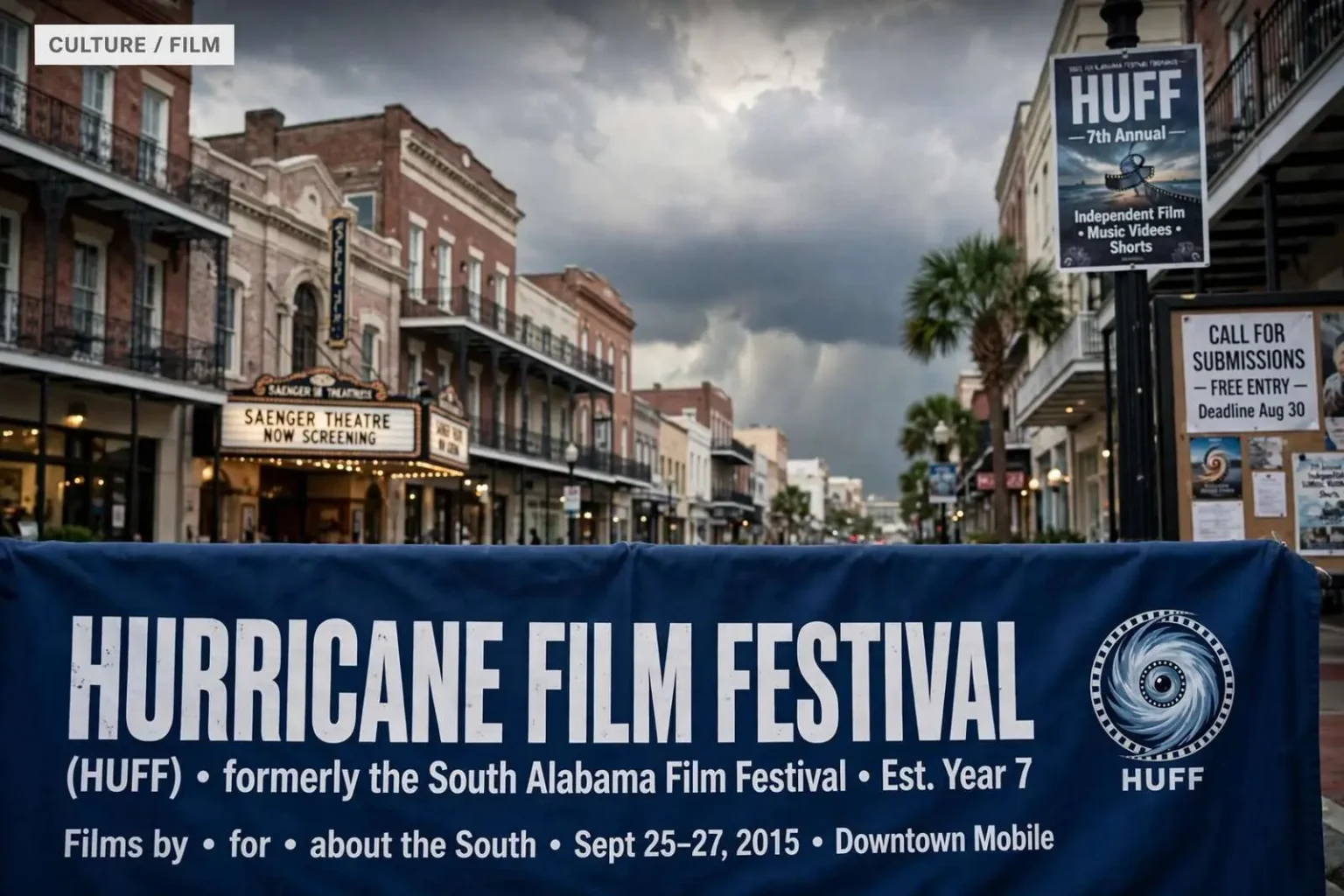
Mobile’s regional film festival is getting a new name. The South Alabama Film Festival, known as SoAL, has rebranded as the Hurricane Film Festival (HUFF) as it enters its seventh year.
In a statement, organizers said the festival showcases films by, for, or about the South, and that the name change was meant to clear up lingering confusion. They noted the festival is not directly affiliated with the University of South Alabama and said they were unsure themselves how to pronounce the old acronym.
The rebrand, arriving as the festival enters its seventh year, reflects both the growing pains of a grassroots event and a deliberate choice about identity. Acronyms that look tidy on paper can mislead in practice, and a festival housed in a city with a major university bearing a similar name spent years fielding the assumption that it was a campus production. Dropping SoAL for HUFF draws a bright line — the festival is an independent community event — while handing the event a name with personality and Gulf Coast flavor.
Why “Hurricane”?
Organizers argued that a region’s defining challenges are as much a part of its character as its highlights. They compared the Gulf Coast’s annual tropical threats to the earthquakes that shadow Los Angeles, framing the region’s gallows humor and communal response to storms as central to its culture.
The logic is sound storytelling. The places that produce distinctive art are usually the places shaped by something hard — and along the northern Gulf Coast, the defining hard thing arrives on the radar screen every June and departs in November. Anyone who has ridden out a hurricane in Mobile or on the Mississippi Coast knows the culture it produces: the plywood and tape in September, the neighbor with the chain saw after, the dark jokes told while boarding up windows. Naming a film festival for that shared experience claims it as an artistic asset rather than a liability.
The earthquake comparison makes the point portable. Los Angeles built an identity partly on living with seismic risk, and its films absorb that anxiety constantly. Gulf Coast cinema — stories of storms, rebuilding, and the strange solidarity of evacuation traffic — has the same raw material. A festival called Hurricane signals to filmmakers that the region’s weather-worn experience is not just accepted here but celebrated as subject matter.
The festival is scheduled for September 25 through 27, 2015, at multiple downtown Mobile venues that had not yet been officially announced at the time of the rebranding.
A Festival Grown from the Region
Seven years is a respectable run for a regional film festival, which typically survives on a few committed organizers, modest sponsorships, and the goodwill of local venues. Events of this kind fill a role that larger festivals cannot: they show work by filmmakers who live down the street, give student and first-time directors a real audience, and build the viewing culture that a city needs before it can support bigger film activity. Mobile’s downtown, with its historic theaters, bars, and walkable blocks, offers the natural infrastructure — the same mix of venues that hosts the city’s music and arts events throughout the year.
The festival’s mission — films by, for, or about the South — gives it an editorial identity in a crowded festival landscape. Regional festivals that try to program like Sundance tend to disappear; ones that own their geography build loyal audiences. Southern storytelling has never been richer on screen, from the region’s documentary tradition to the wave of independent narrative features shooting in Southern cities as production incentives spread. A Gulf Coast festival positioned as the showcase for that work occupies genuine territory.
The name change also lands in a moment when Mobile’s film profile has been rising. The city has hosted productions large and small, its architecture and coastline doubling for both period work and contemporary drama, and local crews have grown along with the traffic. A festival with a memorable name — and HUFF is certainly memorable — gives that growing community an annual anchor and a banner to submit under.
Call for Submissions
HUFF is seeking local and regional submissions, including feature-length films, shorts, and music videos. Submission is free, with entries accepted through Sunday, August 30. Organizers ask that submissions be sent as YouTube or Vimeo links to [email protected].
The free-submission policy deserves note. Film festivals commonly charge entry fees of twenty to fifty dollars per submission, a cost that falls hardest on the emerging filmmakers the festival most wants to reach. Waiving the fee removes a real barrier for students, first-timers, and working filmmakers across the region, and the online-link submission method — YouTube or Vimeo — replaces the old physical-screeners-by-mail ritual with a process any smartphone filmmaker can manage. The email address centralizes entries and keeps the operation lean, consistent with the volunteer-driven economics of a festival at this scale.
The categories — features, shorts, and music videos — map the practical range of regional production. Features get the prestige slots, but shorts are where most local filmmakers actually work, and music videos tie the festival into the Gulf Coast’s strong music scene, giving bands and directors a shared venue. Programs that mix the three keep screenings varied and give audiences a reason to attend whole blocks rather than a single title.
What the Rebrand Means Going Forward
For the seventh-anniversary edition, the new name arrives with three months of runway. Between the August 30 submission deadline and the September 25 opening, organizers will select programs, confirm the downtown venues, and rebrand a year’s worth of print and digital materials. Festivals that rebrand successfully usually do so while keeping their continuity visible — same mission, same region, same community — and HUFF’s statement emphasized exactly that: the films, the South, and the showcase remain; only the banner changes.
The hurricane theme also arrives with natural programming possibilities. Storm stories — documentaries of Camille, Katrina, Ivan, and Frederic; narratives of rebuilding; the strange comedy of hurricane prep — form a Gulf Coast cinematic canon that a festival bearing the name can program explicitly. Paired with the general call for Southern work, the theme gives the 2015 edition both a broad mission and a signature. Mobile audiences will see the result September 25 through 27, when the rebranded festival takes over downtown screens under a name no one will have trouble pronouncing — or forgetting.
The Business of Small Festivals
Regional film festivals run on a fragile blend of volunteer labor, sponsor support, and venue cooperation. Organizers donate hundreds of hours to programming, logistics, and promotion; downtown venues donate screens; sponsors cover the modest cash costs of printing, awards, and equipment. Attendance pays little of it directly — ticket prices at regional festivals rarely cover more than a fraction of operations — which is why the rebranding decision matters commercially as well as artistically. A name that sticks in memory is free marketing, and “HUFF” gives sponsors, filmmakers, and press something easier to promote than an acronym nobody could say aloud.
The September timing also works in the festival’s favor. Early fall brings the first break in the Gulf Coast heat, downtown Mobile’s event calendar is filling, and the dates sit far enough from Mardi Gras and the summer tourist season to claim the city’s attention. Multi-venue festivals depend on foot traffic between screens, and the downtown blocks that host the city’s other signature events provide exactly that: restaurants and bars within a short walk, parking within reach, and the historic atmosphere that makes a festival weekend feel like an occasion.
Filmmaking in the South Finds Its Audience
The festival’s growth mirrors a broader shift in Southern film. For decades, the South on screen was mostly a destination for outside productions; now the region sustains its own ecosystem of writers, directors, crews, and festivals. Alabama has invested in production incentives that brought major shoots to the state, and cities like Mobile and Birmingham have seen local production companies emerge to serve both visiting productions and homegrown projects. Festivals are the front porch of that ecosystem — the place where audiences first see the work and where filmmakers find collaborators for the next one.
Programs that showcase films “by, for, or about” the South serve a documentary tradition as much as a narrative one. The region’s stories — civil rights history, coastal life, the shifts in its economies and towns — have drawn documentarians for generations, and a festival on the Gulf Coast sits inside its own subject matter. Add the hurricane lens the new name provides, and the festival claims a corner of the film world that no West Coast or Northeast event can program with authenticity.
For local audiences, the value is simpler. A festival weekend downtown offers the chance to watch films made by people you might meet in the lobby, to hear directors talk after the screening, and to see familiar streets on screen. That feedback loop — work shown at home, received at home — is what builds a lasting film culture in a city, and it is what the organizers of the festival now known as HUFF have been building for seven years. The new name, the free submissions, and the September dates all point the same direction: an event that intends to grow from a regional secret into the Gulf Coast’s own film weekend, hurricane jokes and all.