
Mobile Weighed a Fivefold Parade Permit Fee Increase, Then Pumped the Brakes
A proposed fivefold increase in Mobile's Mardi Gras parade permit fee drew pushback from carnival groups; no hike for the 2019 season.
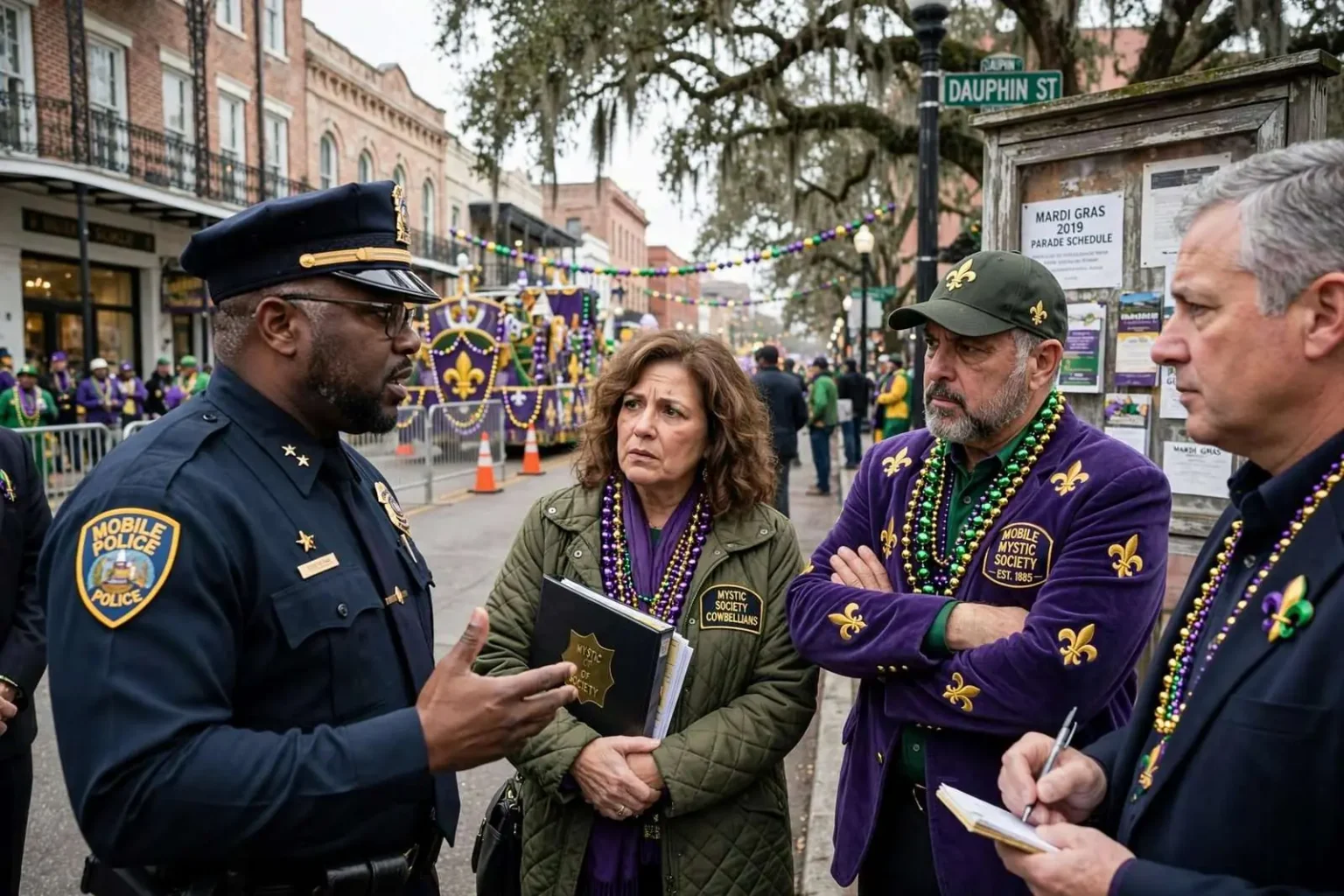
Mardi Gras societies push back on fee hike idea
Mobile’s parading Mardi Gras societies briefly faced the prospect of paying five times more to roll down the streets of the Port City. Police Chief Lawrence Battiste floated raising the city’s parade permit fee from its current level to $5,000, and met Wednesday night with leaders of local carnival organizations to discuss the idea. The proposal, delivered in the months before the 2019 Carnival season, landed like a stone in a community that treats its parade tradition as the defining event of the city’s year.
According to several people in the room, the proposal landed badly — groups warned a sudden jump of that size could force some societies off the streets entirely, and said they could likely absorb an increase to about $1,500 instead. The gap between the two numbers framed the whole conversation: a city weighing the real cost of policing and operating a parade season that has grown enormous, and a network of volunteer-run societies whose budgets are built on member dues, fundraising and decades of tradition rather than deep corporate pockets.
The economics of a parade season
The chief’s proposal reflected a straightforward concern: Mardi Gras costs the city real money, and the permit fee is the most visible lever for recovering it. Mobile’s Carnival season stretches for weeks, with parades rolling on consecutive nights downtown and in neighborhoods across the city, and each one requires police details for traffic and crowd control, public works support for barricades and cleanup, and fire and EMS coverage for crowds that can number in the tens of thousands for the biggest nights. Those costs grow with the schedule, and officials have periodically looked at fees as a way to keep pace.
For the societies, though, the math runs the other way. A parading organization’s expenses already include float construction and maintenance, throws by the case, costumes, band fees, insurance and the rental or upkeep of den space, and most of that spending happens months before the first parade rolls. A permit fee jumping to $5,000 in a single season would land on top of those commitments with no time to adjust — not a gradual increase societies could plan for, but an immediate add that smaller organizations would struggle to absorb without cutting into the very things that make their parades what they are.
That is why the groups at the meeting rallied around the $1,500 figure as something they could live with. It acknowledged the city’s point — that the fee could rise from its longtime level — while drawing a line at an increase that would push marginal societies out of the season altogether. In a Carnival ecosystem that depends on the sheer number and variety of parades, losing several societies would diminish the season for everyone, including the city itself.
Where the idea went
Battiste told the organizations he would take their concerns to Mayor Sandy Stimpson. The referral was the natural next step: any change to the permit fee schedule would ultimately require the administration’s support and action by the Mobile City Council, and the meeting with society leaders was the chief’s forum, not the deciding one. The societies left the room knowing their message had been delivered directly to the official who raised the idea in the first place.
The police department later confirmed the meeting was an open-floor discussion meant to explain Mardi Gras operating costs, and said no decision had been made about whether an increase would take effect or how large it would be. That characterization softened the moment — a discussion about costs rather than a done deal — but it also confirmed that the administration was seriously examining what the season costs and what the city recovers, a review the societies could not ignore.
By Thursday afternoon, the city moved to calm fears: spokesperson Laura Byrne said there would be no permit fee increase for the upcoming 2019 Mardi Gras season, adding that the issue was being explored now only to understand potential impacts down the road. The statement gave the societies their immediate answer — the season they were already preparing for would not carry a new fee — while leaving the long-term question open. The city, in effect, pumped the brakes: no change now, but a signal that the subject would return.
Why the fee matters in Mobile
Mobile holds the distinction of hosting the oldest Carnival celebration in the United States, with organized mystic societies parading in the city decades before New Orleans held its first. That heritage makes the parade schedule more than entertainment; it is a civic institution whose societies — some more than a century old — pass membership down through families and treat the season as a community obligation. Any change to how the city charges for parades touches institutions that measure their history in generations, which is why a permit fee discussion can turn into a citywide conversation almost overnight.
The season’s scale is also why the money is significant. Mardi Gras in Mobile draws visitors from across the Gulf Coast during the weeks before Lent, filling hotels and restaurants downtown and giving the city a tourism engine that operates in the heart of winter. The parades themselves are the draw, and their number and variety depend on the health of the societies that stage them. Officials weighing a fee increase have to balance the direct cost recovery against the risk of thinning a season whose economic and civic value depends on abundance.
How permit fees fit the picture
Parade permit fees exist in cities across the Gulf Coast, and they generally function as a partial offset to the public costs of staging events on city streets — not as a full reimbursement. The actual expenses of a parade season, including police overtime, street closures and cleanup, far exceed what permit fees typically recover, which is why municipalities periodically revisit the numbers. The question in Mobile, as everywhere the discussion arises, is how much of the burden belongs on the parading organizations and how much is simply the cost of hosting a public celebration the whole city profits from.
The societies’ position at the meeting — open to roughly $1,500, resistant to $5,000 — reflected that framing. Volunteer carnival organizations are not businesses with pricing power; their members pay dues and fundraise to put on the parades, and the amount they can absorb is bounded by what their memberships will bear. A fee that exceeds that boundary does not generate more revenue; it subtracts parades. City officials who have studied Carnival economics in the region generally understand that trade-off, which is why negotiated, phased increases are far more common than sudden multiples.
The season that followed
With the fee question settled for 2019, the societies rolled into the season as planned, and the episode settled into city politics as a warning shot rather than a turning point. For the mystic societies, the week’s events demonstrated the value of showing up in force when city hall floats a change: leaders from across the Carnival community came to the same meeting, spoke with one voice about what their organizations could absorb, and saw the proposal set aside within a day of the discussion.
For the administration, the episode demonstrated the politics of touching Mardi Gras. Even a conversation — explicitly framed as a discussion of costs, with no decision made — was enough to mobilize the city’s Carnival establishment, and the speed of the city’s Thursday statement showed how quickly officials moved to contain the fallout. The deeper question of what a parade season costs and who should pay for it remained on the table, but any future attempt to answer it would start with the knowledge that Mobile’s parading societies treat their permit fees as a matter of institutional survival, not a line item.
The societies behind the season
Mobile’s Carnival calendar is staged almost entirely by volunteer mystic societies, organizations whose members spend the year between seasons planning floats, buying throws and rehearsing traditions that in some cases stretch back more than a century. The parading societies range from large downtown organizations with elaborate floats and signature throws to neighborhood groups whose members build and decorate their floats themselves, and each one answers to its own membership for the budget that makes a parade possible. That structure is why a permit fee discussion lands differently in Mobile than it might in a city whose parades are run by commercial operators: the people in the room with the police chief were unpaid volunteers defending an institution their families have sustained for generations.
The societies’ finances reflect their volunteer character. Members pay annual dues that fund the season, and organizations raise additional money through balls, fundraisers and member contributions. Large societies carry significant costs — professional float builders, insurance, bands, warehouse leases — while smaller parading groups operate on budgets that leave little room for surprise expenses. A new $5,000 fee would have drawn from the same pool of money that buys throws for the crowds, pays the bands and keeps the floats rolling, which is why representatives at the meeting described the increase as something that could force societies off the streets entirely.
What the season costs the city
The police department’s framing of the meeting — an open-floor discussion meant to explain Mardi Gras operating costs — points to the other side of the ledger. A parade does not roll without public services: officers at intersections along the route, barricades set and removed, streets cleaned before dawn, and emergency coverage for dense crowds on the biggest nights. Multiplied across a season of consecutive parade nights, those services add up, and as the schedule has grown over the years the city’s costs have grown with it. The permit fee is the most direct instrument for recovering a share of that expense, which is why officials periodically examine it.
The tension between those two realities — genuine public costs and volunteer-run institutions with fixed resources — is the enduring shape of the debate. Cities that host Carnival traditions resolve it in different ways: some charge fees that rise with the scale of the parade, some phase in increases over several years and some subsidize the season as a matter of civic identity. Mobile’s 2019 episode ended in the third posture for the moment, with the city explicitly saying the issue was being explored only to understand potential impacts down the road.
The politics of touching Mardi Gras
There is a reason the city moved so quickly to defuse the issue. In Mobile, Carnival is not an event the city permits so much as a tradition the city belongs to, and proposals that raise the cost of parading are read by many residents as a challenge to the institution itself. The speed of the response — a Wednesday night meeting, a Thursday afternoon statement — reflected the administration’s awareness that a fee increase perceived as hostile to the societies would generate opposition from the city’s most established civic networks, whose members are also its voters, donors and downtown stakeholders.
Chief Battiste’s decision to convene the society leaders before proposing anything formal was, in that light, a prudent first step. The room heard the city’s cost concerns, the city heard exactly how much the organizations could absorb, and the mayor’s office received the message through the chief rather than through a contested public agenda item. Whether the eventual answer is a modest increase along the lines the societies suggested, a phased schedule or the status quo, the conversation that started with a $5,000 figure produced something useful: a clear statement of what the season costs the city and what the societies can carry.


