Mobile Police Department Opens Applications for Citizens’ Academy
The Mobile Police Department is accepting applications for its free Citizens' Academy, offering residents a firsthand look at daily police work.
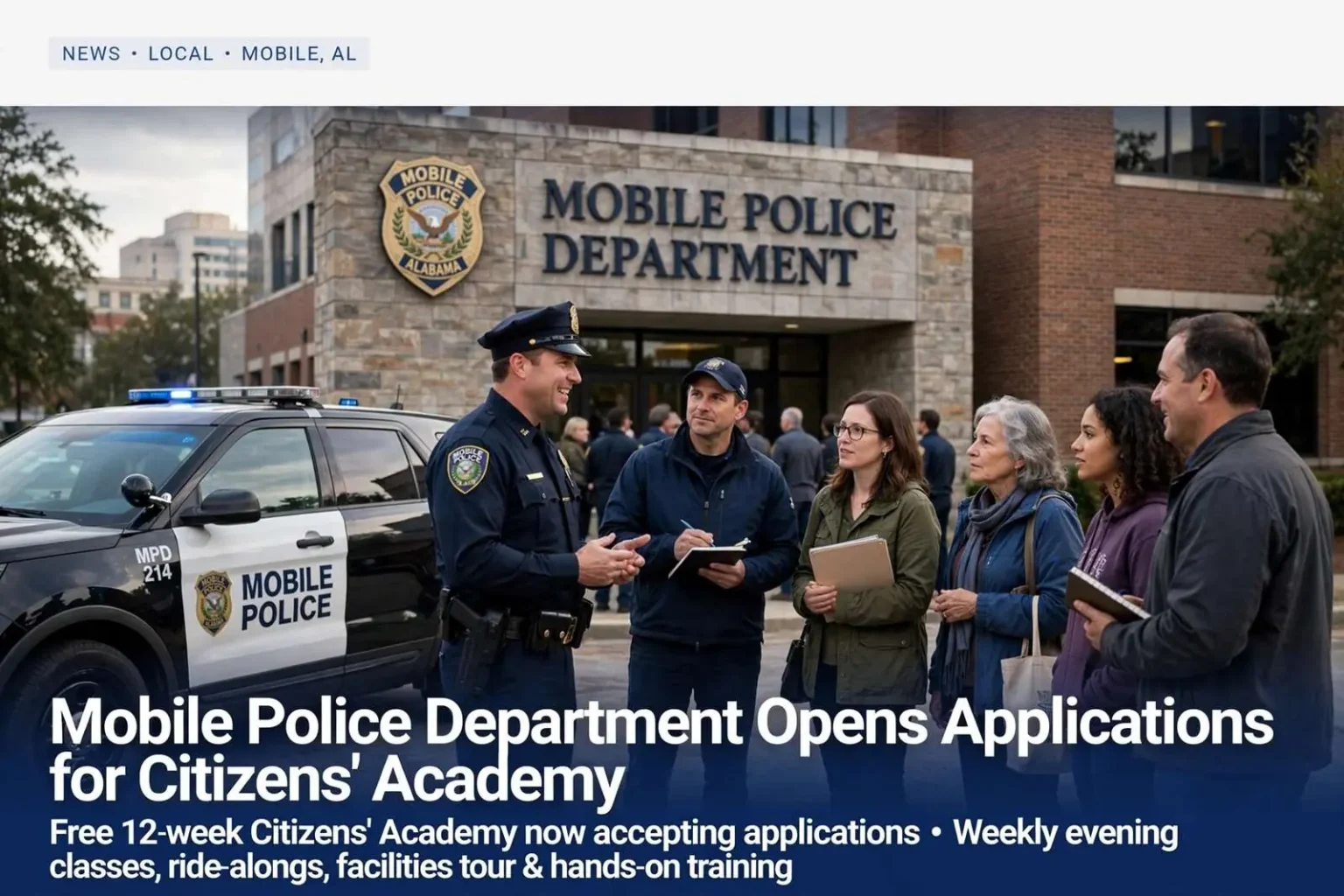
Residents curious about what Mobile police officers actually do day to day now have a chance to find out. The Mobile Police Department has opened applications for its next Citizens’ Academy, a free program designed to give community members an inside look at how the department operates.
The academy meets weekly on Tuesday evenings, running from 6:30 to 9:30 p.m., with classes taught by officers and department staff who specialize in the topics being covered. Participants move through a broad curriculum touching on nearly every function of the department, including patrol operations, tactical response, narcotics enforcement, youth crimes investigations, officer training standards and community policing strategy.
Beyond the classroom sessions, participants have the option to ride along with a patrol officer during a shift and tour several law enforcement facilities in the Mobile area, including the Mobile County Metro Jail and the department’s communications center, where 911 calls are received and dispatched. The academy also gives participants hands-on time at the Mobile Police Department’s pistol range, allowing them to handle firearms under supervision as part of the training experience.
What participants actually learn
The weekly sessions are structured to mirror the department’s own training in miniature. Instructors walk participants through how patrol districts are organized and dispatched, what happens when a call comes in and how officers prioritize responses across a city of roughly 190,000 residents. Classes on narcotics enforcement cover how investigators build cases against street-level and mid-level dealers, while sessions on youth crimes examine how detectives handle offenses involving minors, both as victims and as suspects.
Training standards are another staple of the curriculum. Participants learn what recruits cover at the police academy, how much continuing education veteran officers complete each year, and how the department’s policies on use of force compare to state law and national practice. The community policing sessions give residents a chance to hear how the department approaches neighborhood-level problem solving, from business watch programs to foot patrols in commercial corridors.
The ride-along option is often cited by graduates as the most memorable part of the program. Spending a shift in a patrol car puts participants on real calls, from minor traffic complaints to arrests, under the direct supervision of a field officer. The facility tours complete the picture: the Metro Jail visit shows the intake and housing operation run by the Mobile County Sheriff’s Office, and the communications center demonstrates how 911 telecommunicators triage hundreds of calls a day and route them to the right responders.
Why the department runs the academy
Department officials describe the Citizens’ Academy as a way to build trust and understanding between residents and the officers who serve their neighborhoods. By walking participants through the realities of patrol work, investigations and department policy, organizers hope attendees leave with a clearer sense of the decisions officers make under pressure and the resources available to the department.
The program has run for multiple years in Mobile, drawing participants from across the city who want a closer relationship with local law enforcement or who are simply curious about the profession. Graduates often go on to serve as informal ambassadors for the department in their own neighborhoods, and some alumni have pursued careers in law enforcement or emergency communications after seeing the work up close.
There is no cost to attend, but seating is limited each session, and the department has encouraged interested residents not to wait to apply. The program typically fills as word spreads through neighborhood associations, church groups and civic clubs across Mobile’s communities, from Africatown and Toulminville to Spring Hill and West Mobile.
How to apply
Applicants can register by calling the department’s community affairs office, and applications are reviewed before participants are confirmed for the upcoming session. The department conducts standard background screening on applicants, a routine step that helps ensure the ride-alongs, range time and facility tours remain secure. Organizers have asked interested residents to apply promptly because class size is capped to keep the hands-on portions manageable.
Participants should plan for a twelve-week commitment, with classes on Tuesday evenings from 6:30 to 9:30 p.m. The schedule is designed for working adults, with sessions that begin after the workday and end before 10 p.m. Graduation ceremonies close out each academy, and the department has used those events to highlight participants who went the extra mile during the program.
The department behind the program
The Mobile Police Department is the largest municipal law enforcement agency on the Alabama Gulf Coast, patrolling the state’s fourth-largest city and operating specialized units covering homicide, robbery, narcotics, juvenile investigations, traffic and tactical response. The department’s headquarters on South Royal Street anchors an operation that includes precinct-level patrol divisions spread across the city, and its officers answer more than 200,000 calls for service in a typical year.
The communications center that academy participants tour handles emergency calls for both police and fire services, and the Metro Jail they visit houses arrestees from every law enforcement agency in the county. Seeing those operations firsthand, officials say, helps residents understand how a single 911 call moves from a phone in a living room to an officer on a doorstep and, when necessary, to a jail intake desk.
Range time is supervised closely by certified firearms instructors, and participants are walked through safe handling, loading and shooting under one-on-one direction. For many attendees who have never touched a handgun, the session demystifies both the tool and the training officers receive before they carry one on the street.
Who should apply
The department has consistently stressed that the academy is open to any interested resident, with no expectation that participants are considering law enforcement careers. Business owners, neighborhood association leaders, students, retirees and faith community members have all taken part in past sessions. The common thread, organizers say, is a desire to understand rather than merely observe from a distance.
Applications are being accepted now for the upcoming session, and the department has published its contact information for the community affairs office, where staff can answer questions about the schedule, the background screening process and the curriculum. For residents who have ever wondered what happens after they dial 911, or what an officer’s shift actually looks like, the Citizens’ Academy offers the closest available answer without taking the job itself.
A model used across the Gulf Coast
Mobile’s Citizens’ Academy follows a model that has become standard practice among law enforcement agencies across Alabama and the Gulf Coast. Neighboring departments in Baldwin County, including those in Daphne, Fairhope and Gulf Shores, run similar citizen academies, as do the Mobile County Sheriff’s Office and agencies in Pensacola across the state line. The concept spread nationally in the 1990s as departments looked for structured ways to open their operations to the public beyond ride-along requests and career fairs.
The format’s appeal is mutual. Residents gain a realistic view of policing that is neither the dramatized version seen on television nor the abstract version debated in public meetings, while officers gain a roster of informed residents who understand the constraints, policies and pressures behind the department’s decisions. Police executives in Mobile have pointed to the academy when discussing community relations, describing informed residents as partners who can help spread accurate information during critical incidents rather than speculation.
What a typical session looks like
A typical Tuesday evening begins with classroom instruction from a specialist, whether a narcotics detective, a training officer or a juvenile unit investigator, followed by demonstrations, question-and-answer periods and, on selected weeks, the hands-on components. The tactical response portion introduces participants to the equipment and procedures of specialized units, while the youth crimes session brings in detectives who explain how cases involving children are handled differently from adult investigations, from interview techniques to coordination with school officials and family services.
By the time participants graduate, they have visited the range, toured the jail and communications center, ridden with a patrol officer and heard directly from the investigators, trainers and commanders who run the department’s daily operations. The department’s stated goal is a resident who understands what the police can and cannot do, how decisions are made under pressure and where the community fits into public safety, and each graduating class is part of the department’s long-running effort to build that understanding one neighborhood at a time.
Department staff recommend that applicants bring questions to the first session, since the curriculum flexes to the interests of each class and instructors regularly extend discussions that draw strong participation. Past participants have ranged in age from college students to residents in their seventies, and the department has found that the mix of perspectives, from long-time Mobilians to newcomers to the Gulf Coast, is part of what makes each academy session valuable for both the attendees and the officers teaching them.