Mobile River Bridge Comment Period Draws Strong Public Support
More than 640 people weighed in on the proposed I-10 Mobile River Bridge, with most backing the preferred route and a bike-pedestrian lane.
Record Public Response to the Bridge Plan
Public input on the long-discussed Interstate 10 Mobile River Bridge project has come in heavy, with more than 640 people speaking at hearings or submitting written comments during a 45-day review window that closed in early November. The comment period accompanied the release of a federal environmental impact study on the roughly $850 million project and included two public meetings, one at the Alabama Cruise Terminal and another at the Five Rivers Delta Resource Center. Alabama Department of Transportation officials collected the feedback as part of the ongoing federal review process required before construction can move forward on the new Mobile River crossing.
The volume of participation stands out for a corridor study. Scoping and draft-study comment periods for major highway projects often draw a few dozen speakers, mostly from advocacy groups or affected landowners. The Mobile River Bridge meetings, by contrast, drew residents from both sides of Mobile Bay, including commuters who cross the river daily, downtown business owners, neighborhood leaders and out-of-town drivers who rely on the interstate route along the Gulf Coast.
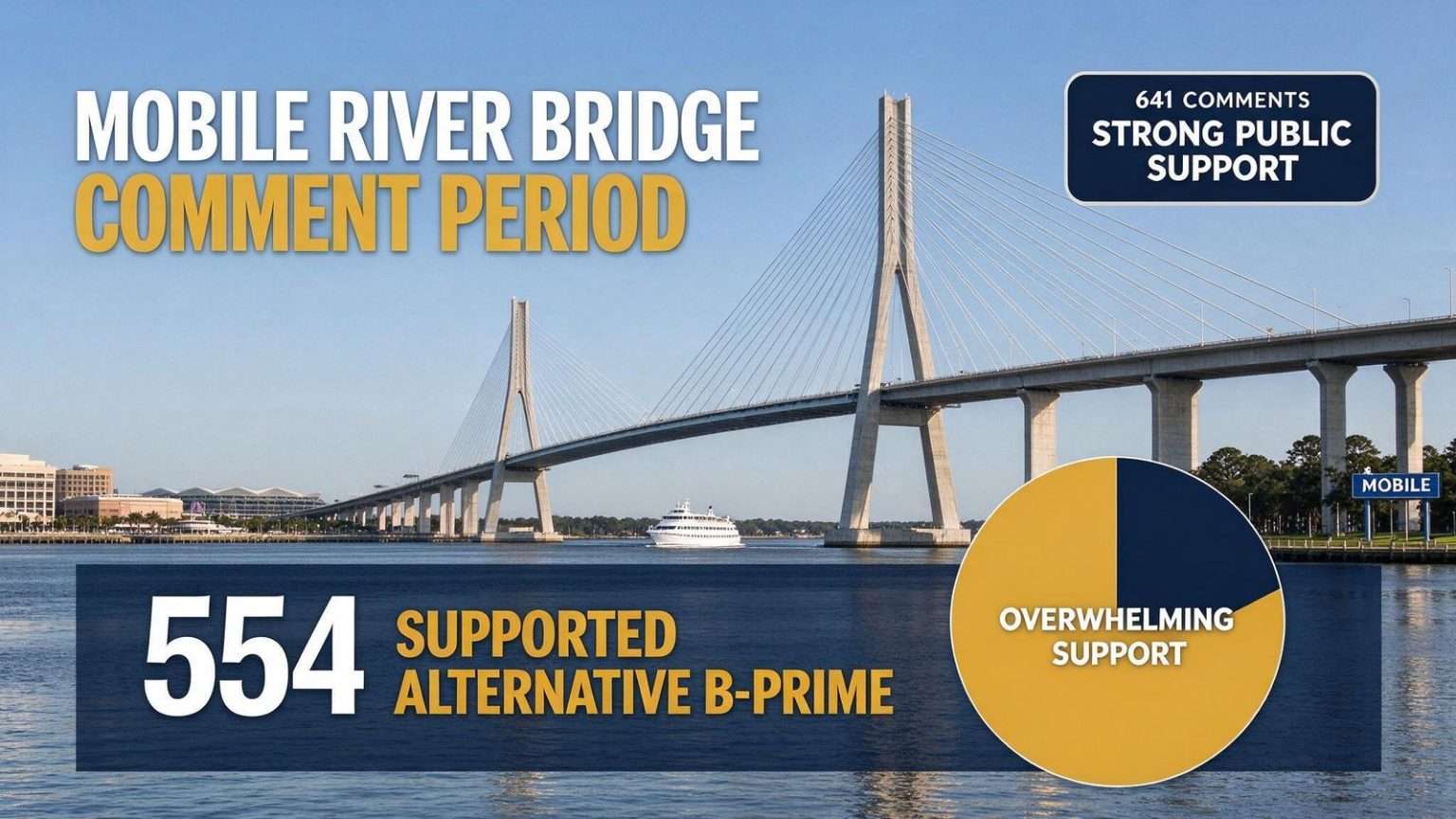
Of the 641 individual comments logged, an overwhelming 554 expressed support for the state’s preferred route, known as Alternative B-Prime. Only four comments backed a different alignment, and just 40 people, roughly 6 percent of all respondents, opposed the bridge project outright. The lopsided tally gives state officials a clear public mandate for the preferred alternative as the environmental review advances.
Why the Numbers Matter
Alternative B-Prime would place the new crossing north of the existing tunnels downtown, connecting the interstate directly toward the existing Bayway and routing through-traffic away from the tight downtown curves that slow drivers today. Supporters at the hearings cited predictable travel times, relief for the tunnels and a modern crossing built to current interstate standards as the main reasons for their preference.
A separate petition effort added even more voices to the record. A total of 4,200 signatures were gathered on a petition asking that the completed bridge be named in honor of a local serviceman, Corporal Christopher Edward Mason, an effort organized by his father. Transportation officials have indicated the bridge would carry that name if the petition request is honored. Naming a major Gulf Coast crossing for a fallen serviceman would place the project in a long Alabama tradition of honoring military service on the state’s roads and bridges.
Environmental studies are the legal backbone of any federally funded highway project. Under the National Environmental Policy Act, agencies must study impacts on traffic, air quality, historic properties, wetlands and nearby neighborhoods, and they must document and respond to public comment before a project can receive the approvals needed for right-of-way acquisition and construction. The comment record compiled this fall becomes part of that administrative file and will help shape the final study.
The two meeting locations themselves reflected the bridge’s reach. The Alabama Cruise Terminal sits on the Mobile riverfront, in the shadow of the tunnels the new crossing is meant to relieve, while the Five Rivers Delta Resource Center in Spanish Fort serves residents of the Eastern Shore who commute across the bay daily. Holding meetings on both sides of the water gave drivers from Mobile and Baldwin counties equal access to the mic.
Bike-Ped Access Emerges as the Contested Issue
Bicycle and pedestrian access to the bridge emerged as one of the more contested elements of the design. A petition circulated by a local bicycle and pedestrian advocacy group gathered 3,213 signatures in favor of including a dedicated bike-pedestrian lane on the span, adding to 111 additional individual comments on the same topic, 72 of which supported the addition. Twenty-nine commenters spoke against including the path, some questioning its cost and others its practicality atop a bridge high enough to clear oceangoing ships on the river.
State transportation officials have previously raised concerns about the cost and design challenges of adding such a lane to the bridge. A protected path on a major cable-stayed or tied-arch crossing would require additional width, railing height and separation from high-speed traffic, all of which add expense to a project already estimated near $850 million. Coastal bridges elsewhere, from the Sunshine Skyway in Florida to the Crescent City Connection in Louisiana, illustrate both the appeal and the engineering burden of accommodating walkers and cyclists on tall spans.
Advocates counter that a bridge without bike-pedestrian access would be built once and could not easily be retrofitted later, and that a path would connect the Mobile riverfront with the Eastern Shore greenways already popular with runners and cyclists. Support among the 3,213 petition signers, they argue, shows the demand exists even if the state’s engineers remain cautious.
What the Individual Comments Showed
Among those who commented specifically on potential bicycle-pedestrian use, 253 said they personally would not use such a path if it were built, while smaller numbers indicated they would use it occasionally, weekly or daily. The self-reported usage figures complicate the advocacy case, since even enthusiastic petition signatures do not always translate into routine crossings on foot or by bike. Planners read such data carefully when weighing amenities against cost.
A related question about the existing I-10 Wallace Tunnel found that 232 respondents cross it weekly, 108 daily and 133 only occasionally, with just four saying they never use the tunnel. The answers underline how central the tunnel is to daily life in the region: nearly every respondent touches the crossing at some point in a typical month, whether commuting to work, heading to the beach or hauling freight through the port city.
The Wallace Tunnel, which carries the interstate beneath the Mobile River in two bores, was built for a fraction of today’s traffic volume. At peak hours and after wrecks, backups routinely stretch through downtown streets and onto the approaches, frustrating commuters and freight haulers alike. The Bankhead Tunnel, the older companion crossing a few blocks away, carries city traffic and adds to the pattern of chokepoints along the riverfront.
What Comes Next for the Project
The bridge and approach project has been years in the making, aimed at easing chronic congestion at the Wallace Tunnel and providing an alternative Mobile River crossing for the growing volume of interstate and local traffic passing through downtown Mobile. Local leaders have pursued some version of a new crossing for decades, and the project has repeatedly surfaced in regional transportation plans as the top priority for the Gulf Coast corridor. Port growth, tourism traffic along the beach highway routes and steady population gains across the two-county area have only added urgency.
With the comment period closed, the results now feed into the state’s ongoing environmental review process, one of the final major steps before the project can move toward design and construction phases. Officials will review the comments, incorporate substantive concerns into the final environmental documents and determine whether any changes to the preferred alternative are warranted. Only after the federal review concludes can the project advance to final design, right-of-way acquisition and the financing decisions that will determine how the roughly $850 million price tag is paid.
Financing remains one of the open questions hovering over the effort. Large bridge projects on the Gulf Coast have relied on combinations of federal funds, state dollars and tolling, and any toll proposal would itself require additional study and public comment. The strong show of support for the route in the comment record does not settle how the bridge would be funded, and that debate is expected to intensify once the environmental work is complete.
A Region Ready to Move
For a region that has debated a new Mobile River crossing for years, the strong turnout and lopsided support for the preferred route suggest broad public appetite for the project to move forward, even as questions about bike-pedestrian access and the ultimate price tag remain unresolved. More than six hundred individual comments, thousands of petition signatures and two well-attended meetings amount to one of the most extensive public records ever compiled for a transportation project in south Alabama.
The comment record also gives elected officials a benchmark to measure against. Members of the local legislative delegation and county and city leaders have pushed the state to keep the project on schedule, and the level of public backing documented this fall strengthens their hand when funding decisions come before state and federal authorities. Projects with demonstrated public support tend to fare better in competitive federal funding programs.
For the families who signed the petition to honor Corporal Mason, and for the cyclists hoping for a path across the river, the next milestones will come as the final environmental study is published and the state moves toward a decision on design and construction. What is no longer in doubt is the direction of public opinion: the region wants its new bridge, and it has said so in numbers that are hard to ignore.