Mobile Man Accused of Posing as Officer in Armed Search of Woman’s Home
Mobile police arrested a man accused of joining five others in posing as officers and searching a woman's home for drugs at gunpoint over the weekend.
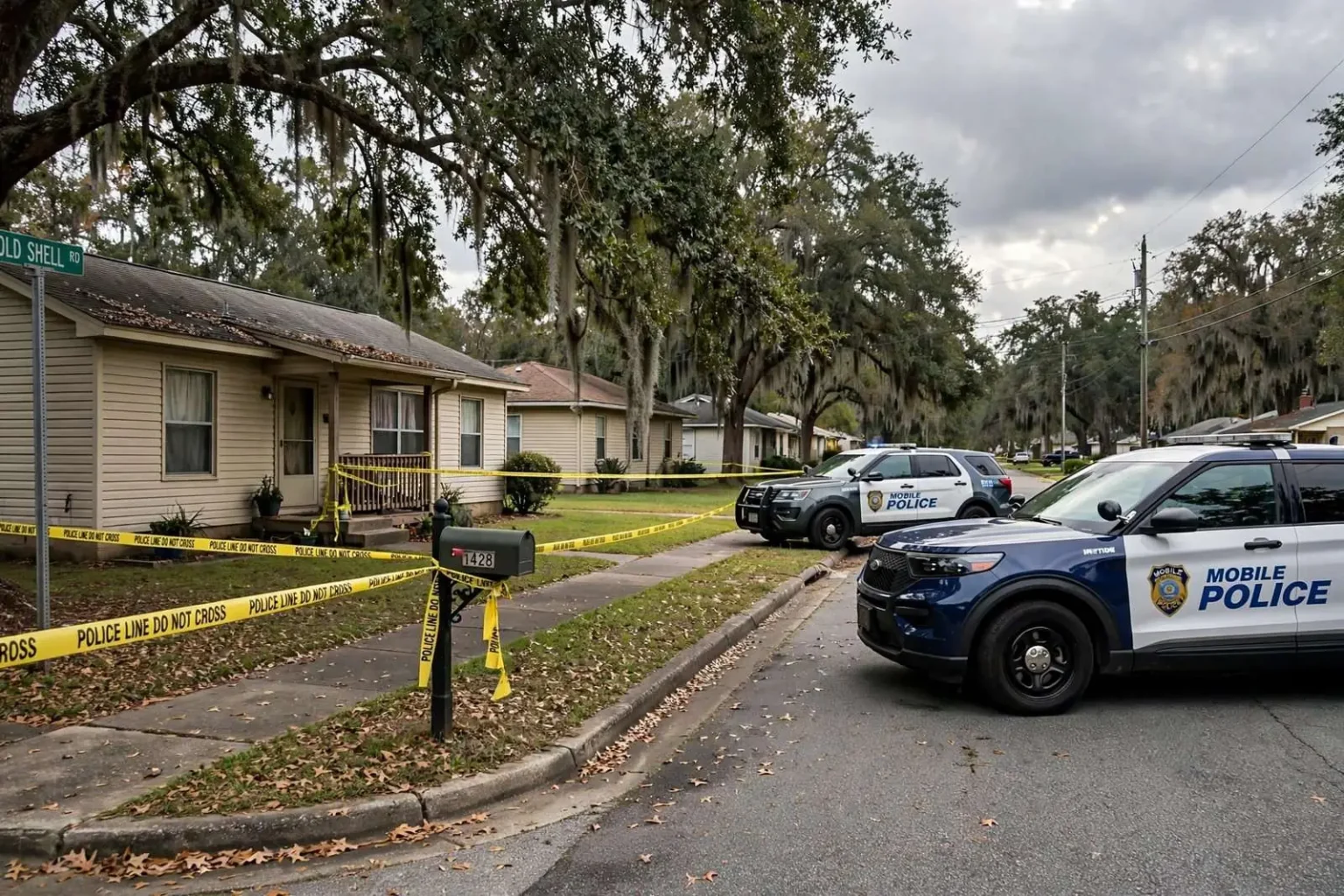
Mobile police have arrested one of six men accused of posing as law enforcement officers and forcing their way into a woman’s home over the weekend while searching for narcotics.
Officers booked the 25-year-old suspect into the Mobile County Metro Jail on a Thursday afternoon, several days after the Mobile Police Department says he and five other men knocked on the door of a home near Old Shell Road. When the woman answered, the group allegedly identified themselves as police officers and demanded to search the residence for drugs.
What happened at the door
Investigators said at least two of the men displayed handguns during the encounter. The group left after failing to locate any narcotics in the home, according to police. No injuries were reported.
The scheme described by investigators is a known and particularly dangerous form of home invasion. Posing as police gives intruders exactly what they need to defeat a homeowner’s caution: she opened her door because she believed she had no choice, and she allowed a search because refusing an officer seemed riskier than complying. The fake authority did not end the danger once inside — with at least two handguns displayed and five other men present, the woman spent the encounter outnumbered and armed only with the knowledge that the “officers” had not come the way real ones come. That the group left without finding anything, and without injuring anyone, was the extent of the good fortune in the case.
A police spokesman said detectives were still working to identify and locate the remaining five suspects as of Friday morning and had not yet released descriptions of the other men involved.
The days between the weekend invasion and Thursday’s arrest indicate investigators worked the case continuously — developing a suspect, presenting the case to a magistrate and taking him into custody while the trail of the other five was still warm. Holding back the descriptions of the remaining suspects is a standard tactic in an active investigation: details kept out of public release can be used to test the accuracy of any tip that comes in.
The charges
The man who was arrested faces charges of impersonating a peace officer, first-degree robbery and first-degree burglary, along with a pair of unrelated traffic offenses uncovered through the booking process.
First-degree burglary is the backbone of the charging decision. Under Alabama law, a burglary rises to first degree when the intruder is armed or causes injury — and entering a home while displaying a handgun, under a false pretext, sits squarely in that category. The robbery charge reflects the confrontation itself: a demand backed by displayed weapons is robbery whether or not anything of value was taken. The impersonation count addresses the method — falsely representing oneself as a peace officer — which Alabama law treats as its own offense precisely because of the havoc it wreaks on public trust.
Court records reviewed by South Alabama News show he had previously faced charges including contempt of court, third-degree theft and breaking into a vehicle.
Those prior cases, none of them violent felonies on their face, show a record that had escalated: from a vehicle break-in and petty theft to an armed home invasion carried out under the color of police authority. Prosecutors weighing the new charges will have the full record in front of them, and the traffic offenses picked up at booking — a routine byproduct of any arrest — will be handled separately.
Questions that remain open
Police did not disclose whether the woman targeted in the search was believed to have any connection to the suspects or whether the incident was linked to a specific ongoing investigation.
That silence leaves the case’s central question unanswered: why this house. Home-invasion crews that pose as police generally fall into two groups — those who believe a specific target keeps drugs or money inside, and those using the pretext opportunistically at a random door. The answer shapes the investigation differently in each case. A connection between the woman and the suspects gives detectives a thread to pull through phone records, acquaintances and prior dealings; a random target means the group may have been working a neighborhood, and other residents could have been potential victims that night.
The location near Old Shell Road places the invasion in one of Mobile’s busiest and best-known corridors, which runs east to west through the city past residential neighborhoods, the university area and midtown commercial strips. A group of six men approaching a house together in such an area, at an hour when neighbors are home, means the possibility of additional witnesses is real — one of the reasons investigators spent the days after the weekend canvassing and reviewing camera footage before announcing an arrest.
Impersonation is treated as a grave offense
Impersonating a law enforcement officer while armed is treated as a serious offense under Alabama law, given the added danger posed when victims believe they are complying with legitimate police authority.
The law’s severity reflects two distinct harms. The immediate harm falls on the victim, who is stripped of the normal defenses against an intrusion — a locked door, a refusal to open, a call to 911 — by the false belief that the people at the door are real officers. The second harm is slower but broader: every genuine traffic stop, every knock at the door by an actual detective, becomes harder the next time, because a community that has heard about a fake-officer invasion hesitates at the sound of a uniformed voice.
The Mobile Police Department urged residents who are uncertain whether individuals at their door are genuine officers to ask for identification and, if suspicious, to call 911 to verify before allowing anyone inside.
The guidance is worth restating because it runs against instinct. A real officer will not object to a resident calling 911 to confirm — in fact, dispatch can verify within seconds whether officers have been sent to an address, and legitimate police routinely encourage exactly that check. Officers in the field carry credentials and, when requested, will wait while a resident verifies. A group that demands entry immediately, refuses identification, or discourages a verification call has answered the question itself.
The investigation into the remaining suspects was ongoing at the time of the report. Detectives are asking anyone with information about the weekend invasion — anyone who saw the group in the Old Shell Road area, or who has heard accounts of the scheme firsthand — to contact Mobile police or leave an anonymous tip. Each of the five men still at large faces the same exposure as the man already in custody, and investigators have made clear that identifying them is the case’s remaining work.
Inside the arrest
The path from weekend invasion to Thursday booking compressed a lot of investigative work into a few days. Detectives first had to establish that the “officers” were not real — quickly confirmed once the woman’s account was compared with police activity in the area that night. From there, the case became a search for six men: canvassing for witnesses who saw the group arrive or leave, pulling camera footage from the neighborhood, and running the description through known offenders in the area.
The arrest itself, at the Mobile County Metro Jail on Congress Street downtown, marked the point where the case moved from canvass to prosecution. Booking a suspect into the jail involves processing, photographs and fingerprinting — and, routinely, a records check that turns up unrelated matters, which is how the pair of traffic offenses entered the case. The suspect will remain in custody or out on bond depending on the judge’s determination at his initial appearance, where bond amounts for first-degree charges are set with an eye to both flight risk and public safety.
Each of the five men still unidentified faces the same three felony charges once located, and the man already charged is likely to see his case joined with theirs eventually, since the offenses alleged were a single coordinated event. Joint defendants complicate a prosecution’s scheduling but not its theory: the state’s account — six men, one plan, a false badge — is the same for all of them.
A warning that travels beyond one neighborhood
Cases of impersonation-for-invasion recur across Alabama often enough that law enforcement agencies statewide repeat the same public guidance, and the Mobile Police Department’s advisory after this invasion was part of that standing effort. The core of the advice is the verification call, and agencies stress that the check costs nothing: 911 dispatchers can confirm in seconds whether police are at an address, and no legitimate operation is spoiled by a resident making one.
The department’s message also carries a second layer for residents of the Old Shell Road area and beyond. A group of six men announcing a drug search is not how narcotics warrants work in Alabama. Real search teams arrive with a signed warrant, usually in force and in uniform, and they identify themselves with a specificity that false officers cannot match. A resident asked to consent to a search of her home by anyone — real or not — has the right to require a warrant, and forcing past that right is exactly the line the men in this case are accused of crossing.
For now, the case rests with detectives working the remaining five names. The woman at the home near Old Shell Road, unharmed but for the ordeal itself, has already given investigators the account that produced the first arrest; the tips that follow may produce the rest.