
Stimpson Details Sally Recovery: 101,000 Still in the Dark, Curfew Extended in Mobile
Mayor Sandy Stimpson's Thursday update on Hurricane Sally recovery in Mobile: 101,000 without power, debris pickup plans, and an extended curfew.
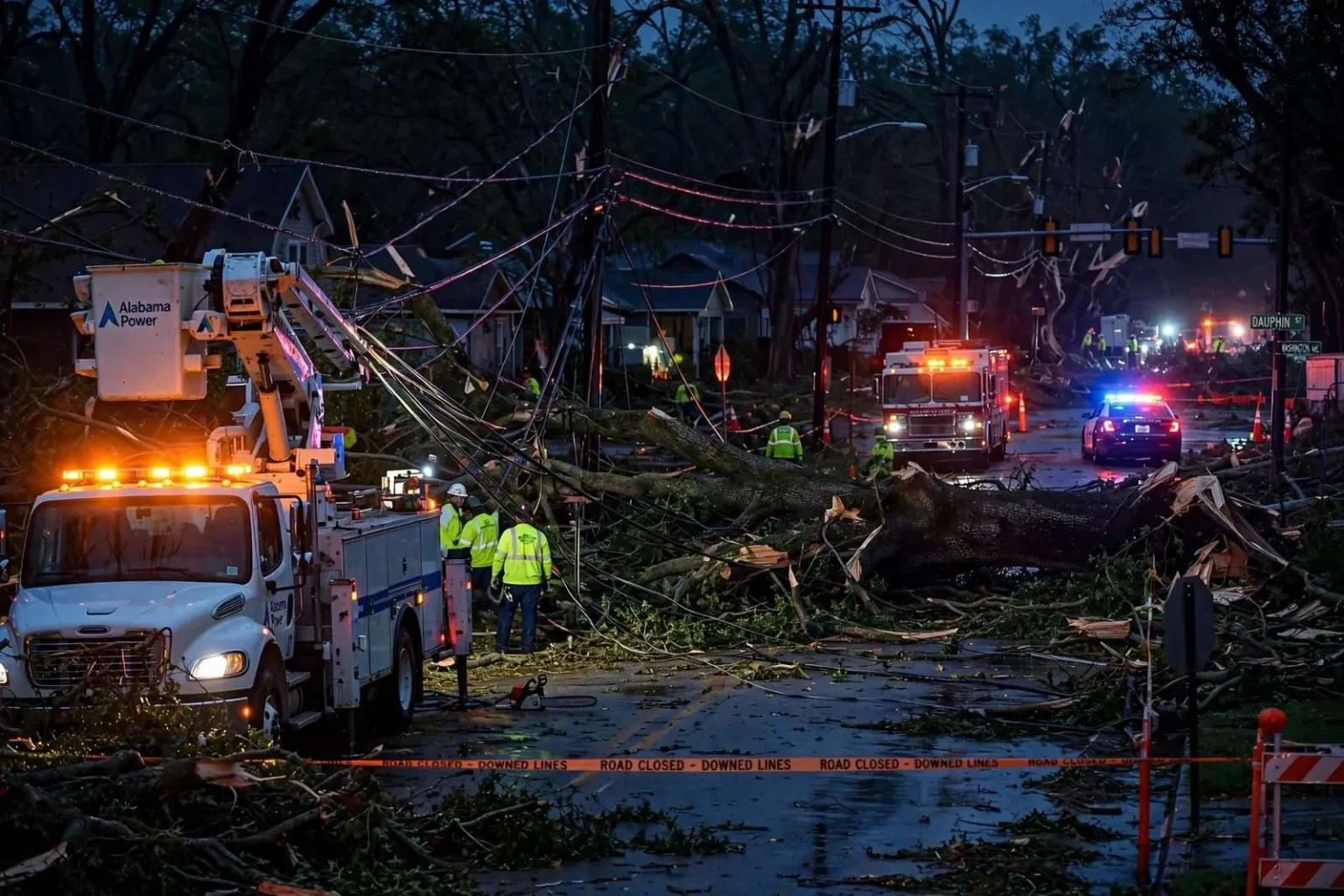
Mayor Sandy Stimpson told residents the city was fortunate to escape a direct hit from Hurricane Sally, but two days after landfall more than 100,000 customers were still without power and a nighttime curfew remained in effect. The storm’s slow crawl across the Gulf Coast left behind a landscape of downed trees, tangled power lines and flooded streets that officials spent the rest of the week working to clear.
Sally came ashore Wednesday near Gulf Shores as a Category 2 storm, its slow forward speed compounding the damage by subjecting the coast to hours of sustained winds and bands of heavy rain. Mobile sat on the storm’s eastern side, where the onshore push of water and wind was strongest, and by Thursday morning the city looked less like a near miss than a direct casualty.
On Thursday, Sept. 17, Stimpson said outages had fallen from roughly 160,000 to about 101,000 customers, with around 3,000 utility workers racing to restore power by Friday or Saturday morning. He predicted outages would be largely resolved by the end of the weekend, a timeline that depended on crews reaching neighborhoods where fallen trees had pulled service lines down block after block. Alabama Power staged crews and out-of-state reinforcements across the region, and residents were asked to treat every dangling line as live.
Fire and police response
Mobile Fire-Rescue Chief Jeremy Lami said the busiest stretch ran from Wednesday night into Thursday evening, when crews handled 221 incidents — including multiple structure fires and rescues at the same time as firefighters used chainsaws to reach people trapped by fallen trees. The volume pushed departments to prioritize life-threatening calls while property alarms and lesser emergencies waited. Amid it all, Lami reported a figure that mattered most: no first responders or citizens died in the storm’s aftermath.
Police Chief Lawrence Battiste asked for patience as officers answered some 2,500 calls for service and helped staff dozens of dark intersections; about 79 major crossings lacked working signals. Motorists were urged to treat every signalized intersection as a four-way stop, a rule that kept traffic moving in a city where streetlights and signals had gone dark across whole districts. Officers also worked to deter looting and keep cleared routes open for utility and debris crews.
The nighttime curfew, which ran from 9 p.m. to 6 a.m., was extended to protect residents from hazards that could not be seen after dark — downed lines, dangling limbs and debris-strewn roads. Stimpson said he hoped to lift the curfew by Friday, but the decision hinged on how quickly power could be restored and streets made safe.
Trees, debris and curfew
Mobile County EMA’s Mike Evans counted well over 300 trees down across the area, many tangled in live power lines and requiring coordination with Alabama Power before they could be cut. The tree damage defined Sally’s aftermath in Mobile: mature oaks that had weathered decades of storms gave way in saturated ground, and each removal required crews to determine whether lines beneath the limbs were energized.
The city activated its debris-removal contract with DRC Emergency Services to begin curb-side collection on Monday, Sept. 21. Residents were asked to separate debris into three piles — construction and demolition material, vegetation, and household hazardous waste — so that contractors could haul each category efficiently and keep hazardous items out of the landfill stream. Garbage makeup days were also scheduled to cover collections missed during the storm.
Officials directed residents needing tarps to call 211, damage reports to 311, and pointed to the city’s new real-time map of downed trees and power lines. The mapping tool was part of a broader push to keep information flowing while neighborhoods waited on restoration, letting residents see which streets had been cleared and report new hazards without tying up emergency dispatch lines.
The city’s animal shelter, which held nearly 100 pets when the storm approached, evacuated its animals ahead of landfall; 25 remained in the facility. Staff and volunteers relocated the rest to partner facilities out of the storm’s path, a precaution that spared the shelter from housing dozens of animals without power or air conditioning through the sweltering days that followed.
What the recovery looked like on the ground
For residents, the days after Sally were defined by patience and practical problems. Generators hummed outside homes without power. Gas stations without electricity closed or drew long lines. Cell service was spotty in pockets where towers lost power, complicating the task of checking on elderly relatives and reporting damage. Schools closed until conditions could be assessed, and many businesses stayed shut even as the curfew lifted.
The storm also tested the region’s emergency systems in ways officials said would inform future planning. The 211 line, normally a referral service, took tarp and assistance requests; the 311 line absorbed damage reports; and the real-time map marked a step toward the kind of digital situational awareness larger cities use. Each channel reduced the load on 911, which needed to stay clear for genuine emergencies during the response.
Insurance and federal assistance questions quickly followed the physical cleanup. State officials encouraged residents to document damage with photographs before making temporary repairs, and to file claims promptly, since adjusters across the Gulf Coast were dealing with a crush of cases from a single storm that struck at the peak of hurricane season. For households without flood insurance, the storm was a costly lesson about the gap between wind and water coverage.
Lessons for the next storm
Sally’s aftermath underscored how much of a hurricane’s impact is decided by trees and power lines rather than wind speed alone. A Category 2 storm toppling hundreds of mature oaks can leave a metro area dark for days, and the coordination required — between tree crews, utility linemen, police escorts and debris contractors — is where restoration timelines are won or lost. City officials said the three-pile debris sorting and the DRC contract activation were designed to move the cleanup in one pass rather than two.
The response also demonstrated the value of the region’s mutual-aid network. The 3,000 workers converging on Mobile included linemen and vegetation crews from outside Alabama, a standard practice after major storms that the industry scaled up quickly for Sally. Their arrival was the difference between the mayor’s promised end-of-weekend restoration and a recovery stretching into the following week.
As the weekend approached, Stimpson’s message balanced gratitude with urgency: the city had avoided the worst of what Sally threatened, but the work of restoring power, clearing streets and returning to normal was only beginning. Residents were asked to keep separating debris, keep treating dark intersections as four-way stops, and keep reporting hazards through 311 and the city’s map until every neighborhood was back online.
Neighboring communities faced the same arithmetic. Across Mobile and Baldwin counties, the storm’s landfall near Gulf Shores meant coastal towns took the brunt while inland areas still dealt with widespread outages and road blockages. County emergency management agencies coordinated with municipal public works departments to prioritize school zones, medical facilities and arterial roads, the standard sequence that governs recovery work after a Gulf storm.
The debris piles that began appearing along curbs in the weeks after the storm told the story of the damage more plainly than any statistic. Vegetation made up the bulk of what Sally left behind, and the volumes were large enough that contractors staged material at collection points before hauling it for grinding and disposal. Officials reminded residents that mixing household waste into vegetation piles slowed the process, and that hazardous items such as paints, solvents and batteries required their own pile under the city’s sorting instructions.
For businesses along the corridor, reopening depended on the restoration timeline. Restaurants that lost refrigerated inventory filed losses alongside claims for structural damage. Fuel distribution resumed quickly once terminals and pipelines confirmed no damage, but stations without power had to wait for lines to be reconnected before they could pump. The rhythm of the city’s return was tied directly to the utility restoration map, block by block.
Community institutions filled gaps where they could. Churches and neighborhood groups organized chainsaws and volunteers for elderly residents who could not clear their own driveways. The shelter animals that had been evacuated were gradually returned as conditions stabilized, and staff continued working to place the 25 that remained in adoptive homes. Volunteers were reminded that unaffiliated cleanup after a storm carries real risk — roof work, chainsaw use and generator operation all demand care, and officials urged residents to leave line-related work to professionals.
The storm’s final chapter, from the city’s perspective, is the paperwork. Federal reimbursement for debris removal requires detailed documentation of volumes, locations and costs, which is why the sorting rules and contractor tracking mattered beyond convenience. A clean record can mean millions of dollars in recovery funding, and cities along the Gulf have learned to run storm cleanup with federal auditors in mind from the first pickup.
Stimpson’s closing message to residents carried the practical tone that defined the week: the city had come through with no loss of life among responders or citizens, restoration targets were in sight, and the tools to get help — 211 for tarps, 311 for damage, the online map for hazards — remained available until the last neighborhood was restored. For a storm that arrived as the season’s first real test of the Gulf Coast’s preparedness, Sally left behind damage and disruption, but also a response that officials said proved the planning had worked.


