Woman Critically Injured in Shooting at Mobile Apartment Complex
A woman remained hospitalized in critical condition after she was shot outside a Mobile apartment complex late on a Monday night, police said.
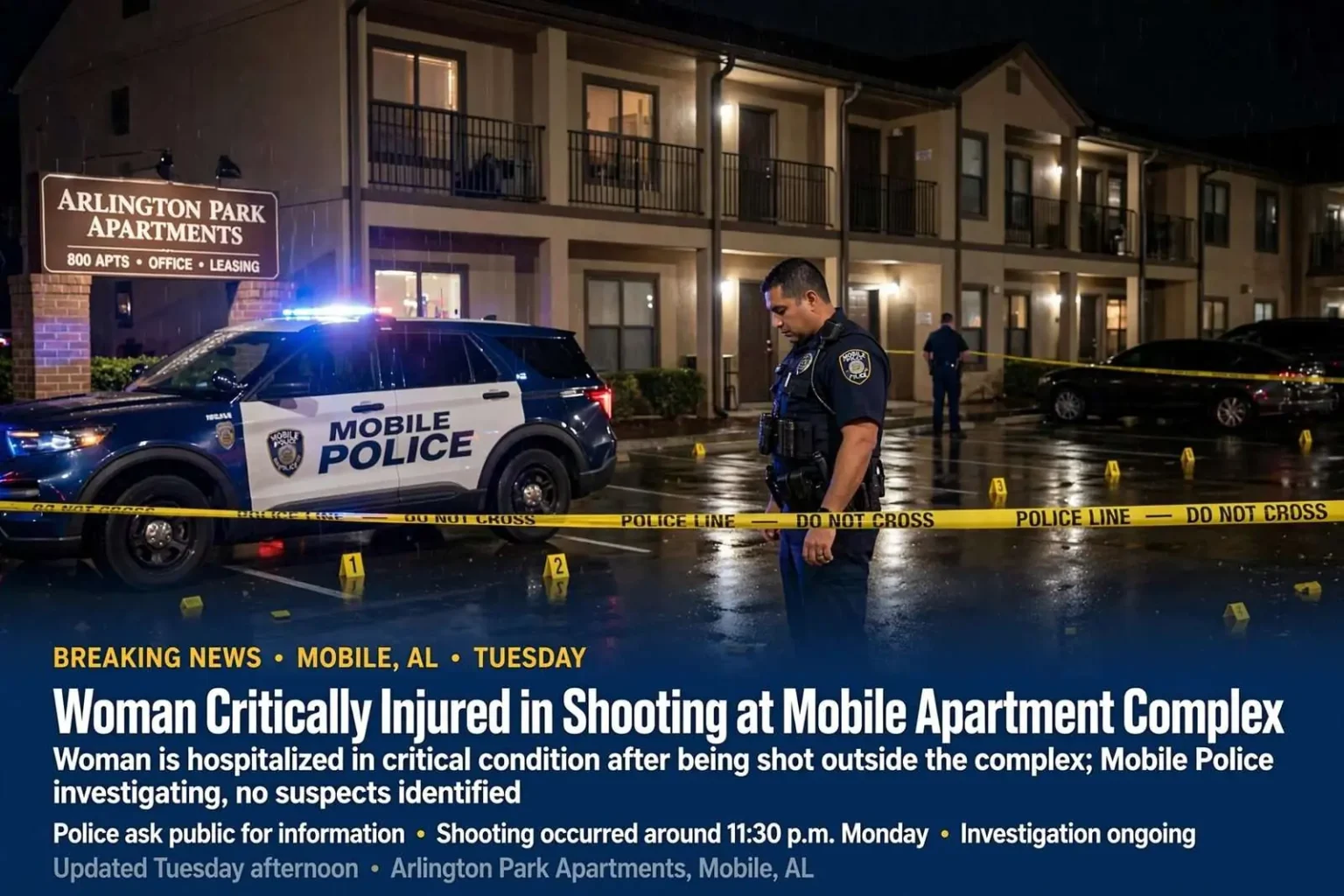
A woman remained hospitalized in critical condition Tuesday after she was shot outside a Mobile apartment complex late the previous night, according to the Mobile Police Department and crime data from the Mobile County Sheriff’s Office.
Officers found the woman, who has not been publicly identified, outside Arlington Park Apartments around 11:30 p.m. Monday after someone called authorities to report a person down in the area. The discovery came in the hours when most of the complex’s residents were home, and the sound of a person collapsing in a parking area or walkway was what first drew attention to the scene.
Sheriff’s office crime data confirmed a 911 call reporting a shooting came from the complex around that time, a record that helped investigators pin down when the gunfire occurred and how quickly help arrived after the first call.
Mobile Police Officer Terence Perkins said the woman remained in critical condition at a local hospital as of Tuesday afternoon, and investigators had not identified any suspects in the case. Her name was withheld, consistent with the department’s practice of not releasing the identities of victims in active investigations and with respect for family notifications.
An active investigation with few details
Police asked anyone with information about the shooting to contact the Mobile Police Department, and said the investigation remained active as detectives worked to determine what led up to the shooting and who was involved. No further details about a possible motive or the circumstances leading up to the incident were released.
That lack of public detail is typical in the first days of a shooting investigation. Detectives must run down the victim’s movements before the shooting, identify who she was with, and establish whether the gunfire came from someone on foot, from a vehicle, or during an argument inside the complex that spilled outside.
The critical condition reported Tuesday afternoon meant the woman was unable to speak with investigators, leaving police to rely on physical evidence, witnesses and any surveillance footage from the property. Cases in which the victim cannot provide an account are significantly harder to move quickly, and investigators generally hold off on releasing theories until they have corroboration.
Officials also had not said whether the woman lived at the complex or was visiting, a distinction that shapes the direction of the canvass — either toward her neighbors or toward the people who were with her that evening.
The complex and the area
Arlington Park Apartments, located in Mobile, has periodically drawn police attention for reported disturbances, though officials did not immediately say whether this incident was connected to any broader pattern in the area. Large apartment communities generate significant call volume in most cities, ranging from noise complaints and parking disputes to more serious incidents, and analysts look at that history when assessing whether a shooting is isolated or part of a trend.
Shootings involving unidentified victims and no named suspects are often among the more difficult cases for investigators to resolve quickly, frequently requiring tips from residents or surveillance footage from nearby businesses to develop leads. In apartment complexes, the people most likely to know what happened are the neighbors who heard the shots, saw unfamiliar vehicles, or know the arguments and relationships that preceded the violence.
That is why the department’s public appeals in cases like this one emphasize small details. A resident who heard shouting but assumed it was nothing, or who noticed a car parked oddly for an hour before the gunfire, may hold the piece that ties the scene together.
What detectives were doing
Mobile police continued to ask residents in the area to come forward with any information, however small, that could help identify who was responsible for the shooting. Detectives assigned to the case began the standard sequence: processing the scene for shell casings and other physical evidence, canvassing the complex unit by unit, and requesting video from the property’s own cameras and from neighboring homes and businesses.
Investigators said they were reviewing any available surveillance footage from the apartment complex and canvassing nearby units for witnesses who may have heard the shots or seen anyone in the area in the minutes before and after the gunfire. The timing just before midnight meant many residents were awake, and detectives hoped that among them were people who saw the shooter or a getaway vehicle.
Crime scene technicians marked and collected evidence at the exterior scene, and the area around where the woman was found was held for a period while that work proceeded. The hospital, meanwhile, became a second focus, since the woman’s condition and any statements she might later be able to give could reshape the investigation.
How residents can help
Police urged anyone with information about the shooting to contact the Mobile Police Department or leave an anonymous tip through Mobile Area Crime Stoppers. The Crime Stoppers channel is central to cases like this one: residents who are hesitant to give a statement in person can pass along what they know without their names attached, and qualifying tips that lead to arrests can earn cash rewards.
Detectives stressed that partial information is still valuable. A first name, a nickname, the sound of a vehicle, the direction someone ran — none of these solves a case alone, but combined they allow investigators to develop the probable cause needed for warrants and interviews.
The broader picture
The shooting came amid the routine violence that Mobile, like most mid-sized Southern cities, works to combat through a mix of patrol strategy, community outreach and targeted enforcement. Late-night shootings outside apartment complexes are among the most common scenarios in the city’s gun violence statistics, and they are also among the most dependent on community cooperation to solve.
Public safety officials have repeatedly pointed to the gap between the number of shooting victims and the number of residents willing to talk to investigators. Witness fear, unfamiliarity with victims, and a simple reluctance to get involved leave many cases stalled in the file until someone comes forward — sometimes months or years later.
For residents of Arlington Park, the concern in the days after the shooting was immediate: whether the person who fired was still at large, and whether the violence was connected to anyone in the complex. Police did not announce any arrests, did not say whether they believed the shooting was random, and did not describe a suspect — leaving neighbors to weigh ordinary caution against the department’s assurances that the investigation was moving.
As of the initial report, no updates on the woman’s condition or the status of the investigation had been made public. If her condition improved, detectives would have the chance to interview her; if it did not, the case would proceed like a homicide investigation from the start.
The department said updates would be released as they became available, and investigators repeated their standing request: anyone who was at the complex late Monday night, anyone who heard the shots, and anyone who knows why this woman was targeted should contact police and say so.
The first hours after a shooting
The sequence that followed the 11:30 p.m. discovery followed a pattern familiar to any major-city police department. Uniformed officers secured the scene and rendered aid first, since the victim’s survival was the immediate priority. Paramedics transported her to a local hospital while officers held the area and called out investigators and crime scene personnel.
In the hours that followed, technicians photographed the scene from every angle, documented where the victim was found relative to buildings, walkways and parked cars, and searched the ground for cartridge casings, bullets and other evidence that could indicate how many shots were fired and from where. That physical evidence becomes the skeleton of the case, against which witness statements are measured.
The 911 records from the sheriff’s office communications center add another layer. Callers’ accounts of what they heard — the number of shots, the direction, any voices or vehicles — are logged with timestamps, giving investigators a timeline even before a single witness is formally interviewed.
By Tuesday morning, detectives were also checking whether any other calls for service in the area that night might be connected — a disturbance complaint, a vehicle accident, a report of a car leaving at high speed. Shootings are rarely the first event in a chain; the earlier links are often documented in the dispatch log without anyone realizing at the time what they would lead to.
This methodical early work is invisible to the public, which is why the first-day news accounts of cases like this one are so spare: the woman’s condition, the location, the request for tips. The substance develops over days and weeks, and in Mobile it very often develops from a resident deciding to make the call that investigators have asked for.
The department has not set a deadline for itself, but its message has been consistent since Monday night: the investigation is active, detectives are working the case, and the fastest route to an arrest runs through the community around Arlington Park Apartments.