

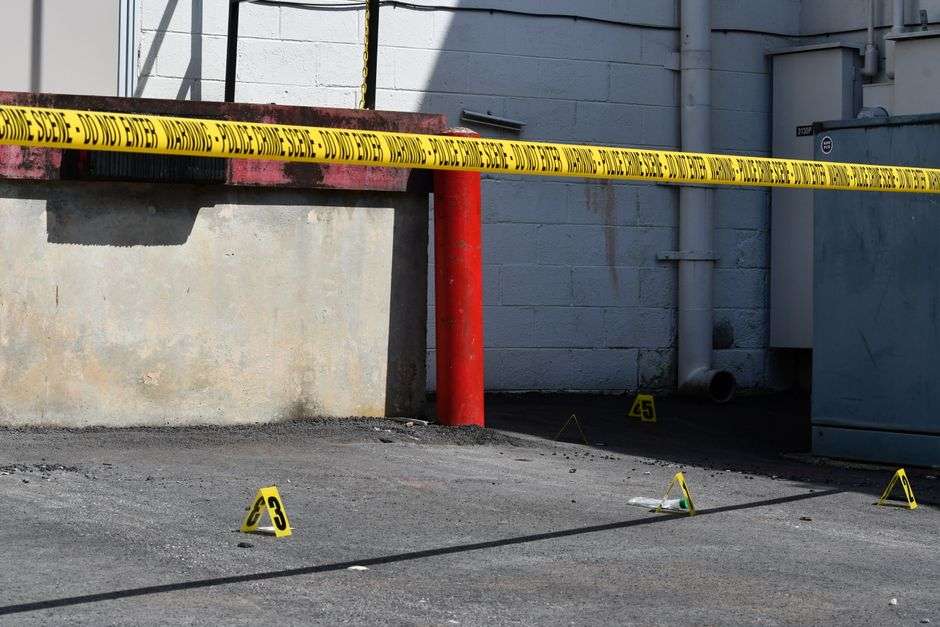
A man is dead after a daylight shooting Tuesday afternoon on Halls Mill Road in Mobile, and police say the circumstances that led to the gunfire remain under investigation. Mobile Police and Mobile Fire-Rescue units responded to the 4400 block of Halls Mill Road just after 3 p.m. after a report of a person shot. When paramedics arrived, they found a man suffering from a severe gunshot wound. He was pronounced dead at the scene.
The response drew a heavy law enforcement presence to the area. More than a dozen patrol vehicles lined both sides of Halls Mill Road as detectives combed the scene for evidence, and crime scene tape was strung across the area for much of the afternoon and evening. Drivers who use the corridor daily were forced to navigate around the investigation while officers held the scene through the afternoon rush.
Based on the placement of that tape, investigators believe the shooting happened at or near a business in the 4400 block, which sits in a stretch of Halls Mill Road lined with small commercial operations, including a tax service and an auto sales lot. Detectives spent hours documenting the property, photographing vehicles in the lot and marking physical evidence as they worked to establish exactly where the gunfire began.
Detectives work to pin down the scene
Mobile Police Officer Roderick Miles, speaking with reporters at the scene, said detectives were still working to pin down precisely where on the property the shooting occurred.
“As you can see behind me, that is a tax service and an auto sales business,” Miles said. “So we don’t know what part of the business that the victim or the subject came from.”
That uncertainty is a central thread of the early investigation. A commercial strip with multiple operations sharing a parking area can hold several possible crime scenes, and determining whether the victim was a customer, an employee or someone passing through shapes where detectives focus their canvass and which records they request, from business hours to surveillance footage.
Investigators spoke with several possible witnesses at the scene. Not long after the shooting, a person arrived at the Mobile Police Department’s Second Precinct and spoke with detectives about the incident, though police have not said whether that individual is considered a suspect, a witness, or something else. Officials said they are questioning a person as part of the investigation, but as of Tuesday evening no arrests had been announced and police had not confirmed whether they are actively searching for an outside suspect.
A busy southside corridor disrupted
Halls Mill Road is a busy secondary corridor on Mobile’s south side, connecting neighborhoods and small businesses between Zeigler Boulevard and the residential areas to the south. The stretch where Tuesday’s shooting occurred is typical of the road’s character: modest commercial buildings set close to the street, wedged between established residential blocks that feed onto the corridor throughout the day. The area sees steady traffic from commuters, students and customers of the small businesses that line it.
A daylight killing in such a setting lands differently than a late-night shooting on an empty street. Dozens of people were going about ordinary Tuesday routines — running errands, picking up vehicles, handling tax paperwork — when the gunfire erupted, and police immediately began working the phones and doors of nearby businesses for any camera angle that might have caught the moments before or after.
How Mobile police investigate a daytime homicide
When a shooting is reported, Mobile Fire-Rescue medics are dispatched alongside police, both to treat any survivor and to make the formal determination when a victim cannot be saved. Once a victim is pronounced dead, the scene shifts from a potential assault case to a homicide investigation, and the department’s specialized units take over: detectives assume control of the scene, crime scene technicians process evidence, and patrol officers hold the perimeter and begin the witness canvass while memories are freshest.
The early hours matter enormously in cases like this. Surveillance footage from nearby businesses is often overwritten on a rolling cycle, so detectives move quickly to identify and preserve cameras covering the block. Physical evidence — shell casings, vehicles of interest, items dropped or discarded in a panic — is photographed and collected in place before the tape comes down.
The Second Precinct, where the person arrived to speak with detectives, serves the western and southwestern portions of the city, and its detectives routinely take on cases that begin in the districts they cover. Whether the person who came forward initiated contact or was summoned by investigators, such interviews are typically conducted behind closed doors, with detectives declining to characterize the person’s status until evidence supports a clearer picture.
What police are — and are not — saying
As of Tuesday evening, police had not released the victim’s name, pending notification of family, and had not described a motive. Officials were also careful not to characterize the status of the person being questioned, reflecting standard practice in the hours after a killing: investigators often speak with several people who may be witnesses, suspects, or something in between, and publicly labeling someone prematurely can complicate both the investigation and any later prosecution.
No arrests had been announced by nightfall, and detectives continued working the scene into the evening. The department typically asks anyone with information about a homicide to come forward, and tips from the public — a description, a vehicle, a name overheard in a nearby shop — are frequently what move a case from scene work to an arrest.
What comes next
In the days ahead, investigators will follow several parallel tracks: the medical examiner’s examination of the victim, which can establish the number and trajectory of gunshot wounds; the analysis of evidence collected from the scene; the review of any surveillance footage recovered from the business or neighboring properties; and continued interviews with the witnesses identified Tuesday.
For the businesses in the 4400 block, the aftermath of a killing at their doorstep carries its own weight. Small operations along Halls Mill Road depend on regular customers and walk-in traffic, and a crime scene cordon spanning an afternoon and evening interrupts exactly the kind of everyday commerce that keeps such shops open. Detectives will work with the business owners in the coming days to review what their cameras recorded.
The investigation remains active, and Mobile police have said details will be released as they are confirmed. Residents of the neighborhoods along the corridor were left Tuesday night with the same questions detectives are chasing: who fired the shots, why, and whether the danger that took one man’s life in broad daylight was random or something far more targeted.
Daylight shootings also test a police department’s relationship with the neighborhood where they occur. When violence erupts where people shop and work, residents often have information detectives need, but fear of retaliation can keep witnesses quiet. Departments across the Gulf Coast address that by routing tips through anonymous channels, allowing people to pass along what they know without identifying themselves, and Mobile investigators have long relied on such tips to break through the silence that often follows a public killing.
The geography of the investigation
The 4400 block sits along a stretch of Halls Mill Road where the character of the corridor changes block by block. Small service businesses, auto-related operations and strip storefronts alternate with single-family homes and apartment complexes set back from the road. That mix complicates the kind of canvass detectives conduct after a shooting: rather than a single business district with one set of cameras, the block is a patchwork of properties, each with its own sightlines onto the parking area where the shooting is believed to have occurred.
Zeigler Boulevard, the major cross street to the north, carries heavy traffic between west Mobile and the airport corridor, and vehicles leaving the scene Tuesday afternoon would have merged quickly into that flow. Detectives looking for a fleeing vehicle typically widen their camera search to the surrounding arterial streets, checking whether any business or traffic camera caught the car or truck that left the area in the moments after the shots were fired.
Fire-Rescue crews who responded just after 3 p.m. found conditions that left no path to treatment — the severity of the wound made the scene a recovery and investigation operation almost immediately. The distinction matters for the timeline of the case: a homicide declared at the scene moves directly into the Medical Examiner’s custody process, with an autopsy scheduled and the victim’s identity confirmed through family notification before any public release of a name.
The wider context on Mobile’s streets
Mobile police investigate dozens of shootings across the city each year, and the department’s response to this one reflected the seriousness with which any fatal daytime gunfire is treated. The visible show of force — more than a dozen units holding the corridor for hours — serves an investigative purpose, preserving the scene, but it also signals to the surrounding neighborhoods that the city commits resources when a life is taken in the open.
For now, the case rests with the detectives who spent Tuesday evening on the asphalt behind the tape. Whether the person questioned at the Second Precinct becomes a suspect, whether the shooter fled or was already known to the victim, and whether the business connection proves central or incidental are all questions the coming days of lab work and interviews will answer. What is certain is that a man died in the middle of an ordinary afternoon on a road where ordinary afternoons matter to thousands of Mobile residents, and the investigation into his death is just beginning.