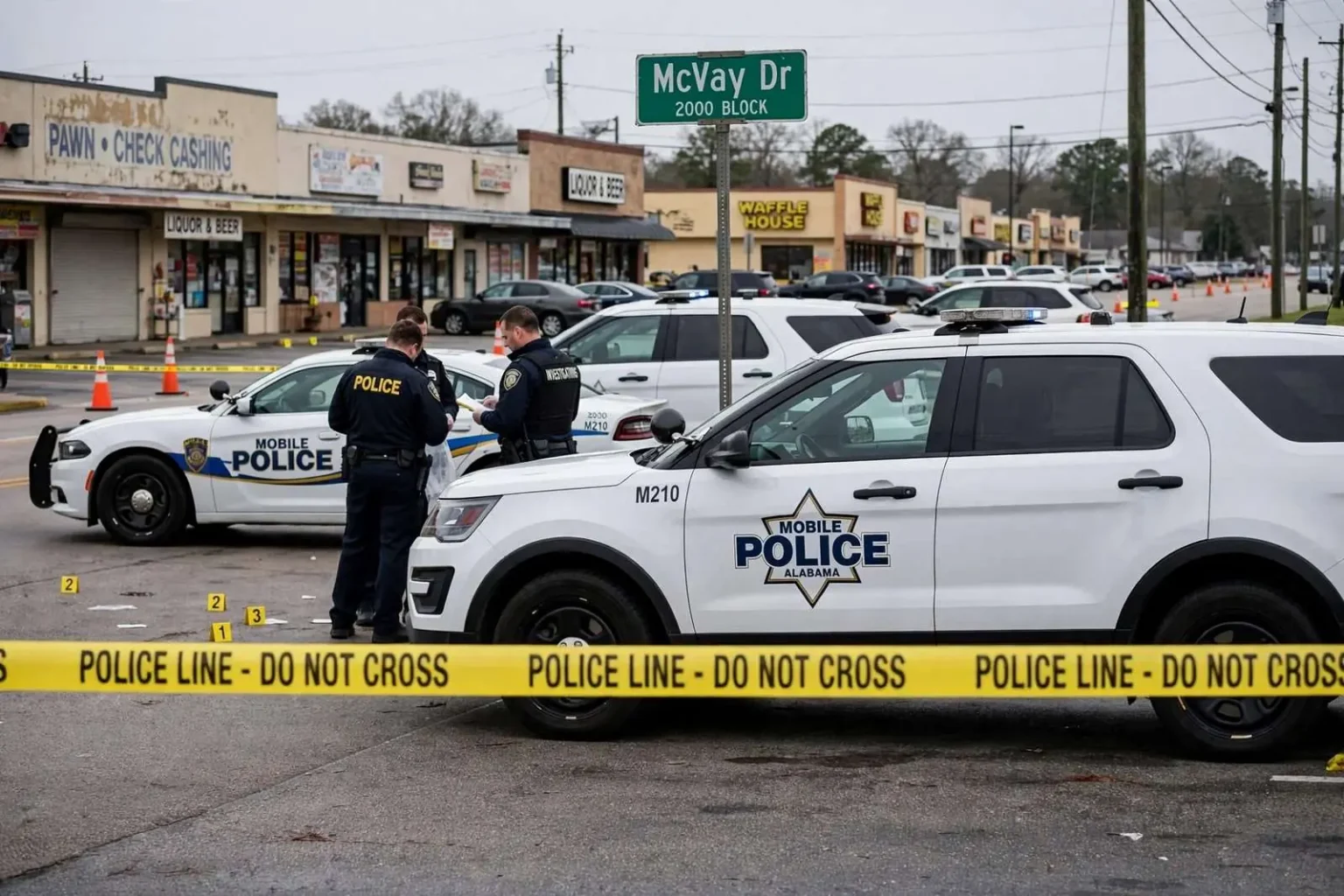
Mobile police are investigating a fatal shooting that left one man dead on McVay Drive, according to Mobile Police Chief William Jackson. Officers responded to the scene in the 2000 block of McVay Drive, where they found a male victim who was pronounced deceased, Jackson confirmed. The announcement placed the city’s latest homicide along one of west Mobile’s busiest commercial corridors, an area more accustomed to traffic congestion than crime scene tape.
Details remained scarce in the hours after the shooting. Mobile police have not yet released the identity of the victim or details about a possible suspect or motive, leaving open the most basic questions about what happened along the roadway. The department’s early statement offered no description of how the shooting unfolded, whether it occurred indoors or outside, or whether anyone fled the area before officers arrived. Those details typically emerge only after investigators complete initial interviews and review whatever physical evidence the scene holds.
The shooting prompted a heavy law enforcement presence in the area and disrupted traffic for drivers passing through that stretch of McVay Drive while investigators worked the scene. Patrol vehicles converged on the block as officers established a perimeter, and the usual flow of cars gave way to detours and slow passes as motorists craned to see what was happening. For businesses along the corridor, the response brought the day’s routines to a halt, with employees and customers watching from parking lots as investigators moved methodically through the area.
Investigators on the scene
Investigators remained on scene gathering evidence in the aftermath of the shooting. Homicide work in the first hours focuses on locking down what can be lost quickly: canvassing for witnesses before they disperse, securing surveillance video from nearby businesses before it is overwritten, and documenting the scene in detail before the body is removed and the roadway is reopened. Detectives typically walk the block, knock on doors and interview anyone who may have seen or heard something, even fragments of information that seem minor on their own.
That early evidence collection often determines whether a case is solved. Surveillance cameras along commercial corridors like McVay Drive frequently capture license plates, vehicles and movement in the minutes surrounding an incident, and investigators work quickly to preserve those recordings. Shell casings, ballistic evidence and the victim’s movements all become part of the reconstruction. Until the department releases more, the public record consists of the location, the victim’s status and the assurance that the case is active.
The lack of a released suspect description or motive means residents nearby are left to wonder about their own safety. Police generally withhold details that could compromise an investigation, but the silence also reflects how early the case still was. Detectives had not said whether they believed the victim was targeted, whether the shooting involved an altercation, or whether any risk remained to people in the area, questions that often are answered in the days following an incident as interviews progress.
A corridor that anchors west Mobile
McVay Drive is a busy corridor on Mobile’s west side, and shootings in the area tend to draw significant attention from residents and businesses nearby. The roadway threads through a stretch of the city lined with shopping centers, restaurants, offices and residential neighborhoods branching off in every direction, making it a daily route for thousands of commuters and errand-runners. Its traffic volumes and visibility mean that anything out of the ordinary, and certainly a homicide, registers immediately with the people who live and work along it.
West Mobile’s growth over recent decades shaped the character of the corridor, as the city’s population spread westward toward the county line and commercial development followed. Neighborhoods of varying ages and price ranges sit within a short distance of the 2000 block, and residents there have watched the corridor evolve through cycles of investment and decline familiar to many mid-sized Southern cities. When violence touches such an area, the reaction is often a mix of shock and resignation, along with renewed calls for police presence and community attention.
The killing added to the year’s toll of homicides in Mobile, a count that police officials track publicly and that community leaders cite in recurring conversations about violence prevention. Each case represents not only a life lost but an investigation that must be worked, a family that must be notified, and a neighborhood left to process what happened. Clearance of homicide cases depends heavily on community cooperation, which is why departments emphasize tip lines and witness protection in the aftermath of incidents like this one.
Mobile’s police leadership has historically stressed the connection between community tips and case clearance, noting that homicides are rarely solved from physical evidence alone. Witnesses who come forward in the first days, even anonymously, provide the leads that transform a scene into a case that can be presented to prosecutors. The department’s appeal in this shooting follows that longstanding practice.
How the investigation proceeds from here
This is an ongoing investigation, and Mobile police have indicated more information will be released as it becomes available. The department’s next updates will likely address the victim’s identity, once family members have been notified, and any preliminary findings about the circumstances of the shooting. Investigators will also determine whether the case moves quickly toward an arrest or becomes one of the city’s unsolved killings, a question that depends in large part on what witnesses and evidence surface in the coming days and weeks.
The sequence after a fatal shooting follows a familiar pattern. Detectives present their findings to prosecutors if they identify a suspect, and charges can follow quickly or come after extended investigation. In cases where no arrest is made promptly, the file remains open indefinitely, revisited whenever new information arrives. Families of victims often wait months or years for resolution, which is why advocacy groups in Mobile and across Alabama press for continued attention to cold cases alongside new ones.
Anyone with information about the shooting is encouraged to contact the Mobile Police Department. Tipsters who wish to remain anonymous can provide information without revealing their identities, and investigators stress that even details that seem insignificant, a vehicle seen leaving the area, a raised voice heard earlier in the evening, can supply the missing piece in a homicide investigation. Tips from the public have historically broken open cases that appeared stalled, particularly in shootings where witnesses may hesitate out of fear.
The department’s message to the neighborhood is typically twofold: the area is being actively investigated, and cooperation is the fastest route to accountability. For the businesses along the 2000 block and the residents on the streets behind them, the hope is that the disruption of the investigation ends with an arrest and a measure of closure, rather than joining the list of cases that remain unanswered.
This story will be updated as new details emerge from investigators. Residents with information are urged to come forward promptly, as early tips carry the greatest value to detectives working to establish what happened in the 2000 block of McVay Drive and who was responsible for the city’s latest fatal shooting.
What the response looked like on the ground
The heavy law enforcement presence on McVay Drive reflected standard procedure for a death investigation, which treats a fatal shooting scene as far more than a single location. Officers established control of the block to preserve evidence, while others began canvassing the surrounding streets and parking areas for anyone who might have seen or heard something. Mobile police typically deploy patrol units, detectives and crime scene personnel in these situations, each handling a distinct piece of the work: securing the perimeter, interviewing witnesses and processing physical evidence.
Traffic disruption along the corridor lasted for hours as the investigation proceeded. Drivers who use McVay Drive as a daily artery found themselves rerouted or delayed, and the sight of investigators at work became the topic of conversation in nearby shops and offices. That visibility serves a purpose beyond inconvenience, since a visible, thorough police response often prompts witnesses to come forward who might otherwise assume no one is seriously investigating. The scene itself, photographed and mapped in detail, becomes the foundation on which every later finding rests.
Emergency medical crews also responded, though there was no indication the victim could be resuscitated by the time officers located him. The determination that a victim is deceased at the scene shifts the response from rescue to investigation, with the medical examiner taking over questions about the cause and manner of death. Those official findings, while routine in procedure, form part of the permanent record of the case and often confirm details investigators have already pieced together from the scene itself.
Gun violence and its ripple effects in Mobile
Each fatal shooting in Mobile extends beyond the block where it occurs. Families are left to plan funerals and raise questions that may never be fully answered, while schools, churches and employers absorb the loss in quieter ways. Public health researchers have long described gun violence as radiating outward, affecting witnesses, neighbors and entire communities in ways that show up in everything from property values to mental health. That broader cost is part of why police departments invest so heavily in homicide clearance, and why community organizations across Mobile have made violence intervention a recurring priority.
Neighborhood associations along corridors like McVay Drive have historically worked with the department on crime prevention, from improved lighting and surveillance cameras to tip-sharing arrangements that give detectives faster access to what residents see and hear. Those relationships matter most in the days after an incident like this one, when the flow of information from the community determines how much of the story investigators can reconstruct. Departments that maintain trust in their districts consistently outperform those where residents are reluctant to talk.
For now, the facts remain limited to what the chief confirmed: a man is dead, the location is the 2000 block of McVay Drive, and the investigation is active. The questions that matter most to the neighborhood, who fired the shots and why, await the answers that detectives and witnesses together can provide. Mobile police have asked anyone with knowledge of the shooting to come forward, and the department has said it will share more information with the public as the investigation allows.