Mobile Police Investigate Fatal Shooting Tied to Domestic Dispute
A man died from a gunshot wound on Spring Street in Mobile after officers responded to a reported domestic dispute Sunday afternoon.
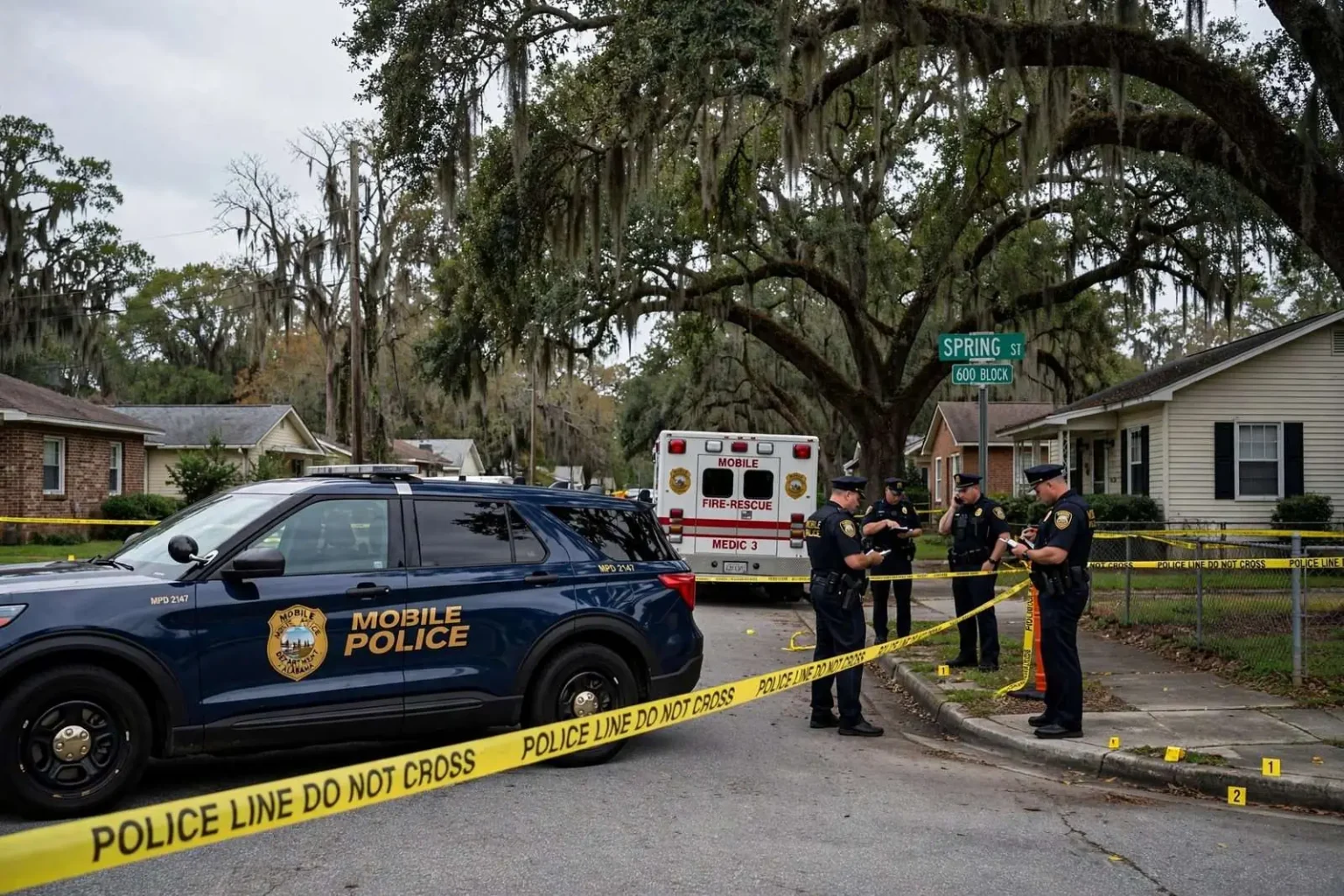
Mobile police are investigating the city’s tenth homicide of the year after a man died from a gunshot wound during a reported domestic dispute over the weekend. Officers responded to the 600 block of Spring Street around 2:10 p.m. Sunday after a 911 call came in reporting trouble at a home in the area.
When Mobile Fire-Rescue Department medics arrived, they found a 41-year-old man who had suffered a gunshot wound. He was pronounced dead at the scene. Mobile Police Department spokesman Officer Terence Perkins confirmed the death and said the case remains under investigation. As of Monday morning, no arrests had been made in connection with the shooting.
Records show the initial call to the Mobile County Sheriff’s Office came in just minutes before officers arrived, describing a domestic dispute in progress. Investigators have not released additional details about what led up to the shooting or the relationship between the people involved, and police have not announced any suspects.
A grim milestone for the city
The case marks a grim milestone for the city: the tenth homicide investigation opened by Mobile police so far this year, and the third since May 6 alone. The clustering of violent deaths in such a short window has drawn attention from residents and city officials concerned about a rise in gun violence tied to domestic situations, a pattern that community safety advocates say deserves the same attention that street-level violence routinely receives.
The response also illustrates how the area’s emergency systems interact. Calls placed to 911 in Mobile County are initially routed based on location, and a report of trouble inside the city limits can be logged through the sheriff’s office communications center before being handed to Mobile police for response. That handoff, though routine, costs only minutes — but in a domestic dispute that is escalating in real time, minutes can determine whether medics arrive to treat a victim or to pronounce one.
How domestic disputes become homicides
Domestic violence advocates in the Mobile area have long pushed for greater awareness of warning signs and available resources, noting that disputes that escalate to gun violence often have a history that goes unreported until it is too late. Advocates describe a familiar arc: escalating arguments, controlling behavior, threats, and sometimes prior calls to police that never result in charges or follow-up. By the time a deadly confrontation occurs, the relationship between victim and attacker frequently means the danger was knowable in advance.
Research on intimate partner violence has consistently found the presence of a firearm to be among the strongest predictors of a domestic dispute turning fatal, and Alabama law includes provisions intended to keep weapons away from domestic abusers under certain conditions. Enforcement, however, depends on incidents being reported and documented — one reason advocates urge neighbors and family members not to treat loud, recurring disputes as private matters not worth reporting.
Local law enforcement continues to encourage residents to seek help or intervene early when domestic situations show signs of escalating, rather than waiting until a confrontation turns deadly. That message extends to friends and relatives, who often are the first to notice that a relationship has become dangerous but hesitate to involve police in what they see as a couple’s private conflict.
Where the investigation stands
With no arrests as of Monday morning, investigators continue to work the case through the standard sequence that follows a Mobile homicide: canvassing the neighborhood for witnesses, collecting forensic evidence from the scene, pulling surveillance video from nearby homes and businesses, and interviewing the people who were inside or around the Spring Street residence when the shooting occurred. Detectives will also examine any prior police contacts at the address, which in domestic cases can document a pattern of escalating conflict.
The fact that the initial call described a domestic dispute in progress gives investigators a starting framework, but prosecutors will ultimately need to establish what happened inside the home and who was responsible. Mobile County District Attorney’s Office prosecutors routinely review domestic-violence homicides closely, and outcomes in such cases can range from murder charges to lesser counts depending on the evidence developed.
The Spring Street case remains under investigation, and police have emphasized that details about the relationship between those involved have not been released — both to protect the integrity of the inquiry and out of sensitivity toward family members still learning what happened.
How to report tips
Mobile police are asking anyone with information about the shooting to come forward. Tips can be called in directly to the department or submitted anonymously through Crime Stoppers by phone or by texting the keyword “CRIME411” to 274637. The anonymous channel matters in cases like this one: witnesses who fear retaliation, or who are reluctant to be seen cooperating with police in a neighborhood case, will often provide information through Crime Stoppers that they would never give in a face-to-face interview.
Crime Stoppers programs across the Gulf Coast operate on the same basic model — tipsters remain anonymous, information is passed to investigators without revealing the source, and rewards may be available for tips that lead to arrests. The organization’s text tip line, 274637, spells “CRIME411” on a phone keypad and is monitored around the clock, allowing tips to flow in even outside business hours.
Resources for families at risk
Advocates stress that help is available before a dispute ever reaches the point of violence. Domestic violence shelters and crisis lines operate across southwest Alabama, offering emergency housing, safety planning, court advocacy for protective orders, and counseling for adults and children. The statewide coalition that coordinates these services maintains a 24-hour hotline, and local programs accept calls from concerned family members and friends, not only from victims themselves.
Safety planning — a structured conversation about escape routes, packed bags, important documents and trusted contacts — is one of the most effective tools advocates offer, because leaving an abusive relationship is statistically the most dangerous moment. Supporters of early intervention argue that the community’s response should not begin at the homicide scene but at the first report of escalating abuse, when shelters, courts and counseling can still change the outcome.
For now, a 41-year-old man is dead in the 600 block of Spring Street, a family is grieving, and Mobile’s homicide count for the year has reached ten. Police continue to ask the same question in every such case: whoever knows something, come forward.
Spring Street and the neighborhood around it
The 600 block of Spring Street sits just west of downtown Mobile, in a residential pocket where single-family homes and small apartment buildings stand blocks from the city’s busy government and medical corridors. Violent crime in the area, as in much of the urban core, tends to draw swift attention from residents who have watched police presence ebb and flow with the city’s budget cycles. Neighbors reported a heavy emergency response Sunday afternoon, with medics staging nearby before the scene was formally turned over to homicide investigators.
For the blocks around the scene, a homicide investigation means more than tape and patrol cars: residents are asked to stay clear, the street is closed for hours, and detectives return over the following days to knock on doors. Police count on those follow-up conversations. Witnesses who are hesitant in the immediate aftermath of a killing frequently come forward once initial shock passes, and even small details — a raised voice earlier in the day, a vehicle in the driveway, the direction someone ran — can piece together a timeline.
A wider problem along the Gulf Coast
Mobile is not alone in confronting the link between domestic conflict and lethal violence; prosecutors and sheriffs across southwest Alabama have sounded similar themes in recent years, and the region’s domestic violence shelters report demand that regularly outstrips available beds. What advocates in the Mobile area have pushed for is not simply awareness but a coordinated system: consistent lethality screening when police respond to a domestic call, faster paths to protective orders, and follow-up contact with victims after an arrest is made or declined.
Each piece matters because domestic homicides rarely arrive without warning. Studies of intimate partner killings repeatedly find that victims had contact with police, hospitals or courts in the months before their deaths, and that the killing often followed a documented escalation. The question for Mobile, as officials put pressure on the tenth homicide investigation of the year, is whether the systems exist to catch the next case while it is still the kind of 911 call that ends with an arrest instead of a body.
Anyone experiencing domestic violence, or worried about someone who is, is encouraged to reach out before a situation escalates: the statewide hotline can connect callers to local shelters and advocates, and emergency situations should always go directly to 911. Information about the Spring Street shooting, meanwhile, can be directed to Mobile police or to Crime Stoppers, where tipsters can remain anonymous by phone or by texting “CRIME411” to 274637.