Congressman Byrne Visits Mobile Police to Mark National Police Week
U.S. Rep. Bradley Byrne visited Mobile police headquarters for National Police Week, pledging support days after two Mississippi officers were killed.
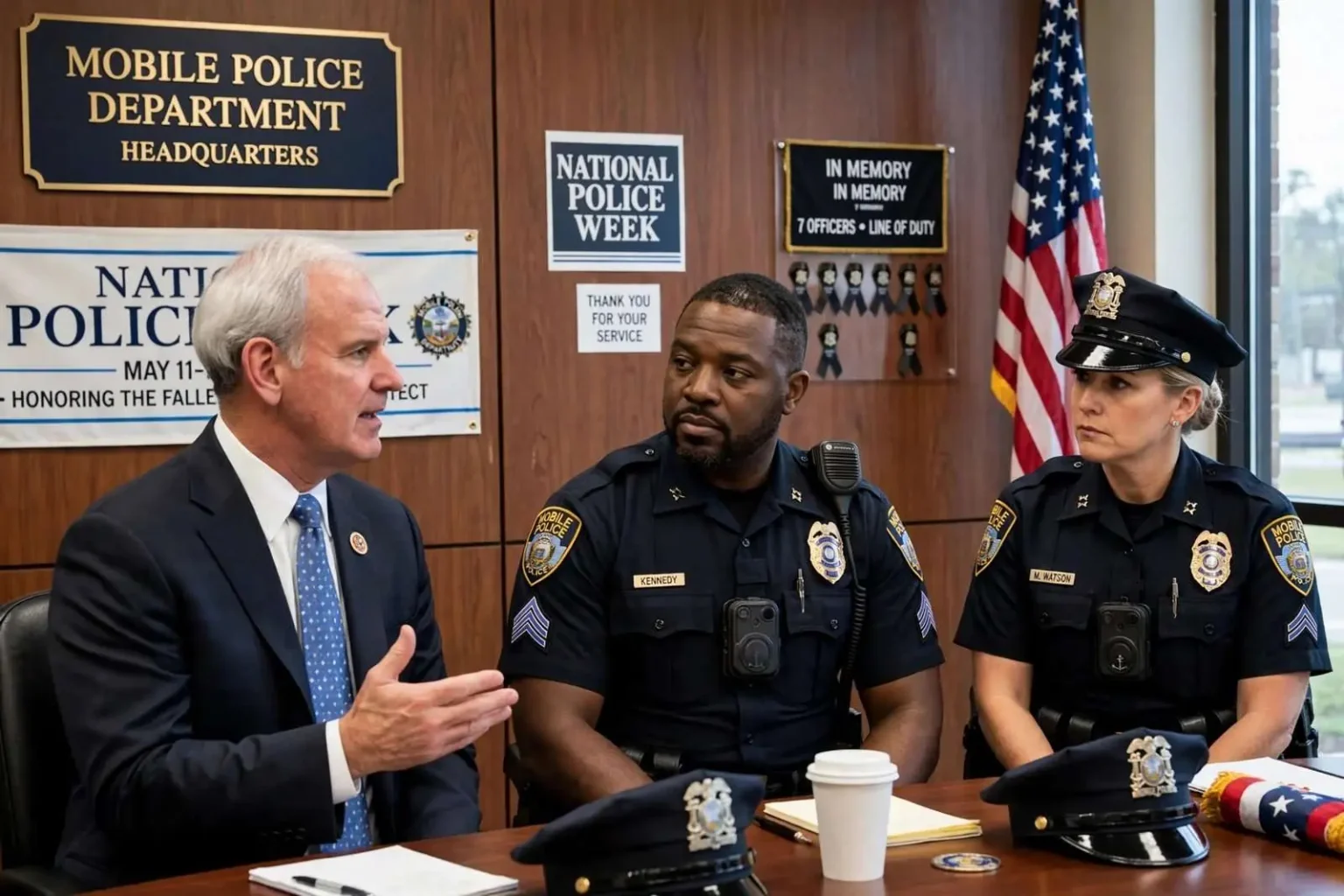
U.S. Rep. Bradley Byrne visited Mobile Police Department headquarters to thank officers for their service during National Police Week, pledging his office’s support in ensuring local law enforcement has the resources and training needed to do their jobs safely. The visit brought Alabama’s 1st District congressman into the department’s own house for a conversation that mixed ceremony with policy, at a week when law enforcement agencies across the country were mourning their dead and Mobile’s own memories of line-of-duty losses remained close at hand.
National Police Week, observed annually since the 1960s, honors officers killed or injured in the line of duty and recognizes the ongoing risks faced by law enforcement personnel. In Washington, the week centers on a memorial ceremony that draws tens of thousands of officers; in cities like Mobile, it is marked by department events, community recognition and the kind of direct engagement between officials and officers that Byrne’s visit represented. For departments, the week is both tribute and advocacy — a moment when the costs of policing, in dollars and in lives, are stated plainly.
Byrne, whose district stretches across southwest Alabama from Mobile to the Florida line, has made federal support for local first responders a recurring theme of his first term. His office has pointed to federal grant programs that flow to police departments for equipment, training and officer safety as a link between Washington and the daily work of Gulf Coast law enforcement, and the congressman has framed those programs as a federal obligation rather than a favor.
The Real Front Line
Speaking to high-ranking police officials at the department’s headquarters, Byrne said the September 11 terrorist attacks served as a wake-up call about the role local first responders play on what he called the real front line against domestic threats. As a member of the House Armed Services Committee, Byrne said he is familiar with military efforts against terrorism abroad, but stressed that police officers, not soldiers, are typically the first to respond when violence strikes at home. The argument reflects a conviction he has carried into committee work: that the security of American communities rests on the readiness of local departments as much as on the nation’s armed forces.
The framing has practical consequences in Washington. Federal programs that fund local law enforcement — from homeland security grants to training academies and ballistic equipment reimbursements — pass through congressional committees where local needs compete for attention. Byrne’s message to Mobile’s officers was that their work informs his; a congressman who sits on Armed Services hears constantly about threats overseas, and he used the visit to argue that the same seriousness should attach to the threats officers face on city streets.
The visit came just days after two police officers in Hattiesburg, Mississippi, were fatally shot during a routine traffic stop, marking that city’s first police killings in more than three decades. Byrne referenced the tragedy directly, telling Mobile officers that while most people can count on returning home safely from work, law enforcement officers and their families live with the knowledge that a routine shift could turn deadly. The Hattiesburg case had jarred departments across the region — a traffic stop, the most ordinary act in policing, ending in two deaths — and Mobile’s leadership did not let the week pass without acknowledging it.
A Department That Carries Its Own Losses
Assistant Mobile Police Chief Joseph Kennedy told those gathered that seven Mobile officers have died in the line of duty during his career with the department, and noted that 118 officers were killed nationwide in 2014 alone. The numbers gave the congressman’s abstractions a local face: seven names Kennedy could recall, seven families connected to the department, and a national figure that had barely improved despite better equipment, training and medical response.
Kennedy said incidents like the Hattiesburg shootings resonate deeply within the law enforcement community, which he described as a brotherhood that feels each loss personally. That bond crosses city and state lines — officers from Mobile have traveled to memorial services for fallen colleagues across the region, and departments routinely send honor guards, escorts and condolences to one another after line-of-duty deaths. The community extends to retired officers, whose presence at department funerals is one of the quiet constants of Gulf Coast law enforcement culture.
The department’s own history gives the week particular weight in Mobile. Line-of-duty deaths are rare enough to be etched in a department’s collective memory and frequent enough that every officer knows the risk is real — a patrol run, a domestic call, a traffic stop. Departments like Mobile’s maintain memorial walls and annual remembrances precisely because institutional memory fades as personnel turn over; Police Week serves as the scheduled moment when that memory is spoken aloud to the newest generation of officers.
What the Week Means for Mobile
Mobile Police Department officials said the week gives them an opportunity to highlight both the dangers of the job and the community support that helps sustain officers and their families. That community piece is not decorative: chaplaincy programs, peer support networks and family assistance efforts are the infrastructure that keeps officers functioning after critical incidents, and departments have increasingly treated officer mental health as a survival issue in its own right. The week’s events give the department a platform to thank the businesses, churches and residents who show up for officers the way officers show up for the city.
Byrne’s presence also carried a message about the federal partnership. Mobile’s department, like most, depends on a mix of city funding and federal grants for specialized training and equipment, and the congressman’s pledge to support resources and training addressed the gap between what city budgets provide and what modern policing requires. From body armor and radios to crisis intervention training, the wish lists of a department like Mobile’s are filled through appropriations decided in the committees where Byrne sits.
The visit closed with the plain exchange that defines Police Week at its best: thanks from an official who can affect policy, and remembrance from officers who carry the cost. The department’s observance of the week continued with events honoring its fallen, and Kennedy’s count of seven stood as the number that gave the week its weight in Mobile — seven officers who did not come home during one chief’s career, and a department that keeps their memory in the work.
For the city, the week is a reminder that the officers responding to its hardest calls are neighbors first. The uniform changes how a person is seen; it does not change that every officer on a Mobile street has a family watching the door. Police Week exists because a country decided that debt deserves an annual accounting — and in Mobile, this year, the accounting was personal.
Byrne and the District He Represents
Byrne’s path to the House Armed Services Committee gave the visit its particular texture. Before entering Congress in a special election to fill the district’s vacant seat, he served in a string of Alabama public roles — including a term as chancellor of the state’s two-year college system and years as a county-level and university trustee — and he built his congressional profile around district priorities like shipbuilding, coastal restoration and support for the region’s military installations. Southwest Alabama’s economy leans heavily on federal presence: the shipyard, the Air Force installations upstate, the Coast Guard sector and the port all draw on defense dollars, and the congressman’s committee seat keeps the region’s voice in those decisions.
That background shapes how he talks about first responders. In Byrne’s telling, the line between national security and local policing blurred permanently after 2001 — information flows down from federal agencies, threats emerge in local jurisdictions, and the first units on any scene are municipal. The congressman has argued that federal training and equipment programs for police are not charity but the domestic half of the nation’s security architecture, and his visit to Mobile’s headquarters was that argument delivered face to face to the people it concerns.
Mobile’s department, for its part, has pressed the same case in its own way. The department of several hundred sworn officers covers a port city with interstate corridors, a downtown entertainment district and some of the state’s busiest commercial zones — a workload that demands specialized units for marine patrols, bomb response, hostage negotiation and crisis intervention. Each specialty carries training costs that recur every year, and federal grants often decide which units get refreshed and which wait.
Remembrance as Policy
The national numbers behind the week tell their own story. The 118 line-of-duty deaths nationwide that Kennedy cited for 2014 fit a long pattern in which traffic-related incidents and gunfire alternate as the leading causes of officer deaths — risks that training, equipment and public awareness measurably reduce. That is the practical purpose of Police Week: not only to mourn, but to keep the subject in front of the legislatures, councils and Congress members who fund the safeguards. Each name added to the national memorial in Washington represents a case that will be studied for the lessons it holds for the next shift.
In Mobile, the week’s observance also reached the officers’ families, who absorb a risk they never signed up for. Departments across the Gulf Coast have expanded family support programs in recent years — benefits counseling, critical incident response, and connections to other law enforcement families who have lived through a line-of-duty death. The brotherhood Kennedy described extends through those families, and department leaders have said the community’s presence at memorials matters as much to them as to the officers in uniform.
The congressman left the headquarters with the week’s essential exchange completed: a pledge made to a room full of commanders, and a room full of officers who had heard such pledges before. What made this one land was the timing — a week after two Mississippi officers fell on a traffic stop, in a year when Mobile counted 118 names nationally and seven of its own across a career. The department went back to work. The week guaranteed, for a moment, that the city noticed.