Mobile Fire Investigators Seek Person of Interest in Carter Avenue Arson
Mobile Fire-Rescue investigators are searching for a person of interest after a suspicious house fire on Carter Avenue believed to be arson.
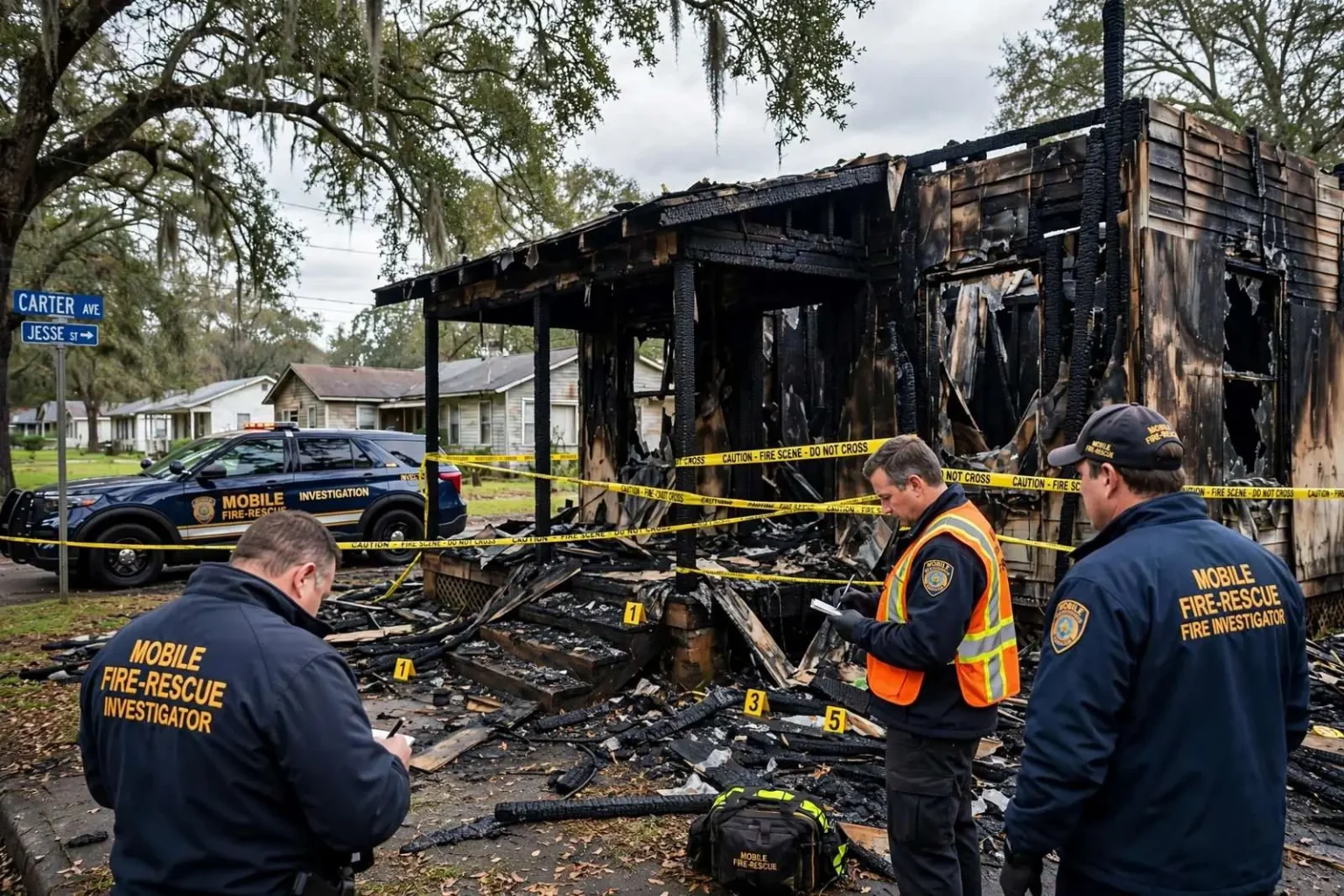
Mobile fire investigators are seeking a person of interest after a house fire on Carter Avenue that authorities believe was intentionally set. The blaze broke out on a Friday afternoon at a single-story wood-frame home located between Jesse and Main streets. Firefighters responding to the scene around 3 p.m. found flames coming from the windows of the home. No injuries were reported.
Investigators with the Mobile Fire-Rescue Department said the circumstances surrounding the fire pointed to arson, and they announced that they wanted to speak with a man who reportedly had an argument with his uncle, the homeowner, prior to the blaze. A department spokesman said fire investigators believed the individual sought might have information relevant to the case. Authorities asked residents with any information about his whereabouts to contact Mobile Fire-Rescue Department investigators.
The identification of a potential family connection has shaped the direction of the inquiry from its earliest hours. Arson cases involving relatives or acquaintances of the property owner follow a different investigative path than fires with no obvious human link, and Mobile Fire-Rescue has emphasized in this case that the man sought is described as a person of interest, not a charged suspect. No arrest had been announced, and officials cautioned that the investigation remained open while evidence was still being gathered.
The Scene on Carter Avenue
Carter Avenue sits in a residential section of north Mobile, a part of the city where modest single-family homes, many of them wood-frame construction dating back decades, line quiet streets between major north-south corridors. The stretch between Jesse and Main streets is typical of the neighborhood: closely spaced lots, mature trees, and houses that in many cases have remained in the same families for generations. Wood-frame homes of that age are particularly vulnerable when fire breaks out, because older wiring, aging materials, and the proximity of neighboring structures can all accelerate the spread of flames.
The fire was reported in the mid-afternoon, a time when many residents are at work or school, but smoke rising from the single-story home drew quick attention on the street. Crews arriving to find flames coming from the windows face a fundamentally different situation than a fire that is still contained; window failure feeds fresh air to the interior and pushes smoke through the structure, complicating both suppression and the subsequent search for the point of origin. Firefighters brought the blaze under control without any reported injuries, a notable outcome given how quickly residential fires can threaten both occupants and responding crews.
In the days that followed, investigators continued to process the scene for physical evidence. That work is painstaking: scenes of suspected arson are treated carefully so that potential evidence is not disturbed, and every removal of debris is documented. Neighbors along Carter Avenue reported hearing raised voices at the home in the hours before smoke and flames were spotted, though fire officials cautioned that the investigation remained open and no charges had been filed at the time.
A Person of Interest With a Family Connection
The central question in the early stage of the case concerns the man investigators want to question. According to the department, he reportedly had an argument with his uncle, the homeowner, prior to the blaze. A department spokesman said fire investigators believed the individual sought might have information relevant to the case, a formulation that stops short of naming him a suspect while making clear that investigators regard the interview as important to establishing what happened.
That distinction matters legally as well as practically. A person of interest in an arson investigation may simply be a witness whose account could clarify a timeline, or someone whose relationship to events makes him a focus of the inquiry. Until evidence supports a charge, investigators generally avoid publicizing names, both to protect the integrity of the case and to avoid prejudicing any later prosecution. In this instance, authorities have asked residents with any information about the man’s whereabouts to contact Mobile Fire-Rescue Department investigators directly.
Family relationships frequently surface in arson investigations, and not always as a sign of guilt. Disputes over property, inheritance, living arrangements, or money can produce heated arguments in the hours before an incident without any causal link, and investigators are trained to test such connections against physical evidence rather than assume them. At the same time, fire officials acknowledge that a documented argument immediately preceding a suspicious fire is a detail that cannot be ignored, which is why establishing a precise timeline of the afternoon has been central to the work on Carter Avenue.
One Fire Among Several Under Scrutiny
The Carter Avenue fire is one of several suspicious blazes that Mobile Fire-Rescue and city police have investigated in recent months, as arson cases in the city drew increased scrutiny from local law enforcement. That pattern has pushed the department’s investigative unit into closer coordination with patrol officers and detectives, particularly in cases where a fire’s circumstances suggest human involvement rather than an electrical fault, unattended cooking, or another accidental cause.
Investigators have said that establishing a motive and a timeline in cases involving family disputes can be critical to determining whether a fire was accidental or deliberately set. Motive shapes everything downstream: it guides which witnesses are interviewed, what records are pulled, and what physical evidence is given priority at the scene. In disputes between relatives, investigators often look at the days and weeks before the fire, not just the final hours, to understand the pressures surrounding the household.
The heightened attention to arson in Mobile reflects a broader reality for fire departments in mid-sized cities. Intentionally set fires consume investigative resources at a level accidental fires do not, because each one requires scene processing, witness canvassing, and often months of follow-up before a case is ready for prosecutors. Departments that see a cluster of suspicious fires typically respond by cross-training more personnel in origin-and-cause work and by publicizing open cases, precisely so that residents who saw something come forward while memories are still fresh.
How an Arson Case Is Built
Arson investigations of this kind typically involve coordination between fire marshals and city police, particularly when a dispute between family members appears to precede the incident. Fire investigators establish where and how the fire started; police investigators handle interviews, background work, and any criminal case that emerges from the findings. In Mobile, that division of labor is well established, and fires that appear intentional are examined jointly rather than handled by a single agency working alone.
The physical side of the work begins with identifying the point of origin. Investigators examine burn patterns, the depth of charring, and the movement of smoke to reconstruct how the fire developed, and samples collected from the scene can be analyzed in a laboratory for the presence of accelerants. Only after the origin and the cause are established does the criminal side of the case take shape, because a fire that began in faulty wiring or a cooking appliance follows a very different path than one that shows signs of being set.
Alabama law treats the deliberate setting of a fire to a building as a serious felony, with classifications and penalties that rise sharply when the structure is occupied or when people are harmed. A case built on those statutes requires proof that the fire was intentionally set and that the person charged was responsible, which is why investigators in the Carter Avenue case have been careful to describe their work as ongoing and to emphasize that no charges had been filed as the inquiry continued.
Why Family Disputes Draw Special Attention
House fires tied to domestic disputes remain a persistent concern for public safety officials in Mobile, who have repeatedly urged residents to report threats or property damage stemming from family conflicts before they escalate. The guidance is grounded in experience: fires that follow arguments within a household rarely come without warning, and neighbors or relatives who notice escalating conflict are often positioned to alert authorities before a situation turns dangerous.
For investigators, a family connection cuts in two directions. It can provide a ready-made pool of witnesses who know the household’s dynamics, schedules, and recent tensions, but it can also complicate the case, because relatives may be reluctant to speak about one another or may minimize what they saw. Officials in the Carter Avenue investigation have framed their request broadly, asking anyone with information about the person of interest’s whereabouts to come forward rather than limiting the appeal to those closest to the home.
The Broader Risk of Intentionally Set Fires
Fire officials noted that intentionally set fires pose elevated risks not only to the property involved but to neighboring homes and to firefighters responding to the scene. In tightly built residential blocks like the one along Carter Avenue, a fire in one wood-frame house can threaten adjacent structures through radiant heat and wind-blown embers, turning a single-family incident into a block-wide emergency. Firefighters, meanwhile, face heightened danger in any structure fire, and a fire that has been set offers none of the predictability that helps crews anticipate how a building will behave as it burns.
The financial and human costs extend beyond the immediate flames. An intentionally set house fire displaces residents, destroys property that insurance may cover only after a prolonged investigation, and burdens a fire department’s resources at the expense of the rest of the city. Those realities are part of why Mobile officials have treated the recent cluster of suspicious fires as a priority rather than as a series of isolated incidents.
The investigation into the Carter Avenue fire remained active, with authorities continuing to ask for the public’s help identifying the person of interest and establishing what happened in the moments before the fire broke out. Anyone with information about the case was urged to contact Mobile Fire-Rescue Department’s investigative unit. Officials have not said when they expect the investigation to conclude, and no court action had been announced in connection with the fire.