Investigators: Fire at Mobile’s Warren Village Apartments Was Deliberately Set
Mobile Fire-Rescue says someone forced entry into a vacant unit at Warren Village Apartments and intentionally started a fire early Tuesday.
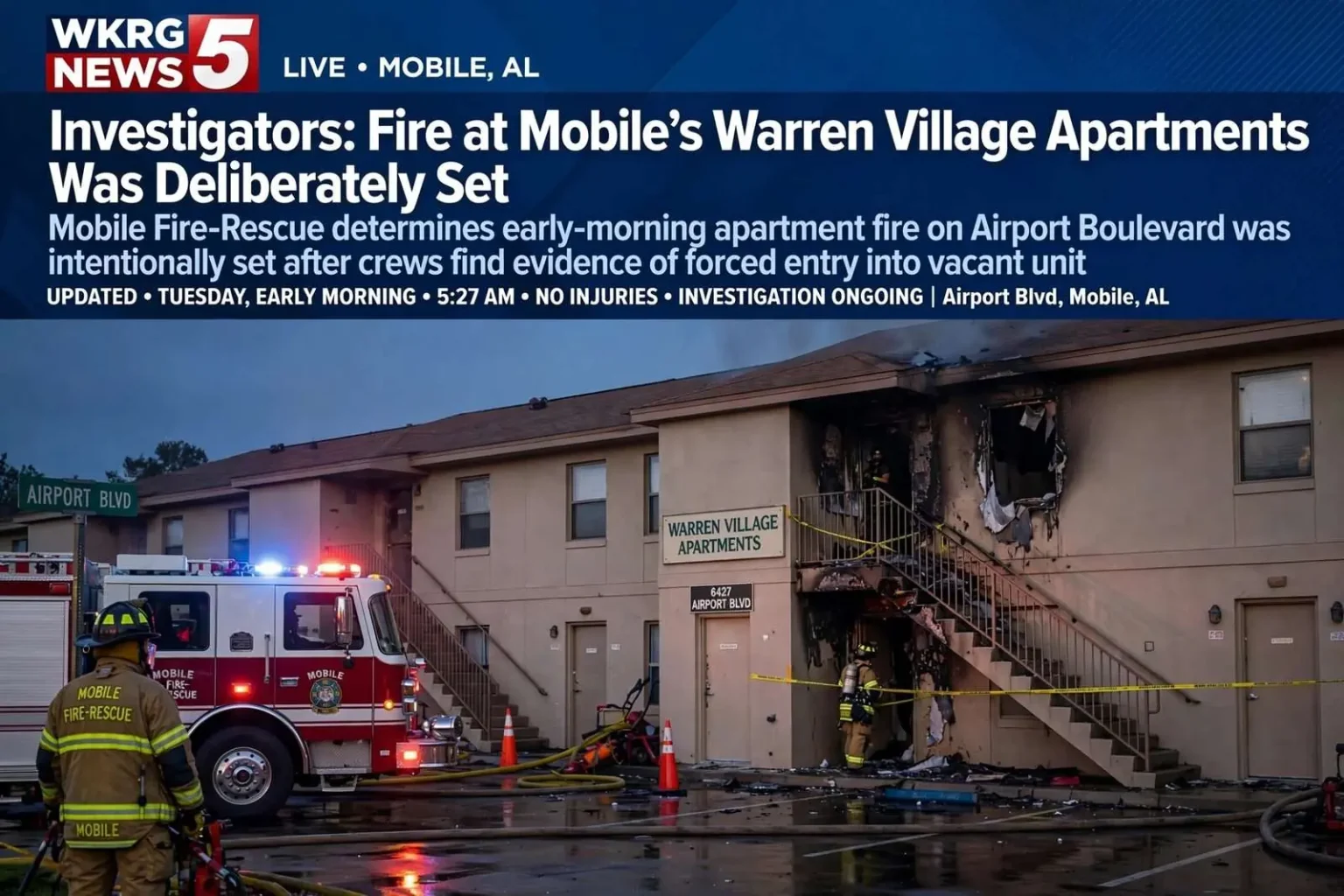
Mobile Fire-Rescue investigators have determined that an early-morning apartment fire on Airport Boulevard was set intentionally, after crews found evidence someone had forced their way into a vacant unit before the blaze started.
Firefighters were dispatched to Warren Village Apartments around 5:27 a.m. Tuesday after reports of smoke and flames at the complex. Crews arriving on scene found smoke coming from the vacant apartment along with a small fire burning in an adjacent stairwell, according to a Mobile Fire-Rescue spokesman.
The first-arriving crews faced the standard calculus of any occupied apartment fire: confirm everyone is out, locate the seat of the fire, and keep it from extending into neighboring units through the shared stairwell. In this case the flames were confined to the vacant apartment and a small fire in the adjacent stairwell, and crews knocked the blaze down without injuries. The pre-dawn hour, though, meant the complex’s other residents were asleep — and the stairwell fire meant the building’s common exit path was burning before anyone had dialed 911.
Investigators who responded to examine the scene determined the apartment had been forcibly entered before the fire was set, pointing to an intentional cause rather than an accidental one such as faulty wiring or a discarded cigarette.
How investigators reach that conclusion
The distinction between accidental and incendiary fires rests on physical evidence — burn patterns, the location of the fire’s origin, signs of forced entry, and the presence or absence of any accidental ignition source. A vacant unit with no electricity in active use and no occupant has few of the ordinary accidental causes a detective must rule out: no unattended cooking, no overloaded outlets under load, no smoking materials in use. That narrows the field quickly.
Forced entry before the fire, in an apartment where nobody lived, is the finding that effectively settles the question. A unit with no occupant has no reason for anyone to be inside; a break-in followed by fire points investigators toward arson as the working cause from the outset, with the remaining questions being who entered, why, and with what.
No injuries were reported in connection with the fire, and total damage was estimated at roughly $5,000. Because the unit involved was vacant at the time, investigators have not indicated whether any resident or former occupant is considered a person of interest in the case.
The challenges of a vacant-unit arson
Arson cases involving vacant units present particular challenges for investigators, since there is often no resident on hand to describe who had access to the property or when the fire may have started relative to any suspicious activity nearby.
An occupied-unit fire comes with a built-in witness: the person who lived there, who knows when they left, who had keys, and whether anything was out of place. A vacant unit offers none of that. Investigators instead work backward from the property’s history — when the unit was vacated, whether it was properly secured, whether it had become a known gathering spot — and from the surrounding neighborhood, canvassing for anyone who saw movement, lights, vehicles, or people at the complex in the hours before the 5:27 a.m. alarm.
Fire officials typically rely on physical evidence at the scene, such as signs of forced entry or accelerant residue, combined with tips from neighbors or passersby, to build a case in the absence of witnesses. Accelerant detection is a central step in any suspected arson: investigators and specialized K-9 teams can identify traces of ignitable liquids that survive the fire, and laboratory analysis of debris samples can confirm what was used and where it was poured. Even without an accelerant finding, though, the combination of forced entry into an unoccupied unit and fire inside it is treated as incendiary by definition.
The relatively modest damage estimate — about $5,000 — reflects the crews’ fast knockdown rather than a small intent. Fires set in vacant units are dangerous out of proportion to their property loss because of where they sit: attached to occupied apartments, sharing walls and stairwells with families asleep down the hall. The stairwell fire at Warren Village illustrated the risk directly.
A busy corridor, a familiar pattern
Warren Village Apartments sits along one of Mobile’s busier commercial corridors on Airport Boulevard, an area with a mix of residential complexes, retail centers and offices.
Airport Boulevard runs east-west across the heart of the city, from Spring Hill Avenue near the medical district out past University of South Alabama territory toward Semmes Road, and its apartment complexes — hundreds of units built in waves from the 1960s onward — house a rotating population of students, service workers, and families. Vacant units in such complexes turn over frequently, and complexes along the corridor have seen periodic fires, some accidental, some proven or suspected arsons, over the years.
The 5:27 a.m. dispatch put the response in the hands of the department’s night shift, when staffing is thinnest and the first minutes matter most. Early-morning fires in apartment buildings are statistically among the most dangerous for occupants precisely because everyone is asleep; in this case, the vacancy of the unit where the fire started may have prevented exactly the casualties that a fire in an occupied apartment three feet away could have produced. Fire crews arriving before sunrise also work in darkness against a building whose lighting may have been cut off in the vacant unit, adding difficulty to a search of adjacent spaces that cannot be skipped until crews are certain no one is inside.
The property damage number, meanwhile, is only the direct cost. Vacant units that have burned are expensive for owners to restore, drag down the value and insurability of the complex around them, and, if left unrepaired, become the next vacancy on the block — the kind of boarded or gutted unit that invites the same trespassing that led to this fire. Breaking that cycle is one reason the department pairs its fire-suppression work with code-enforcement referrals and, in cases like this one, a public appeal for information.
Fires at multi-unit residential properties, even those confined to a single vacant apartment, can pose broader safety risks to neighboring units, and Mobile Fire-Rescue has previously urged residents in apartment complexes to report unfamiliar activity around vacant or unoccupied units promptly.
The department’s advice to apartment residents follows a straightforward logic: vacant units that stay secured stay safe, and the first sign a vacant unit has been breached — a broken padlock, an open window that was shut the day before, footprints in the landscaping, strangers coming and going at odd hours — is worth a phone call before it becomes a fire. Complex managers are similarly urged to keep vacant units locked, inspected, and cleared of debris that could feed a blaze, and to keep stairwells and exits unobstructed so that fires in any unit cannot sever the building’s escape routes.
Mobile Fire-Rescue itself operates from a network of stations spread across the city, and its investigators — the fire marshals and detectives who take over a scene once the flames are out — are tasked with cause determination on every significant fire. An intentional-cause finding is not an endpoint: it converts a fire response into a criminal investigation, shared with Mobile police and, once a suspect is identified, prosecutors, since arson that endangers occupied structures is a felony under Alabama law, with potential enhancements when people are put at risk.
The case remains open
The investigation into the Warren Village fire remains open, and no arrests had been announced as of the most recent update from Mobile Fire-Rescue.
Investigators are asking anyone who witnessed suspicious activity near the complex before the fire, or who has other information, to contact fire investigators directly. Tips in vacant-unit arson cases routinely come from the people closest to the property: neighbors who noticed a car that didn’t belong, residents who heard glass break in the night, maintenance workers who found a door that should have been locked left open. Even fragments of information — a description, a time, a direction of travel — can be matched against the physical evidence to identify a suspect.
Residents with information relevant to the case are encouraged to contact fire investigators rather than approaching the property themselves. Until an arrest is made, the department’s standing advice applies to the complex as a whole: watch the vacant unit, report what looks wrong, and leave the confrontation to the investigators trained for it.
Arson carries serious penalties in Alabama, and cases that begin like this one — a forced entry, a deliberately set fire, and a set of burn patterns that tell the story — are built for courtrooms as much as for fire scenes. Investigators will now work the case the way arson cases are ultimately won: with evidence preserved, interviews documented, and a timeline anchored to the 911 call that brought the first engine to Airport Boulevard before dawn.