Theodore Man Jailed After Truck Ties Him to Hit-and-Run That Injured Teen
A Theodore man is behind bars after Alabama State Troopers linked his truck to a hit-and-run crash that seriously injured a 16-year-old pedestrian.
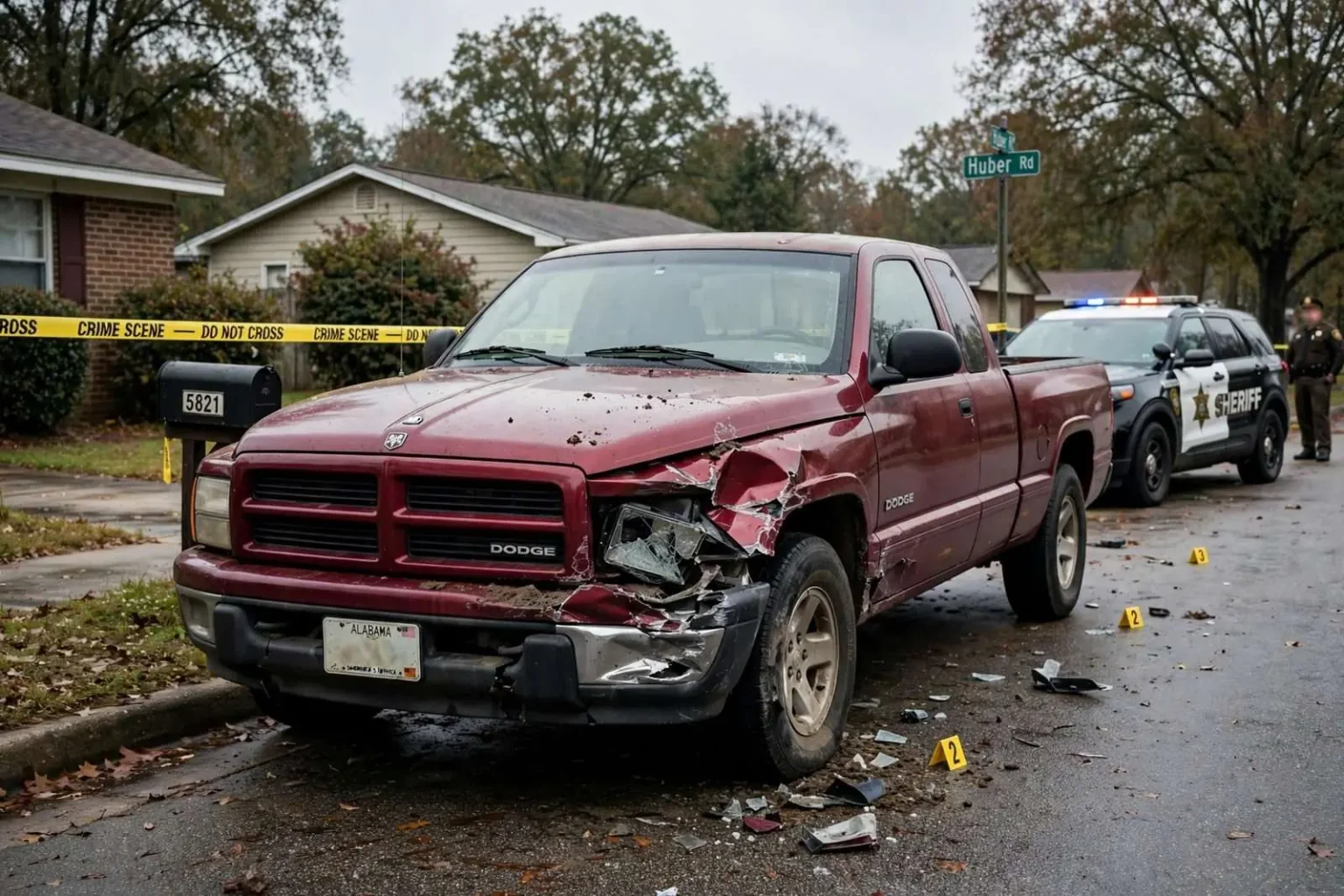
A Theodore man spent the weekend in the Mobile County Metro Jail after investigators tied his truck to a hit-and-run crash earlier in the month that left a 16-year-old with serious injuries. Alabama State Troopers said they received an anonymous tip pointing them to a 1998 Dodge Dakota parked at a home on Huber Road, a truck that matched the description of the vehicle that had fled the scene of a collision with a pedestrian on Garden Grove Road on Dec. 7. Once the truck was located, investigators said, evidence gathered at the crash scene matched the vehicle.
The crash happened on Garden Grove Road, a residential street in the Theodore area of Mobile County where neighbors are accustomed to slow afternoons and school buses rather than emergency lights. According to troopers, the teenager was struck in a collision with the vehicle, and the driver did not stop. The injured teen was described only as a 16-year-old with serious injuries; the identity has not been made public, and troopers have not released details about what caused the initial collision or the full extent of the injuries beyond that description.
The Huber Road address where the truck was eventually found sits less than five miles from where the teenager was struck, according to troopers. That short distance mattered. In hit-and-run investigations, vehicles involved in crashes frequently sustain damage — a crumpled fender, a shattered headlight, paint transfer — and drivers often park the vehicle close to home, either hoping the damage goes unnoticed or intending to deal with it later. A tip from a member of the public gave troopers the specific location they needed, and the anonymous report pointed them straight to the Dodge Dakota on Huber Road.
From dealership lot to jail cell
When troopers examined the vehicle, they determined the 1998 Dodge Dakota did not belong to the man who had been driving it. The truck belonged to a local auto sales dealership and was being driven at the time of the crash by one of the dealership’s employees, 32-year-old Anthony Dewayne Weaver, according to investigators. That detail added a layer to the case, because the vehicle’s registered owner was a business rather than an individual, and identifying the driver required connecting the truck to the person who had taken it onto the road on the night of the crash.
Weaver was taken into custody and charged with leaving the scene of an accident involving injury. Under Alabama law, a driver involved in a collision that results in injury or death is required to remain at the scene, provide identifying information and render reasonable aid to anyone hurt. Fleeing instead is a criminal offense, and prosecutors and judges treat it as an aggravating factor because it leaves victims without immediate help and investigators without a cooperative driver.
Why Weaver is being held without bond
Although the new charge itself might ordinarily have allowed Weaver to post bond and return home while awaiting court, jail records showed him held without bond. According to troopers, the arrest also triggered a violation of bond conditions tied to two earlier felony cases. Defendants released on bond are typically ordered to remain law-abiding and to avoid new arrests as a condition of their release, and a new charge — particularly one stemming from a crash investigators say he fled — can prompt a court to revoke that release. That is what landed Weaver in the Mobile County Metro Jail without a bond amount attached to the latest case.
Court and jail records show Weaver had prior legal trouble stretching back years, including a July 2013 arrest on charges of first-degree robbery and second-degree assault. Alongside those felony arrests, his record included earlier charges involving theft, reckless endangerment and multiple traffic violations. The new hit-and-run charge added to an already lengthy record heading into his latest stint behind bars, and the progression is the kind of history courts weigh when deciding whether a defendant can be safely released while a case is pending.
The challenge of solving hit-and-run cases
The case highlights the challenges investigators face when a driver flees the scene of a crash, often leaving witnesses and physical evidence as the only leads. Unlike a typical traffic collision investigation, where both drivers exchange information and give statements, a hit-and-run begins with a victim, debris and questions. Investigators must work backward: identifying a vehicle from fragments left at the scene, canvassing for surveillance cameras, interviewing residents who may have seen the car or truck before or after the crash, and monitoring body shops and salvage yards, where damaged vehicles sometimes surface days later.
Public tips frequently make the difference. In this instance, troopers credited a tip from the public with helping them track down the truck and, ultimately, the driver who had fled. Law enforcement agencies across Alabama repeatedly emphasize that residents who see a damaged vehicle parked somewhere unusual, or who hear secondhand accounts of a crash, can pass that information along anonymously. Tip lines exist precisely because witnesses are often reluctant to get involved in a case publicly, and the Theodore investigation shows how a single call can move a case from a dead end to an arrest.
Theodore and the roads that carry its traffic
Theodore, an unincorporated community south of Mobile, is stitched together by a network of state highways and residential streets like Garden Grove Road and Huber Road that carry a steady mix of commuter, school and commercial traffic. Growth along the U.S. 90 corridor has pushed more vehicles through neighborhood streets, and pedestrians — including teenagers walking home from school or a friend’s house — share roads that were not always designed with foot traffic in mind. Local law enforcement agencies routinely run enforcement details in the area, but pedestrian-involved crashes remain a persistent concern across Mobile County.
For families in the area, the case is a reminder of the stakes when a driver leaves the scene. A pedestrian struck by a vehicle faces a critical window in which rapid medical care can mean the difference between recovery and lasting harm. Every minute a driver flees rather than stops is a minute that emergency responders are not en route. That reality is reflected in the way Alabama law treats failure-to-remain offenses, and in the frustration investigators and victims’ families express when a driver chooses flight over aid.
What happens next
Troopers have not released details about what caused the initial collision on Garden Grove Road or the extent of the teenager’s injuries beyond describing them as serious, and the identity of the injured teenager has not been made public. Those questions remain open as the investigation continues. Once the case moves through the court system, the charge of leaving the scene of an accident involving injury will be handled alongside whatever action the courts take on the alleged bond violations from Weaver’s two earlier felony cases.
In the meantime, the investigation illustrates how a modern hit-and-run case comes together: a crash scene documented piece by piece, a description circulated, an anonymous tip received, a vehicle located and physically linked to the collision, and a driver identified through records rather than a confession. Each step depends on evidence that must be gathered quickly before it disappears — before a damaged truck is repaired, repainted or sold, and before witnesses’ memories fade.
What residents should do after a crash
Safety officials advise drivers involved in any collision to stop immediately, check for injuries, call 911 and remain at the scene until authorities arrive. For witnesses, the most valuable contributions are concrete details: a partial license plate, the color, make and model of the vehicle, the direction of travel after impact, and any damage noticed on the fleeing vehicle. Notes taken in the first minutes — even a photo of a plate or a bumper sticker — can later become the thread investigators pull to identify a driver.
Residents with information about a crash who prefer not to identify themselves can use anonymous tip channels maintained by state troopers and local police departments. Information about impaired or hit-and-run drivers can also be reported to 911 in real time, which gives dispatchers the best chance of locating a vehicle still in the area. In the Garden Grove Road case, the tip that reached troopers arrived after the crash and still produced an arrest — a fact investigators hope encourages other witnesses to come forward regardless of how much time has passed.
A community watching the courts
For the 16-year-old’s family and the residents of the Garden Grove Road neighborhood, the arrest answers one question — who was behind the wheel — but leaves many others open, including whether the driver will face additional counts as the investigation concludes. The Mobile County District Attorney’s Office will review the evidence troopers assembled and decide how to proceed in court. As in every case, the charges at booking are only the starting point, and the final resolution will depend on the evidence, the defendant’s record and the decisions made in the weeks and months ahead.